This race served as a fitness test for me in my first week of Ironman training. I was excited to see what kind of speed I would have coming off of a marathon training plan. I had a great run at a great race, and I was happy with my fitness!
As I get older (or maybe just wiser), I find that I benefit from a longer warm-up. It may be that I was just too lazy in past years to take 15-20 minutes for preparation. I could get away with it in my early twenties. Now that I'm approaching thirty, I'm more mindful of how my body feels, and my body feels better when I take at least 15 minutes to warm up.
That said, I ran the 1.2 miles to my closest Metro station and took the train to Crystal City. I picked up my packet, stopped in at Crystal City Sport & Health (right next to the start line, thank you very much) to pin my number and have a drink, and then took another 1.2 miles to warm up. My left ankle felt tight on the inner side, just behind the ankle bone (I think these are annular ligaments that are tight and cranky from all of my ankle injuries last season). It loosened up within a few minutes, though, so I wasn't too worried.
Standing on the start line, I felt nervous. I haven't run hard and fast in many months. I remember, though, that 5ks hurt, and I was not excited about the 30 minutes of pain. I think I seeded myself well, since I didn't have to pass very many slower runners early on. And, considering the tight quarters, the pack thinned out relatively quickly.
I bought a Garmin 910XT with the leftover budget from my bike purchase; this was my first race using my new GPS watch. I ran by heart rate, trying to keep it under 170 BPM for the first mile, then shooting for around 173 BPM until the last half mile. After that, I let 'er rip, and ended up at a full (probably ugly) sprint across the line. Finished in 27:26, and didn't throw up! But it was a close call.
There was one woman who ran near me the whole time. She was probably 20 years older than me, with a similar build, wearing an Ironman cap with green stripes. We went back and forth through the whole race. For a while, I was running behind her and we were perfectly in step, stride-for-stride. I passed her with a little over a quarter mile to go, and held her off until the end. After I got a water bottle and established that I wasn't going to puke, I started looking for her. She found me first, though, and we chatted about our race together. Thanks, lady in the green cap, for pushing me to run my very best! If you ever need a running buddy, call me!
The other person I saw on-course who really impressed me: There was a woman, probably a new mother I assume , heavy-set in the way that new mothers often are. She was almost at the very back of the race, probably only half a dozen people behind her; I passed her as I was heading the opposite way, towards the finish line. She was pushing her baby in its stroller, wearing blue spandex tights, a cute, turquoise shirt, and a floppy, sparkly tutu. She had a huge smile on her face, as she walked along the race course. She looked so proud and happy to be doing this 5k. So good for you, mom with the sparkly, blue skirt, and congratulations on your 5k!
I enjoyed this race. It had a great feel to it, and it was cool to run on the roads of Crystal City, which had been closed to traffic for this race. There was an exciting mix of people: strong, fit runners, walkers doing their first-ever event, an older women (late 70s, maybe?) wearing salmon-colored jeans and a nice sweater, the mom with her sparkly tutu, and a bunch of middle-of-the-pack runners like me. Everyone seemed excited to be there, and the race was well-organized. I would definitely do this race again. In fact, I might sign up for another one! They run every Friday through the end of April. So let me know if you're going to do one, and maybe I'll see you there!
Saturday, April 11, 2015
Sunday, March 29, 2015
Race Report: Yuengling Marathon 2015
I did my first marathon! It hurt. It was much harder than I expected, much more painful than a half distance triathlon or anything else I've tried. But I also recovered much faster than I expected, based on the duration of the event.
Pre-race
My roommate and I headed to Virginia Beach at around noon on Saturday. Between bad traffic and stops for peeing and snacks, the 3 hour drive took us almost 6 hours. And then when we got to Virginia Beach, we had mapped the wrong convention center location (the convention and tourism office instead of the actual convention center). By this point, I only had 45 minutes left to pick up my racing packet, so I was super stressed. After that, we had to drive up and down the main drag in Virginia Beach looking for my hotel. I couldn't find my confirmation e-mail for my hotel, but I had in my mind it was a Days Inn that I was staying at. I was wrong. We went to both Days Inn locations on the beach, and I wasn't booked at either one. I finally found my confirmation email, and realized that I was actually booked at a Best Western. So then, of course, we went to the wrong Best Western. We finally got to our hotel--and keep in mind that we've driven up and down Atlantic Avenue 3 times at this point, and each 1-mile trip was taking 10-15 minutes, so we'd been fighting through the ridiculousness for an hour--and we were greeted by this view:
 Not too bad!
I needed a nap and a butt-load of water at that point, though.
My parents arrived shortly after we did, and we settled into our room. Once we figured out the sleeping arrangements, we headed to a popular Italian spot for dinner.
Day-of
I woke up at 5:30 (3 hours before race start) to try and get my breakfast in. I brought a huge bowl of steel-cut oatmeal with protein powder, coconut oil, and raspberry jam. I ate most of the oatmeal, but 2 cups of steel-cut oats is a lot. I figure I ended up with about 500 calories for breakfast.
 After breakfast, I tried to go back to sleep, but I was too excited. I ended up staying up and watching the weather channel. My dad got up and around sometime after 7 to keep me company, and we took off for the the start line (a little over a mile away) around 7:45.
 It was chilly before the race, but I was kitted up in sweat pants and a jacket. I chose to wear my favorite running shorts with a short-sleeve shirt, arm warmers, gloves, and a thermal cap. The only thing I didn't keep for the whole race was the gloves, because there was a cool breeze, and I kept having to put my arm warmers and cap back on.
 The course was great. Flat as a pancake, with some really interesting sights. We got to run through Camp Pendleton, and a great group of soldiers were cheering us on as we ran through. There was a long, boring stretch from mile 13 to mile 19, where we got onto Fort Story, but it was still very pretty. And Fort Story was kind of a drag; the roads were bad, and the only spectators to speak of were armed guards. Still, much better than running on McConnell Airforce Base in my first half marathon!
 I felt good through the halfway point. My sartorius often bothers me on really long runs; I get a sharp muscle pain at the tendon, right up at the attachment near my hip. It feels like the tendon is trying to pull away from the bone every time I lift my leg. It started bothering me around mile 14, worked itself out after a few miles, but came back in the last 10k.
At halfway, I tried to pick up the pace a little bit, which I think was a mistake. I should have stayed steady until the last 3-4 miles. I had a very rough time from around mile 17 to . . . until the end of the race, actually. Maybe if I'd kept it slow at mile 14, I would have felt stronger throughout the second half.
 I did well with my nutrition plan. I took a gel or chews every 30 minutes, drank Gatorade and water at every water stop, and drank from the water bottle I was carrying every 5 minutes. I never got stomach upset, although I did have a little bit of cramping in the second half; it went away when I had Gatorade. I think in the future, I will carry Nuun instead of water, and only drink electrolytes. I've been doing some reading on isotonic fluid replacement, so I may see if I can get more scientific with that. I've also never done a sweat test (where you weigh yourself before and after a hard workout to see how much sweat you lost), and that might be helpful before my next big race. Taken as a whole, though, I was very happy with how my nutrition plan worked for me. I'm glad I practiced it in my training.
I'm not very happy with my pacing. I was able to restrain myself early in the race, but my plan to pick up my pace in the second half was not wise. Now that I've done a marathon, I think I'll be able to develop a better race plan and pace more consistently. I was counting on a negative split, but a better strategy would have been to keep things easy until the last 10k, or even later.
I experienced virtually no chafing, though I did stop at about the 17 mile point to put some lube on my little toes. But I had no blisters on my feet at the end of the race, no raw spots that surprised me during my first post-race shower. Normally I get chafing under my arms and in my . . . personal area. Aquafor and chamois cream, and lots of practice on where and how much to apply, served me well.
 The most surprising thing to me was how much muscular pain I experienced. My back and legs seized up so much by the end that I could barely hobble across the finish line; I literally could not lift my feet more than a few inches off the ground. I'm not sure why that happened, but I assume it was a lack of overall strength. I know it's a little crazy at the paces that I run, but I think I would feel much more confident with a few 26-mile or longer training runs leading up to a marathon. Around 16-18 miles is where the wheels started coming off for me, and I did a lot of runs at those distances. My theory is that I built up a resistance to that point in training, and if I want to feel good throughout the race I'll need to do some 26-milers.

I'm also surprised by how quickly I recovered. I had a hard time with stairs on Monday and Tuesday, but by Wednesday I felt like I'd just come off a week of recovery: snappy legs, no muscle soreness, I was rocking my commute! And I didn't get the horrible stomach upset that I often feel at the end of triathlons. So marathons are much worse during, but much better after.
I can't decide whether I'll do more marathons . . . For sure I won't do one again until after my Ironman in September, but I'm not sure if I ever want to do that again. I said the same thing after my first triathlon, though; I imagine that the challenge of figuring out the training and racing puzzle will draw me back eventually.
Final: 5:10:39 (11:51/mile)
F25-29: 121/153
Women: 707/946
Overall: 1763/2185
Pre-race
My roommate and I headed to Virginia Beach at around noon on Saturday. Between bad traffic and stops for peeing and snacks, the 3 hour drive took us almost 6 hours. And then when we got to Virginia Beach, we had mapped the wrong convention center location (the convention and tourism office instead of the actual convention center). By this point, I only had 45 minutes left to pick up my racing packet, so I was super stressed. After that, we had to drive up and down the main drag in Virginia Beach looking for my hotel. I couldn't find my confirmation e-mail for my hotel, but I had in my mind it was a Days Inn that I was staying at. I was wrong. We went to both Days Inn locations on the beach, and I wasn't booked at either one. I finally found my confirmation email, and realized that I was actually booked at a Best Western. So then, of course, we went to the wrong Best Western. We finally got to our hotel--and keep in mind that we've driven up and down Atlantic Avenue 3 times at this point, and each 1-mile trip was taking 10-15 minutes, so we'd been fighting through the ridiculousness for an hour--and we were greeted by this view:
I needed a nap and a butt-load of water at that point, though.
My parents arrived shortly after we did, and we settled into our room. Once we figured out the sleeping arrangements, we headed to a popular Italian spot for dinner.
Day-of
I woke up at 5:30 (3 hours before race start) to try and get my breakfast in. I brought a huge bowl of steel-cut oatmeal with protein powder, coconut oil, and raspberry jam. I ate most of the oatmeal, but 2 cups of steel-cut oats is a lot. I figure I ended up with about 500 calories for breakfast.
At halfway, I tried to pick up the pace a little bit, which I think was a mistake. I should have stayed steady until the last 3-4 miles. I had a very rough time from around mile 17 to . . . until the end of the race, actually. Maybe if I'd kept it slow at mile 14, I would have felt stronger throughout the second half.
I'm not very happy with my pacing. I was able to restrain myself early in the race, but my plan to pick up my pace in the second half was not wise. Now that I've done a marathon, I think I'll be able to develop a better race plan and pace more consistently. I was counting on a negative split, but a better strategy would have been to keep things easy until the last 10k, or even later.
I experienced virtually no chafing, though I did stop at about the 17 mile point to put some lube on my little toes. But I had no blisters on my feet at the end of the race, no raw spots that surprised me during my first post-race shower. Normally I get chafing under my arms and in my . . . personal area. Aquafor and chamois cream, and lots of practice on where and how much to apply, served me well.
I'm also surprised by how quickly I recovered. I had a hard time with stairs on Monday and Tuesday, but by Wednesday I felt like I'd just come off a week of recovery: snappy legs, no muscle soreness, I was rocking my commute! And I didn't get the horrible stomach upset that I often feel at the end of triathlons. So marathons are much worse during, but much better after.
I can't decide whether I'll do more marathons . . . For sure I won't do one again until after my Ironman in September, but I'm not sure if I ever want to do that again. I said the same thing after my first triathlon, though; I imagine that the challenge of figuring out the training and racing puzzle will draw me back eventually.
Final: 5:10:39 (11:51/mile)
F25-29: 121/153
Women: 707/946
Overall: 1763/2185
Saturday, March 21, 2015
Pre-Race Nerves
Tomorrow I run my first marathon in Virginia Beach.
I've been slightly nervous all week. I haven't felt this nervous before an event in years. It's nice; feels like a challenge again! I go into it thinking, What if I can't do this? I don't really believe that I'll try and fail; I recognize that I'm pushing the limits of what I've done before, and it's possible that I might not be able to do it. Can I run 26.2 miles? I don't know! I've prepared well, but there's still a thrilling niggle of doubt.
So cheers to chasing the unknown! I'm off to Virginia Beach to pick up my race packet!
I've been slightly nervous all week. I haven't felt this nervous before an event in years. It's nice; feels like a challenge again! I go into it thinking, What if I can't do this? I don't really believe that I'll try and fail; I recognize that I'm pushing the limits of what I've done before, and it's possible that I might not be able to do it. Can I run 26.2 miles? I don't know! I've prepared well, but there's still a thrilling niggle of doubt.
So cheers to chasing the unknown! I'm off to Virginia Beach to pick up my race packet!
Friday, March 20, 2015
Ooh, Shiny!
Look what I got!

Technically, this is a reward for finishing my marathon, which I haven't finished yet.
So hopefully I don't totally poop out on Sunday, because I'm pretty sure that Tri360 won't take it back!
Technically, this is a reward for finishing my marathon, which I haven't finished yet.
So hopefully I don't totally poop out on Sunday, because I'm pretty sure that Tri360 won't take it back!
Thursday, February 26, 2015
Ironman Mallorca
It's official! I am going to Mallorca for the 2nd iteration of the Thomas Cook Ironman!

Sunday, February 22, 2015
:-(
Ironman Barcelona sold out.
I already had plane tickets, but hadn't registered yet.
Sad face.
Fortunately, There are plenty of races still open. In fact, IM Mallorca is still open, and it's only a week before. It's still in the same part of the world, I can change my plane tickets for less than 100 USD, and I can still see everything I wanted to see in Spain and the surrounding area. Flights to the mainland from Mallorca are less than 50 Euros, one-way.
I was never going to Barcelona for Barcelona; I arrived at that race primarily by a process of elimination. My roommate wanted to go to Western Europe, and Spain was going to be a lot less expensive than Zurich. The time of year is perfect. It's a beautiful part of the world, a part of the world I've never seen, and I can easily see Spain, southern France, Portugal, and maybe even Italy!
The one big change between IM Barcelona and IM Mallorca is the course. Barcelona's bike course is pancake-flat, but Mallorca has a pretty significant climb. From what I can see on the course map, there's a 15 km climb that peaks at 600 m. The descent is technical, too. I'm a little concerned about my ability to make the bike cut-off with that big climb in the mix.
On the other hand, I finally live in an area with some hills, so I can train properly for a hilly course. I was thinking of signing up for Challenge Poconos for a warm-up race, and the course will help prepare me for Mallorca better than for Barcelona. I'm planning to buy an aero road bike, which will be better suited to a climbing course than to a flat course like Barcelona. And I'm excited to have a more challenging course for my first Ironman (because my first Ironman isn't challenge enough in my brain, apparently).
So I was bummed for a couple of hours last night, but now I'm excited to switch to Mallorca. It'll work out, either way.
I already had plane tickets, but hadn't registered yet.
Sad face.
Fortunately, There are plenty of races still open. In fact, IM Mallorca is still open, and it's only a week before. It's still in the same part of the world, I can change my plane tickets for less than 100 USD, and I can still see everything I wanted to see in Spain and the surrounding area. Flights to the mainland from Mallorca are less than 50 Euros, one-way.
I was never going to Barcelona for Barcelona; I arrived at that race primarily by a process of elimination. My roommate wanted to go to Western Europe, and Spain was going to be a lot less expensive than Zurich. The time of year is perfect. It's a beautiful part of the world, a part of the world I've never seen, and I can easily see Spain, southern France, Portugal, and maybe even Italy!
The one big change between IM Barcelona and IM Mallorca is the course. Barcelona's bike course is pancake-flat, but Mallorca has a pretty significant climb. From what I can see on the course map, there's a 15 km climb that peaks at 600 m. The descent is technical, too. I'm a little concerned about my ability to make the bike cut-off with that big climb in the mix.
On the other hand, I finally live in an area with some hills, so I can train properly for a hilly course. I was thinking of signing up for Challenge Poconos for a warm-up race, and the course will help prepare me for Mallorca better than for Barcelona. I'm planning to buy an aero road bike, which will be better suited to a climbing course than to a flat course like Barcelona. And I'm excited to have a more challenging course for my first Ironman (because my first Ironman isn't challenge enough in my brain, apparently).
So I was bummed for a couple of hours last night, but now I'm excited to switch to Mallorca. It'll work out, either way.
Saturday, January 31, 2015
LTHR TT
That alphabet-soup title translates to Lactate Threshold Heart Rate Time Trial, for those in the know. Here's a 60-minute workout that will help you approximate your LTHR for the bike (keep in mind it will be different on the run, and LTHR isn't an accurate measure to use in the pool). You can also use this workout to estimate your functional threshold power (FTP), if you have access to a power meter. There's a 20-minute warm-up to get you ready for the time trial, and the time trial is 30 minutes long. You should go as hard as you can for those 30 minutes. If you're testing heart rate, hit the lap button 10 minutes into the time trial; your LTHR will be the average heart rate you sustain for the last 20 minutes of the time trial. If you're testing FTP, take the average for the whole 30 minutes (so you'll hit your lap button at the beginning of the time trial).
Click the link below to download the workout:
LTHR TT
Spin & smile!
Click the link below to download the workout:
LTHR TT
Spin & smile!
Wednesday, January 14, 2015
Training with Heart Rate
Still, heart rate training remains a valid training tool, in spite of any drawbacks associated with its use. It may not be the best tool; you shouldn't use it for every application; it might not be appropriate for all athletes; but it is still a tool in the athlete's box of tricks. I think it's worth examining the pros and cons of training with (or without) heart rate.
Body Awareness
Heart rate monitoring allows you to tune out. This can be a positive or a negative, much like running with music. On the one hand, heart rate monitoring may encourage you to pay attention to a somewhat arbitrary number rather than listening to your body. Especially because heart rate can fluctuate so much based on external factors (heat, overtraining, lack of sleep, dehydration), you may end up working lighter than you could or harder than you should based on the number flashing on your wrist.
Even with a heart rate monitor, you should learn to pay attention to your body. Your heart responds differently when you're overtrained, hot, or dehydrated. There will be days when your heart rate tells you you're not working hard enough, but you really need to back off. Or maybe your fitness will improve (i.e. your numbers will change) before your next fitness test, and your body will tell you that you can work harder, even though the numbers tell you to slow down. Like with all data (yes, power junkies, ALL data), heart rate monitoring has its limits, and it can't replace mindfulness and awareness of what's happening in your body.
Delayed Response
Heart rate doesn't immediately change when you change intensity; it lags by anywhere from 30 seconds to 2 minutes. That means that on short, high-intensity intervals, heart rate tells you nothing until after the interval's over. Even worse, on longer intervals, you may be tempted to work harder than you should for the first 30-90 seconds, waiting for your heart rate monitor to show the change in effort. You end up performing the first 2 minutes of a 4-minute interval too hard, the last 2 minutes too easy, and you totally defeat the point of doing a 4-minute interval.
The best (but harder) solution is to learn to pay attention to your body and its signals. The easy (but more limited) solution is to train with a power meter, which I'll discuss next week (because training power has its own advantages and disadvantages).
Worthless in the Water
Heart rate training basically doesn't work in the water. Your vascular pressure is so different in the water that pulse doesn't accurately reflect your work rate. To determine intensity in the water, you have to go by pace and rating of perceived exertion. This link will help you set training zones based on pace. If you're water jogging or doing water aerobics, you're better off with perceived exertion.
Preventing Overtraining
One of my favorite uses of heart rate monitoring doesn't even require the fancy equipment. Just take your pulse every morning. Elevated resting heart rate is an early indicator of overtraining; it usually shows up before other symptoms, like crankiness and weakened immunity. If you keep track of your average resting heart rate, and back off on days when it's elevated, you're more likely to avoid the nastier aspects of training too hard.
For example, I take my heart rate every morning using an iPhone app. I get up, go pee (for some reason my heart rate's higher before peeing), lay back down, and take my heart rate. My fully-recovered heart rate is around 52; my normal in-training heart rate is around 56; if my first-thing-in-the-morning heart rate gets above 61, I take it easy for a day or two. Just make sure that you take your resting heart rate at the same time and in the same circumstances every day. First thing in the morning (right after peeing) is best, to make it as repeatable as possible. Even if you take it after breakfast, the results might be affected by variations in what you ate or drank.
Getting Out of a Rut
Probably the greatest benefit of training with heart rate zones, having that number handy may help knock you out of a steady-state aerobic rut--it may help you to vary your training intensity. Many (most?) cyclists, runners, and triathletes fall prey to the cardinal sin of endurance training: going too hard on the easy days and too easy on the hard days. Improvement stagnates with that training method, and using a heart rate monitor to set and train within zones helps you avoid that pitfall.
I use lactate threshold heart rate (LTHR) to set my training zones. To find your approximate LTHR, you can perform a 30-minute time trial on the bike or run. Warm up thoroughly (I recommend 15-20 minutes of warming up, with some light accelerations towards the end), then start riding/running at race intensity. After 10 minutes, hit the lap button on your heart rate monitor (if you have a lower-end heart rate monitor, it probably doesn't have a lap button, in which case you can stop and then re-start it with a new workout). The average heart rate for those last 20 minutes of the time trial is your approximate LTHR. Keep in mind, though, that just because your first 10 minutes don't count in the average doesn't mean that you should ride them at a lower intensity.
Once you have your LTHR, you can set your training zones at this link (zones based on a bike TT), or you can do it the old-fashioned way:
Zone 1 (recovery): <85% LTHR
Zone 2 (sub-aerobic): 85-89% LTHR
Zone 3 (steady-state aerobic): 90-94% LTHR
Zone 4 (aerobic threshold): 95-99% LTHR
Zone 5a (lactate threshold): 100-102% LTHR
Zone 5b (aerobic capacity/VO2 max): 102-106% LTHR
Zone 5c (anaerobic capacity): >106% LTHR
Keep in mind that your training zones will be different for the bike and the run; your running zones will be higher because of body position and the increased effort of supporting and moving your body weight.
That's all that I have to say about heart rate, for now. I am working on a free cycling workout to help you do a 30-minute time trial indoors on a trainer or stationary bike. Look out for that next week, as well as an article on the basics of training with power.
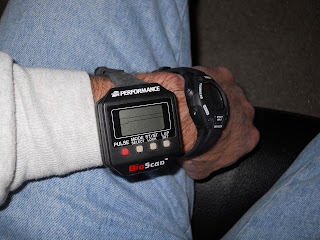
By the way, this is the heart rate monitor that I use.
By the way, this is the heart rate monitor that I use.

Monday, November 24, 2014
Runner's High: No, a Real High
Every now and then, after a long, hard run, I experience a genuine runner's high. It actually feels like the kind of high you get when . . . well, never mind. Not like I know anything about that, anyway.
My working theory is that I'm running so hard that I'm killing brain cells.
My working theory is that I'm running so hard that I'm killing brain cells.
Thursday, November 6, 2014
Update on Strength Training
I've been reflecting on my 2014 season, thinking about what went right, what went wrong. I want to have a very successful season in 2015. I'm turning 30 and doing my first Ironman; when I look back at the end of next year, I want to feel successful.
In racing, my biggest limiter this year was endurance. I didn't have the base to have a good run after a 40k ride, let alone a 56 miler. I lacked the base because I didn't do enough training, and I didn't do enough training because I kept getting hurt.
It was a stressful year. I started my half ironman training at about the same time that I moved to Kansas City and started two new jobs. I ended up with cat scratch fever, and couldn't train for 2 months on doctor's orders. When I finally got the all-clear to start training again, I almost immediately sprained my ankle, and took myself out of the mix for another month. I missed almost all of my base training workouts during that time, and had to play catch up for the rest of the season.
The stress of last year is behind me, now, and I don't foresee any super-stressful phases of life coming my way (certainly nothing that would compromise my immune system enough that I get cat scratch fever again).
But the ankle sprain was the other monkey wrench in my training plans in 2014, and that was something that could have been prevented. Over the past 2 years, I was much more susceptible to injury: twisted ankles, shoulder impingement, I even threw out my back a couple of times. I think the main reason that I had so much trouble with injury was that I wasn't strength training consistently. Then, when I moved to Kansas City, I stopped doing yoga, too. The lack of any strength or flexibility training increased my vulnerability to injury, and thus threw off my whole training season.
That's the long way of saying that I need to do more strength training and yoga.
My goal this off-season (before I start training for a March marathon) is to build consistency in strength and flexibility training. I have a battery of corrective exercises to do, along with myofascial release, stretches, and strength exercises. Here's what I'm doing:
Perform 3x/week:
Warm up
Light jogging, high knees, and butt kickers
SMR (self myofascial release)
M: Plantar fascia, gastro, soleus
W: ITB, hip flexors, quadriceps
F: Gluteals/piriformis, pectorals, rhomboids
Corrective exercise
1-leg bridge (Cook hip raise)
VMO seated leg raise
Eccentric calf raise
Eccentric toe raise
Quick release (anti-rotational exercise)
YTWLs
Neck flexion/extension
Strength
Dumbbell or kettlebell squat
Assisted pull-up
TRX push-up
Plank on foam roller
Handstand
Cable row + hip extension
Cable lat pullover + tricep extension
Cable high-low chop
Stretch
Hamstrings
Calves
Glutes/piriformis
Hip flexors
Pectorals
In racing, my biggest limiter this year was endurance. I didn't have the base to have a good run after a 40k ride, let alone a 56 miler. I lacked the base because I didn't do enough training, and I didn't do enough training because I kept getting hurt.
It was a stressful year. I started my half ironman training at about the same time that I moved to Kansas City and started two new jobs. I ended up with cat scratch fever, and couldn't train for 2 months on doctor's orders. When I finally got the all-clear to start training again, I almost immediately sprained my ankle, and took myself out of the mix for another month. I missed almost all of my base training workouts during that time, and had to play catch up for the rest of the season.
The stress of last year is behind me, now, and I don't foresee any super-stressful phases of life coming my way (certainly nothing that would compromise my immune system enough that I get cat scratch fever again).
But the ankle sprain was the other monkey wrench in my training plans in 2014, and that was something that could have been prevented. Over the past 2 years, I was much more susceptible to injury: twisted ankles, shoulder impingement, I even threw out my back a couple of times. I think the main reason that I had so much trouble with injury was that I wasn't strength training consistently. Then, when I moved to Kansas City, I stopped doing yoga, too. The lack of any strength or flexibility training increased my vulnerability to injury, and thus threw off my whole training season.
That's the long way of saying that I need to do more strength training and yoga.
My goal this off-season (before I start training for a March marathon) is to build consistency in strength and flexibility training. I have a battery of corrective exercises to do, along with myofascial release, stretches, and strength exercises. Here's what I'm doing:
Perform 3x/week:
Warm up
Light jogging, high knees, and butt kickers
SMR (self myofascial release)
M: Plantar fascia, gastro, soleus
W: ITB, hip flexors, quadriceps
F: Gluteals/piriformis, pectorals, rhomboids
Corrective exercise
1-leg bridge (Cook hip raise)
VMO seated leg raise
Eccentric calf raise
Eccentric toe raise
Quick release (anti-rotational exercise)
YTWLs
Neck flexion/extension
Strength
Dumbbell or kettlebell squat
Assisted pull-up
TRX push-up
Plank on foam roller
Handstand
Cable row + hip extension
Cable lat pullover + tricep extension
Cable high-low chop
Stretch
Hamstrings
Calves
Glutes/piriformis
Hip flexors
Pectorals
Sunday, November 2, 2014
Race Report: President Lakes Olympic Triathlon (Grind in the Pines)
Every time I go to New Jersey, something goes wrong. Google Maps drops out just past the GW Bridge; I get accidentally shunted off onto a toll road; the traffic is inexplicably terrible in the middle of nowhere . . . Things just don't go well for me when I go to Jersey.
During this particular trip to Jersey, we got lost in the middle of nowhere in the pitch black after midnight and couldn't find the state park campground. Turns out that we were actually in the state park. New Jersey's signs are not well-lit.
The race itself didn't go poorly, though; let me tell you about it.
Pre-Race:
As you may have guessed, we stayed in a state campground for this race. We drove up on Friday night after work so that we could make more of a weekend of it. We had trouble finding the campground, but the park ranger was super helpful. We called ahead to tell her we were going to be late, and she left all of our papers for the camp site at the park office, which was long-closed by the time we showed up. The campground was really nice. New Jersey's signage may suck, but the state parks are beautiful!
On Saturday, we went to the race site to swim and play. The lake was small, warm, and the color of . . . iced tea? I was pretty freaked out about the water color, until the guy who was setting up the bike racks told me it's from all the cedar trees nearby.
We had hot dogs and s'mores for dinner. That's what we always have when we're camping.
We had the campground mostly to ourselves, except for another woman (in the 30-34 age group, not mine) and her mom who had the same idea. I met them in the bathhouse the next morning while I was getting ready.
This race had day-of packet pick-up, which was terrific. I like to see races that still have same-day packet pick-up. I think that's one of the signs that it's a grassroots race.
Lots of expensive bikes there, though. That doesn't always bode well for the asshole factor (i.e. the number of assholes present who think their races are more important than anyone else's).
Swim: 1500 m in 31:28
Not terrible, especially considering I was still freaked out to be swimming in a lake full of warm iced tea. It was a wetsuit legal swim, but I didn't wear mine. I would have gotten too hot, and I don't like the constriction on my chest and shoulders. I don't remember much of the swim, except that my back really hurt by the end of it.
T1: 1:35
Bike: 40 km in 1:20:36 (19 MPH)
This was, hands down, the easiest bike courses I've ever seen. It was almost pancake flat, lined with trees on both sides, absolutely no wind. The road was completely closed to traffic, too. Great course for a fast bike split. We did three or four loops of the same stretch of tarmac, though, so it was kind of boring.
The assholes were out in force, blowing past slower competitors on their aerobars with their spaceman helmets with nary a "Passing!" or "On your left!" One guy blew past me close enough to have knocked me over without making a sound. Not sure what the point of that was. Triathletes are notoriously poor bike handlers. How did he know that I wouldn't flip out when he got that close to me and knock both of us over? And really, does it consume so much oxygen that a simple "On your left" is going to blow your race performance? Is it that you're less aerodynamic when you open your mouth to speak? These are the guys who pay $1,000 to do an Ironman in Manhattan, aren't they?
I have to admit, though, that I did do kind of an asshole thing of my own. It was near the beginning of the course, winding out to the main looped section. There was a woman on an aero bike slowing waaaaay down for a corner, so I took the inside line. I yelled at her, "On your inside! ON YOUR INSIDE!" She almost clipped me, swinging back into the corner. I had to hit my brakes. As I got out of the corner, she shouted after me, "You mean on your left?" She passed me within a couple of miles anyway, so I'm sorry for being an asshole, lady in the pink tri suit. I needn't have been in such a hurry.
T2: 1:09
Run: 10 km in 1:10:12 (11:20/mile)
Ugh. Half of this run course was on sand. It was awful and I hated it. I don't know if I will come back to this race or not, but if I don't, a big part of it will be because of the awful sand on the run course. And it's not hard-packed sand; it's soft, thick sand. It really destroyed me.
Coming back towards the finish line, about half a mile from the end, I heard people cheering for the girl behind me. I knew she was pretty close, so I put on a little bit more speed and finished strong. That little burst of speed at the end won me first place in my age group, and the chick behind me got second. If I'd succumbed to exhaustion a bit earlier, those places would have been switched!
Total: 3:04:59 (1st F25-29)
Not my worst olympic time ever, but certainly not the best. This was a really fun, down-home race (even if there were a bunch of assholes there). I don't know if I'll go back or not (because sand), but I enjoyed the weekend.
If you're considering signing up for this race and you have more questions about it, please leave a comment!
During this particular trip to Jersey, we got lost in the middle of nowhere in the pitch black after midnight and couldn't find the state park campground. Turns out that we were actually in the state park. New Jersey's signs are not well-lit.
The race itself didn't go poorly, though; let me tell you about it.
Pre-Race:
As you may have guessed, we stayed in a state campground for this race. We drove up on Friday night after work so that we could make more of a weekend of it. We had trouble finding the campground, but the park ranger was super helpful. We called ahead to tell her we were going to be late, and she left all of our papers for the camp site at the park office, which was long-closed by the time we showed up. The campground was really nice. New Jersey's signage may suck, but the state parks are beautiful!
On Saturday, we went to the race site to swim and play. The lake was small, warm, and the color of . . . iced tea? I was pretty freaked out about the water color, until the guy who was setting up the bike racks told me it's from all the cedar trees nearby.
We had hot dogs and s'mores for dinner. That's what we always have when we're camping.
We had the campground mostly to ourselves, except for another woman (in the 30-34 age group, not mine) and her mom who had the same idea. I met them in the bathhouse the next morning while I was getting ready.
This race had day-of packet pick-up, which was terrific. I like to see races that still have same-day packet pick-up. I think that's one of the signs that it's a grassroots race.
Lots of expensive bikes there, though. That doesn't always bode well for the asshole factor (i.e. the number of assholes present who think their races are more important than anyone else's).
Swim: 1500 m in 31:28
Not terrible, especially considering I was still freaked out to be swimming in a lake full of warm iced tea. It was a wetsuit legal swim, but I didn't wear mine. I would have gotten too hot, and I don't like the constriction on my chest and shoulders. I don't remember much of the swim, except that my back really hurt by the end of it.
T1: 1:35
Bike: 40 km in 1:20:36 (19 MPH)
This was, hands down, the easiest bike courses I've ever seen. It was almost pancake flat, lined with trees on both sides, absolutely no wind. The road was completely closed to traffic, too. Great course for a fast bike split. We did three or four loops of the same stretch of tarmac, though, so it was kind of boring.
The assholes were out in force, blowing past slower competitors on their aerobars with their spaceman helmets with nary a "Passing!" or "On your left!" One guy blew past me close enough to have knocked me over without making a sound. Not sure what the point of that was. Triathletes are notoriously poor bike handlers. How did he know that I wouldn't flip out when he got that close to me and knock both of us over? And really, does it consume so much oxygen that a simple "On your left" is going to blow your race performance? Is it that you're less aerodynamic when you open your mouth to speak? These are the guys who pay $1,000 to do an Ironman in Manhattan, aren't they?
I have to admit, though, that I did do kind of an asshole thing of my own. It was near the beginning of the course, winding out to the main looped section. There was a woman on an aero bike slowing waaaaay down for a corner, so I took the inside line. I yelled at her, "On your inside! ON YOUR INSIDE!" She almost clipped me, swinging back into the corner. I had to hit my brakes. As I got out of the corner, she shouted after me, "You mean on your left?" She passed me within a couple of miles anyway, so I'm sorry for being an asshole, lady in the pink tri suit. I needn't have been in such a hurry.
T2: 1:09
Run: 10 km in 1:10:12 (11:20/mile)
Ugh. Half of this run course was on sand. It was awful and I hated it. I don't know if I will come back to this race or not, but if I don't, a big part of it will be because of the awful sand on the run course. And it's not hard-packed sand; it's soft, thick sand. It really destroyed me.
Coming back towards the finish line, about half a mile from the end, I heard people cheering for the girl behind me. I knew she was pretty close, so I put on a little bit more speed and finished strong. That little burst of speed at the end won me first place in my age group, and the chick behind me got second. If I'd succumbed to exhaustion a bit earlier, those places would have been switched!
Total: 3:04:59 (1st F25-29)
Not my worst olympic time ever, but certainly not the best. This was a really fun, down-home race (even if there were a bunch of assholes there). I don't know if I'll go back or not (because sand), but I enjoyed the weekend.
If you're considering signing up for this race and you have more questions about it, please leave a comment!
Friday, October 31, 2014
My First Time on Hokas
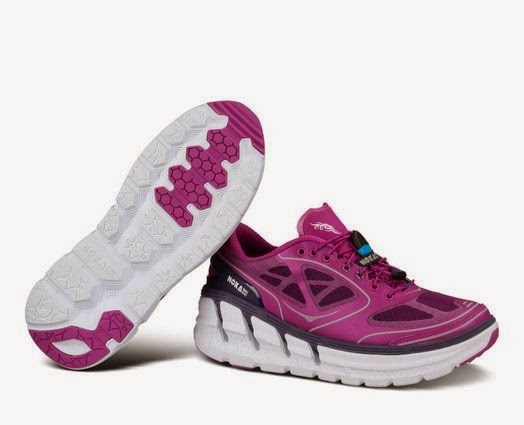
Have you seen (or worn) Hoka One Ones yet? They've been on-trend in the running community for the past year or two, sort of a backlash to the minimalist running movement. I've seen them at a few races, and in stores and magazines. I don't agree with the premise behind them, that cushioning is good and more cushioning is better, but I like how much research and experimentation they put into the initial prototype. And there are some (non-sponsored) people I'd met or read who like them.
The running store next door has weekly runs on Tuesday nights, and often they'll have tech reps from running companies come with their kit for us to try. Last Tuesday, it was Hoka's turn, so I decided to try them out, so that I could offer a more informed opinion on these shoes. I didn't want to disparage something I hadn't even tried.
I ran 3.5 miles in them, and I hate them. They were excruciating, especially on downhills. I felt like they absorbed all of my momentum with each step. I could feel myself landing noticeably harder on the downhills, and I had trouble getting my body weight over my feet instead of behind them. When I'm doing short runs (6 miles or less), I try to keep my feet awake; I try to feel what my feet are doing, so that they stay engaged. Hokas made this mindfulness exercise impossible. The shoes are designed to let your feet fall asleep. They're designed to make your feet stupid.
All of the little niggling aches and pains that show up from time to time (usually when I'm weak, tired, or overtrained) came out at once: my knees hurt, my hips hurt, my back hurt, my Achilles tendons were in agony. By mile 3, I wanted to walk, and seriously considered it, because I feared I might do damage to my body by continuing to run in them. When I got back to the running store, I took off the Hokas and experienced instant relief in my achy joints. I walked home barefoot, because even my Brooks Ghost (which I wear to walk around and for recovery runs only) were too cushy for how my feet were feeling.
So I do not like Hokas, but there are people who do (this guy gives a more unbiased rundown of the advantages and disadvantages), and they seem to be great for running on rough trails. Of course, that's because they soak up all the natural feeling of the ground, increasing the inability of your feet to do functional work . . . Can you tell I'm still a minimalist at heart?
I'm not saying they're bad shoes; they're just terrible shoes for me. Also ugly, but that's a matter of taste as well. I'm pretty set for shoes right now (Saucony Guide 7 for long runs, Mizuno Wave Sayonara for tempo work, Brooks Ghost 6 for recovery), thanks to my short stint at Dick's. It's nice to try some new things, though, for the next time I'm in the market. I'm happy to have had the opportunity to try the Hokas, even if they did ruin my Tuesday night run.
Sunday, October 26, 2014
Race Report: Rev3 Cedar Point Half

This race wasn't very fun, at least the day of. I was severely undertrained, and it showed. The experience was similar to my first olympic distance triathlon, but twice as bad (because twice as long). Still, I enjoyed my time in Sandusky, thanks mostly to my family and friends, and the experience reminded me that no matter how many triathlons I do and how fit I think I am, I still need to train to be successful. This experience reminded me to respect the sport, especially at these longer distances. In that way, I think this race prepared me for my Ironman, because it will inspire me to be more serious about my Ironman training (rather than assuming that my general fitness can get me through).
The Weekend
Emily and I drove to Mansfield, Ohio, on Friday night to stay with my Uncle Dave and Aunt Lori. My dad also drove up from Kansas to be present for my race. My mom, unfortunately, couldn't get the time off of work, so she missed it. I love my aunt and uncle, and of course my dad, and we had a great time on Friday night hanging out.
On Saturday, we had a yummy breakfast with Dave and Lori, then drove to Sandusky. We stopped at a Walmart along the way to get the fixings for a family barbecue that night, then continued on to Cedar Point. I reserved a cabin at Lighthouse Point (part of the Cedar Point resort complex) for the night, and I'm very glad that I did. The cabin was within a mile of all the race activities. Close enough to walk, but not conveniently. The cabin had a deck with a beautiful view of the lake and a fresh, bracing breeze. The beds were comfy and the cabin was spacious enough for five or six people. We had our own coffee maker, a mini fridge, a grill, and a microwave. The kind ladies at the Lighthouse Point office even let us check in 4 hours early, so we dropped all of our stuff off at the cabin and then went to the race expo.
I got my packet, timing chip, and goodie bag, took a look at the Rev3 kit (a very impressive spread, although not quite as impressive as what I've seen at actual Ironman events), and caught part of the athlete meeting. The goodie bag was the best I've seen in a long time! It came in a musette bag, and had lots of great things in it, rather than just coupons and pamphlets. In all, the free kit at this race made the whole affair a great value, especially when compared to IM 70.3 races that I've done (the entry fee on this one was about the same as IM KS 70.3, and included a T-shirt, finisher's visor, finisher's medal, saddle cover, and the musette bag).
Most of my dad's family lives within an hour drive of Sandusky, and all of them drove to Cedar Point to have a cook out with us that evening! We had a great time eating hamburgers and hot dogs, cheesy potatoes, and peach cobbler. Then we played board games and chatted together. Most of the family wasn't returning to watch me compete (it was a fairly long drive at a fairly early hour, and they all had church the next morning). So the time spent with them was really valuable! Having the opportunity to get together with family was the main reason that I chose this race as my 70.3 for the year.
Two of my cousins, Abby and Nancy, stayed at the cabin with me, Emily, and my dad. I let all of them sleep in the next morning while my dad and I went to the transition area to get me set up. I completely forgot about bringing stuff for breakfast (rookie mistake--one of many!), so I gummed down some leftover hot dog buns and one hot dog from the night before. I also had two cups of coffee, timed so that I would get my morning poo out of the way well before the start of my swim wave.
I set up my transition easily. I know it's silly, but I felt a little intimidated by all of the expensive bikes around me. It happens at every race, but it's a let-down to park my $350 Fuji Road Ace next to all of the sleek, carbon, TT bikes. I know that the engine matters more than the chassis, but I still feel like a poser with my little aluminum road bike--I don't even have aero bars on it!
I warmed up with a light jog around the area, went to the bathroom a couple of times, then headed to the beach with my dad. I put my wetsuit on and jogged around a little more to get the rubber loosened up. I haven't swam in my wetsuit in over a year (another rookie mistake), but Lake Erie would be unpleasantly cold without it, and I needed all the buoyancy help that I could get.
The water was ROUGH. Painfully rough, at least for a lake. Not as bad as Venice Beach in September, but still decidedly unpleasant. I even heard the elites talking about it (in the med tent, but we'll get to that later) after the race. No one had a great swim that day. I haven't dealt with waves (well, a little bit of chop in June in the Potomac river, but that didn't even compare) in . . . Well, it's probably been since I left L.A. (2007). But it's not like I wasn't going to do the race because the water was a little scary. They called my wave to line up, and I shuffled into the water with the other women under 40.
The Swim: 1.2 miles in 50:06 (11/17 in F25-29)
I had not done enough swim training. In particular, I hadn't done any long-distance swims, I hadn't done any open-water swims, and I hadn't swam in my wetsuit. And the waves. I know there is a way to swim in really choppy water, but I've never been good at it. As a result, I spent the first third of the course (the part going straight out from shore) swimming about 8 strokes, stopping to catch my breath and look around, then swimming another 4 strokes. I didn't take on a ton of water, but much more than I'm used to swallowing. Fortunately, Lake Erie is much cleaner than it was 10 years ago (and I should know, since I have an uncle who works at a water treatment facility on Lake Erie). The waves were probably 3-4 feet high. I've swam through higher (but again, not well). But I wasn't prepared or trained to keep swimming after a sudden drop of 4 feet. It was slow going. But you can tell from my position in my age group that it was slow going for everyone. There were still plenty of white swim caps around me, and I was passing swim caps from previous waves.
Once we turned the corner it got a little better, in that I could get into more of a rhythm and try to relax. But by that time, my low back was starting to bother me. Now that I'm not teaching yoga regularly I tend not to do yoga regularly, and my body's been paying the price. My right quadratul lumborem (low back) gets really tight, and it gives me trouble when I swim more than about 800 meters. It was bothering me on race day. This swim wasn't even about getting a decent time; it was 100% about making it through the swim.
The last third of the swim course, with the current at my back, wasn't as quick or easy as I'd hoped; I was counting on a little more help from the current than I got. Still, I was doing better than the people around me, who were disoriented by the feeling of push-pull from the waves. The last 400 meters seemed to take forever. I slipped on the beach exit, and was no help at all for the wetsuit strippers. I was glad to be out of the water and on to the bike, though.
The Bike: 56 miles in 3:34:05 (15.69 MPH, 12/17 in F25-29)
The bike course was lovely. Mostly flat, not as much wind as I expected so close to the coast of the lake, and a very nice temperature. Honestly, I don't remember much about it, other than just trying to enjoy myself. I brought three Honey Stinger waffles and two packs of Honey Stinger chews for my nutrition, and I lost two of them trying to get something to eat in the first 800 meters of the bike course. I'm glad I didn't get a penalty for littering, but I was very sad to see those waffles go. They taste much better than Powerbar gels.
I only have room on my bike for a single down-tube bottle. The frame is too small to have a seat tube bottle holder, and I won't use behind-the-seat bottle cages after my experience at my last 70.3 in Kansas (I lost most of my nutrition at that race, and it destroyed me). Fortunately, there were aid stations every 10 miles, so I got a full bottle and a gel at every station. That had me drinking 20 oz. of water and taking in 100 calories about every 45 minutes. I supplemented that with my remaining Honey Stinger chews, and ended up with 200-300 calories every hour. Based on what I've done in training, that was my goal.
My riding slowed down more and more as I got closer to the end. In the final five miles, I was (once again) focused solely on making it through. I already felt tired and spent; I had no idea how I was going to make myself run right off the bike.
The Run: 13.1 miles in 3:21:39 (15:24/mile, 14/17 in F25-29)
I surprised myself with the amount of energy that I had coming out of T2! It actually felt good to run. I was flummoxed, but enjoying the feelings. I did my best to restrain myself, because I knew that if I ran as fast as I felt I could at that point, I would pay for it later.
The first few miles of the race weren't bad. I walked the aid stations and took in as much as I dared at each one. At the mile 3 aid station, I passed up the opportunity to put on more sunscreen (another rookie mistake, and I paid dearly for it later!). Around mile 3, we got away from the lake and into the town of Sandusky. The blacktop was boiling hot, and there was no shade anywhere. I was not happy with the race directors for choosing this particular course.
Things took a turn for the worse around mile 5. I started feeling some GI distress, and I couldn't get any food or water in. I stopped at a toilet, and that helped a little. I walked for a while, and that helped a little. But my body was still too hot, and now I had a serious calorie problem, because I couldn't get any food in. I could barely get water in. I walked for the next mile or two.
I was able to start running again between miles 6 and 8, and I started to feel more optimistic. At that point, we were running through "downtown" Sandusky (more a Main street than a downtown, and totally deserted). There was a little bit of shade, here and there, and I ran in it as much as I could. I was starting to feel . . . crispy. I realized then that it was a mistake to pass up the sunscreen, as I was going to be out there much longer than I'd planned.
I was still having trouble taking in calories; even water felt like too much. I walked a lot, getting passed by people I'd passed earlier. Still, I saw plenty of people with half-distance numbers walking, too, as some of them were on their way out while I was on my way back. So at least I wasn't DFL. I was able to run off and on between miles 8 and 9, but I could feel the lugnuts coming loose. The wheels were going to come off; it was just a question of when.
By mile 10, I was toast. I was able to put on some sunscreen at an aid station around that time, and it probably did some good (since the last 3 miles probably took about an hour). By this point, I was checking my watch and doing math, trying to figure out if I could still make it in under the cut-off.
Those last 3 miles were brutal. I considered sitting down on the road and waiting for an ambulance many times. I walked the entire time, almost tripped on more than one occasion, and was preparing myself for the possibility that I might need to crawl part of the way. The last 30 minutes passed in a blur. Even during the last mile, I was still questioning my ability to finish.
I did finish, and was even able to muster a job for the last 200 yards through the finishing chute. I crossed the line, got hugs from my dad, Emily, and Dave and Lori, then headed straight for the medical tent.
Total: 70.3 miles in 7:51:02 (13/17 F25-29)
I don't know whether the cut-off was at 8:00:00 or 8:30:00, but I'm glad that I didn't have to find out. This time embarrasses me. I can't believe that it took me almost as long to cover 13.1 miles on foot as it did to cover 56 miles on a bike. I didn't train well enough, and I didn't respect the race enough. I neglected my swimming (especially open-water swimming), and lacked the endurance base to have a successful 70.3 experience.
But I did finish, and that in itself was a valuable accomplishment. And the experience and perspective that I gained was valuable. I don't think I've ever had to (or been able to) push myself so hard to finish a race. I'm empowered by having to dig so deep to get through the race.
I spent about 15 minutes in the med tent. Someone came over and checked my pulse, blood oxygenation, and blood pressure. They were all a little bit off of normal, but not dangerously so. I stayed horizontal on a cot, drinking as much water as I could, while my vitals came back down (or up, as the case may be). After 10 minutes, they checked on me again, and the numbers had improved. About that time, I got really cold, so they got me a blanket and a big cup of hot chicken broth.
I didn't realize this, but hot chicken broth is apparently magic. As soon as I started drinking that stuff, I felt instantly better. I felt warm, and my stomach settled down. I could get up and walk around. I had a little bit of energy. I knew that hot chicken broth is a staple of ultra endurance races, from the Ironman on up to ultra marathons, but I'd never experienced its healing power myself. It's magic. I'm going to remember that for next year.
I ended up with a pretty good sunburn, but it wasn't as bad as I expected, based on how I felt on the race course. It was sore for a couple of days, especially around my neck and under my right arm. After two days, it faded into a tan, and I didn't have very much peeling. With my fair skin, I was surprised at how quickly and painlessly it cleared up.
Although I liked this race, I did not enjoy the run course at all. It was boring. It was too exposed. And it offered too few opportunities for spectating and cheering. I think the run course should be altered in the future.
I didn't take advantage of discounted Cedar Point tickets, but I wish I would have! On Saturday, Cedar Point was closed for a private event (I think held by Honda for their employees), but racers and their families could get in. It would have been awesome to get to ride some rides and not have to wait through super long lines! I decided against doing that because I didn't want to be on my feet a lot the day before a race. If I had to do it over again, though, I would definitely have spent some time riding the roller coasters.
I'm very glad that I stayed at a Cedar Point resort, rather than off-site. It made getting around the morning of the race and after the race much easier. We also got validated parking, which saved $15. The cabins were great, with very nice views and wonderful amenities. They were also nice and quiet. Or at least our neighbors were quiet. We weren't, because we were playing board games.
I am considering doing this race again next year, but as an aqua bike instead of a triathlon. It will be about a month before Ironman Barcelona, so I think it would be good preparation if I did the full aquabike. Besides, cutting out the run would mean that I can spend lots of time on my feet at Cedar Point the day before!
Thursday, October 23, 2014
German Salisbury Steaks
I made this recipe up, loosely based on Salisbury Steak and German meatballs. It turned out to be delicious!
Ingredients
1 lb. ground beef (I used 85/15)
1/4 cup caper juice with a few capers
1/4 cup oatmeal (quick oats or regular)
1/2 onion, diced
1/2 green pepper, diced
1 egg, beaten
2 tbsp butter
1 tsp garlic powder
1 tsp thyme
Method
Salt and pepper to taste Start with 1/4 cup of caper juice with a few capers (~12) in a big bowl. Add in the oatmeal, and toss to absorb the juice. Add 1 lb. ground beef, onion, and pepper, and mix with hands.
Mash the butter into the egg, along with some salt and pepper. Add the thyme, garlic powder, and salt and pepper on top, then mix again with your hands.
Divide the meat mixture into 4 equal parts, and form them into oval-shaped patties. Preheat a pan on medium-high heat. Add the patties. Allow them to cook 3-4 minutes on each side.
If you'd like to make a sauce, use wine or wine-based vinegar to deglaze the pan. I used white wine vinegar, cut with a little bit of water and a dash of worcestershire sauce, but I think red wine vinegar or cooking sherry would be even better. Scrape the pan to release all the browned bits. Add some sliced mushrooms, green bell peppers, and capers. Simmer until the sauce reduces by half. I added in some corn starch at the end to thicken it up. Finish the patties off by cooking them in the sauce, or pour it all over the top.
I served these with sliced, roasted sweet potatoes and sliced, baked zucchini. Delicious!
Ingredients
1 lb. ground beef (I used 85/15)
1/4 cup caper juice with a few capers
1/4 cup oatmeal (quick oats or regular)
1/2 onion, diced
1/2 green pepper, diced
1 egg, beaten
2 tbsp butter
1 tsp garlic powder
1 tsp thyme
Method
Salt and pepper to taste Start with 1/4 cup of caper juice with a few capers (~12) in a big bowl. Add in the oatmeal, and toss to absorb the juice. Add 1 lb. ground beef, onion, and pepper, and mix with hands.
Mash the butter into the egg, along with some salt and pepper. Add the thyme, garlic powder, and salt and pepper on top, then mix again with your hands.
Divide the meat mixture into 4 equal parts, and form them into oval-shaped patties. Preheat a pan on medium-high heat. Add the patties. Allow them to cook 3-4 minutes on each side.
If you'd like to make a sauce, use wine or wine-based vinegar to deglaze the pan. I used white wine vinegar, cut with a little bit of water and a dash of worcestershire sauce, but I think red wine vinegar or cooking sherry would be even better. Scrape the pan to release all the browned bits. Add some sliced mushrooms, green bell peppers, and capers. Simmer until the sauce reduces by half. I added in some corn starch at the end to thicken it up. Finish the patties off by cooking them in the sauce, or pour it all over the top.
I served these with sliced, roasted sweet potatoes and sliced, baked zucchini. Delicious!
Wednesday, October 22, 2014
Eating for Success
My roommate and I have both felt a little . . . weighed down, so to speak. Before we moved to Virginia in May, we were both working low-wage jobs where high-calorie food was readily available. I ate a few too many hot dogs and taquitos, and she ate a few too many comped meals (not to mention cheesecake slices). We'd been making much healthier decisions since moving, but we were maintaining weight when we really needed to lose some.
We'd been kicking around the idea of trying a stricter eating routine for a short duration, like six weeks. We decided to take the two months until Thanksgiving to lose as much weight as we can. Primarily, we agreed to swap out a starch at dinner (I normally cook a tried-and-true combo of protein, starch, and vegetable) for a second vegetable, and choose leaner meats. We minimized processed grain options (including breads, crackers, and other flour-based foods), and tried to cut out industrialized foods as much as possible (although Emily does still take Weight Watchers frozen meals to work for lunch, sometimes). We also allow ourselves one "splurge" day per week, every Saturday. Normally, Saturdays involve pizza delivery, diet soda, and beer. There may have been a trip to On the Border, as well.
So far, the plan has been very successful! In the past three weeks, I lost three pounds and Emily lost seven. This past week has represented a departure from the plan, however; I think we're both getting a little burned out. PMS may also play a role. We've decided to have a recovery week every fourth week. We don't eat whatever we want, by any means, but we have eaten more, and we bought a loaf of bread the other night. We'll see if this week undoes what we've accomplished in the past month of hard work.
The biggest challenge for me is in balancing my calorie expenditure with my calorie intake. Especially during the first two weeks, I'd eat about the same number of calories on really heavy workout days (i.e. teaching cycling, lifting weights, and a hilly run) as on easy days (i.e. just teaching yoga). I felt weak and tired and unmotivated for a few days, until I remembered that I have to cut caloric intake in relation to my exercise level. Since then, I've felt fine.
We'd been kicking around the idea of trying a stricter eating routine for a short duration, like six weeks. We decided to take the two months until Thanksgiving to lose as much weight as we can. Primarily, we agreed to swap out a starch at dinner (I normally cook a tried-and-true combo of protein, starch, and vegetable) for a second vegetable, and choose leaner meats. We minimized processed grain options (including breads, crackers, and other flour-based foods), and tried to cut out industrialized foods as much as possible (although Emily does still take Weight Watchers frozen meals to work for lunch, sometimes). We also allow ourselves one "splurge" day per week, every Saturday. Normally, Saturdays involve pizza delivery, diet soda, and beer. There may have been a trip to On the Border, as well.
So far, the plan has been very successful! In the past three weeks, I lost three pounds and Emily lost seven. This past week has represented a departure from the plan, however; I think we're both getting a little burned out. PMS may also play a role. We've decided to have a recovery week every fourth week. We don't eat whatever we want, by any means, but we have eaten more, and we bought a loaf of bread the other night. We'll see if this week undoes what we've accomplished in the past month of hard work.
The biggest challenge for me is in balancing my calorie expenditure with my calorie intake. Especially during the first two weeks, I'd eat about the same number of calories on really heavy workout days (i.e. teaching cycling, lifting weights, and a hilly run) as on easy days (i.e. just teaching yoga). I felt weak and tired and unmotivated for a few days, until I remembered that I have to cut caloric intake in relation to my exercise level. Since then, I've felt fine.
Tuesday, October 21, 2014
Update on Training
This past year's training bordered on disastrous. I lost three months of prime base building time to sickness and injury. I just barely managed to get in enough training to complete a half iron distance race in September. And that was a bit of a stretch. The last 5 miles of my half marathon were sheer torture, and I questioned whether it might be better to sit down and wait for an ambulance to pick me up.
Still, I got through it, and my training has taken a turn for the better.
I did finish the triathlon season with two or three months of consistent, disciplined training. I've been able to maintain consistent running and cross training since my triathlon season ended at the beginning of September. I'm confident in my ability to prepare my body and mind for an Ironman in 2015.
After Rev3 Cedar Point on September 8, I gave myself two full weeks off. The only exercise I did was teaching cycling, yoga, and water aerobics classes. After those two weeks, I started easing back in to running, with a goal of averaging 15 miles per week for the next month. I planned to do a 5k in October, a 10k in November, and a full marathon (my first!) in March. My plan was to see if I could still run (relatively) fast, gradually build a run base again, and start marathon training at the end of November.
I did a 5k a couple of weekends ago, and surprised myself with my time (27:57, after "running" a 3-hour-plus half marathon at the end of my 70.3). It hurt, in the way that races do, but it's such a short-term pain; 5 minutes after crossing the line feeling like death, I was ready to run another one.
I plan to do a 10k the weekend before Veteran's Day, if I can find one nearby. And I'm signed up for the Shamrock Sports Weekend in Virginia Beach on March 20. I'm excited that the sponsor for the race is Yuengling. I love Yuengling lager. It's like PBR, but from Pennsylvania instead of Wisconsin (PBR is from Wisconsin, right?). That will be my first full marathon. I'm using a basic plan adapted from Run Less, Run Faster, plus a four-week build-up from my current 15 miles per week to 25 miles per week. I'm teaching two cycling classes a week and taking one water aerobics class (with a client) for cross-training. That means I'm basically getting paid to train; I'm practically a professional athlete, here.
I've noticed a lot more soreness and cramping, so I'm also trying to incorporate more weight-lifting, corrective exercise, yoga, and self-myofascial-release. You would think that it wouldn't be so difficult to make myself do these things, considering that I am a personal trainer by trade and spend a good amount of my time at a gym. Alas, it's just as difficult for me to make myself get on a foam roller or a weight bench as it is to get my clients to do it.
So that's what I'll be doing for the next six months. I'm eyeing Ironman Barcelona for 2015. I'll let you know when I pull the trigger and plunk down my 650 Euros!
Still, I got through it, and my training has taken a turn for the better.
I did finish the triathlon season with two or three months of consistent, disciplined training. I've been able to maintain consistent running and cross training since my triathlon season ended at the beginning of September. I'm confident in my ability to prepare my body and mind for an Ironman in 2015.
After Rev3 Cedar Point on September 8, I gave myself two full weeks off. The only exercise I did was teaching cycling, yoga, and water aerobics classes. After those two weeks, I started easing back in to running, with a goal of averaging 15 miles per week for the next month. I planned to do a 5k in October, a 10k in November, and a full marathon (my first!) in March. My plan was to see if I could still run (relatively) fast, gradually build a run base again, and start marathon training at the end of November.
I did a 5k a couple of weekends ago, and surprised myself with my time (27:57, after "running" a 3-hour-plus half marathon at the end of my 70.3). It hurt, in the way that races do, but it's such a short-term pain; 5 minutes after crossing the line feeling like death, I was ready to run another one.
I plan to do a 10k the weekend before Veteran's Day, if I can find one nearby. And I'm signed up for the Shamrock Sports Weekend in Virginia Beach on March 20. I'm excited that the sponsor for the race is Yuengling. I love Yuengling lager. It's like PBR, but from Pennsylvania instead of Wisconsin (PBR is from Wisconsin, right?). That will be my first full marathon. I'm using a basic plan adapted from Run Less, Run Faster, plus a four-week build-up from my current 15 miles per week to 25 miles per week. I'm teaching two cycling classes a week and taking one water aerobics class (with a client) for cross-training. That means I'm basically getting paid to train; I'm practically a professional athlete, here.
I've noticed a lot more soreness and cramping, so I'm also trying to incorporate more weight-lifting, corrective exercise, yoga, and self-myofascial-release. You would think that it wouldn't be so difficult to make myself do these things, considering that I am a personal trainer by trade and spend a good amount of my time at a gym. Alas, it's just as difficult for me to make myself get on a foam roller or a weight bench as it is to get my clients to do it.
So that's what I'll be doing for the next six months. I'm eyeing Ironman Barcelona for 2015. I'll let you know when I pull the trigger and plunk down my 650 Euros!
Monday, October 20, 2014
Spinning Workout S&H6 - Chase & Pursuit
Taught this profile a few weeks back at my 6:00 a.m. Monday spin class. It was hit with the group, and it gave me a good workout, so I thought I'd share! Click the link below to download.
S&H6 - Chase & Pursuit
Nothing at All - Third Day (90 BPM)
Sober - P!nk (91 BPM)
Love the Way You Lie - Eminem (87 BPM)
Fistful of Sand - The Bravery (103 BPM)
Take on Me - A-Ha (168 BPM)
Walk This Way - Aerosmith (104 BPM)
Midnight Show - The Killers (140 BPM)
Acqua 'nfunn a Via - Enzo Avitabile (93 BPM)
Toxic - Brittney Spears (143 BPM)
Even Flow - Pearl Jam (103 BPM)
Feel Good, Inc. - The Gorillaz (144 BPM)
For a Pessimist, I'm Pretty Optimistic - Paramore (206 BPM)
City of New Orleans - Arlo Guthrie (76 BPM)
One Sweet Love - Sara Bareilles (100 BPM)
Spin & Smile!
S&H6 - Chase & Pursuit
Nothing at All - Third Day (90 BPM)
Sober - P!nk (91 BPM)
Love the Way You Lie - Eminem (87 BPM)
Fistful of Sand - The Bravery (103 BPM)
Take on Me - A-Ha (168 BPM)
Walk This Way - Aerosmith (104 BPM)
Midnight Show - The Killers (140 BPM)
Acqua 'nfunn a Via - Enzo Avitabile (93 BPM)
Toxic - Brittney Spears (143 BPM)
Even Flow - Pearl Jam (103 BPM)
Feel Good, Inc. - The Gorillaz (144 BPM)
For a Pessimist, I'm Pretty Optimistic - Paramore (206 BPM)
City of New Orleans - Arlo Guthrie (76 BPM)
One Sweet Love - Sara Bareilles (100 BPM)
Spin & Smile!
Sunday, October 19, 2014
Race Report: Glory Days Grill XC 5k

I found this race in the local, free running magazine, Run Washington. One of the great things about living in such a dense, metropolitan area is the multitude of resources available to niche groups. One of the downsides is all the people. But I digress.
This 5k is held in Centreville, about a half hour drive from where we live. My roomie, Emily, wanted to do the race with me. Race day goal number one was to wake her up early enough for us to drive to Centreville, pick up our race packets, and warm up (she's not usually an early riser). The day was cloudy, cool, and rainy, which I consider perfect weather for an October XC race.
We got lost trying to find packet pick-up, because I trusted GPS for directions over e-mailed instructions from the race directors. I really need to ween myself off of Google Maps. When we pulled in to park, I realized (thanks to the signs warning that XC meet parking would be $5) that this race is held as part of a larger high school XC invitational. I love watching high school and college XC meets, so I was excited to (almost, kind of) be a part of one.
Packet pick-up included a very nice, day-glo yellow, dry-fit T-shirt and a commemorative race pin. Not bad, although the entry fee was more than I'm used to for a 5k ($35). There were a beautifully excessive number of porta-johns at the race site. It was one of the most beautiful things I've ever seen. I made use of them multiple times before, during, and after my warm-up. I'd had a lot of water (and maybe a beer or two) the night before.
During my warm-up, I noticed a stocky, Asian woman about my age. She wore running shorts with a matching singlet, and held herself in a--how do I put this delicately?--gay way. I'm serious. She was clearly a lesbian. I'd found my nemesis (please note that this was because of her age, not her supposed sexual preferences).
We got to line up in the staging area for the race. I bounced around, trying to stay warm, like a happy bunny while Emily stood staring at me sullenly. She still wasn't quite awake. We finally got the call to take our marks, then we were off. I held back in the first 150 meters, letting the faster runners go in front of me. Most of the first quarter mile went downhill, and I enjoyed stretching my legs out. The race was laid out in three loops, each about a mile long. I imagine that's because the high school races are run at different lengths for different groups. The ground was soft, not too muddy, although there were a few sloppy puddles that we all had to run around. There were a few short climbs, and some absolutely brutal long ones. It was a cool course, and I enjoyed it.
I started off at a comfortable pace, and ramped it up through the first lap. I passed a lot of people, including my nemesis, within the first mile. I never saw my nemesis again, either, so I did not choose well in terms of race-long motivation. The second mile took a lot out of me; it was mostly uphill, and some of the hills were quite steep. I made up as much time as possible on the downhills, and I was getting passed now and then. There was a little boy who looked about seven who ran right past me. He stayed within reach the whole time, but the one time I tried to pass him, he put on a little kick and kept me away. What a competitor!
One woman, a short, slight, black woman whom I passed in the first mile, came back to me somewhere around the end of mile 2. She passed me, but I kept her within reach. I passed her back on a long, downhill section, but she was able to stay in touch, too. I gradually ramped up my pace to try and drop her, but she kept with me. Finally, I had given all I could at that faster pace, and I had to pull back. She passed me and ran off. It was great, though! It felt like I was actually racing someone, and she definitely pushed me to run faster than I would have run without her!
I crossed the line in 27:57, and felt like I'd given all that I could. I used this race as a measurement tool. I've done slow, zone 2 running almost exclusively this year. My 10k times in my olympic races have been upwards of an hour, and my half marathon time at Rev3 Cedar Point . . . I don't even want to talk about it. I haven't trained myself for hard, fast running, and I've kind of forgotten how to push myself to that level of pain. So I wanted to get a reading on how fast I could run a short race, at this point.
I exceeded my expectations. I was really hoping to be able to run in the low nines, and I managed to run almost exactly nine-minute-miles at this race, on a challenging course and off-road, no less! I'm very happy with my performance. I won 2nd in my age group (F25-29, taking into account that two of the top three overall women were in my age group), and my time would have placed me well in the 30-something categories, too. The 40-somethings, though, were all 21 minutes in change. I would have been way out of contention if I were 20 years older! Isn't that amazing?
I was really happy with this course, the organization, the race amenities (the pictures they took are amazing, and free!), and the atmosphere of the race. Something about going off-road seems to make people a little more laid-back; I've noticed it at XC races and at CX (cyclo-cross) races. There was none of the preening that I've seen at other races and from other athletes (cough, triathletes, cough), and there's no high-tech or expensive gear to show off. I think XC and CX races might be my favorites.
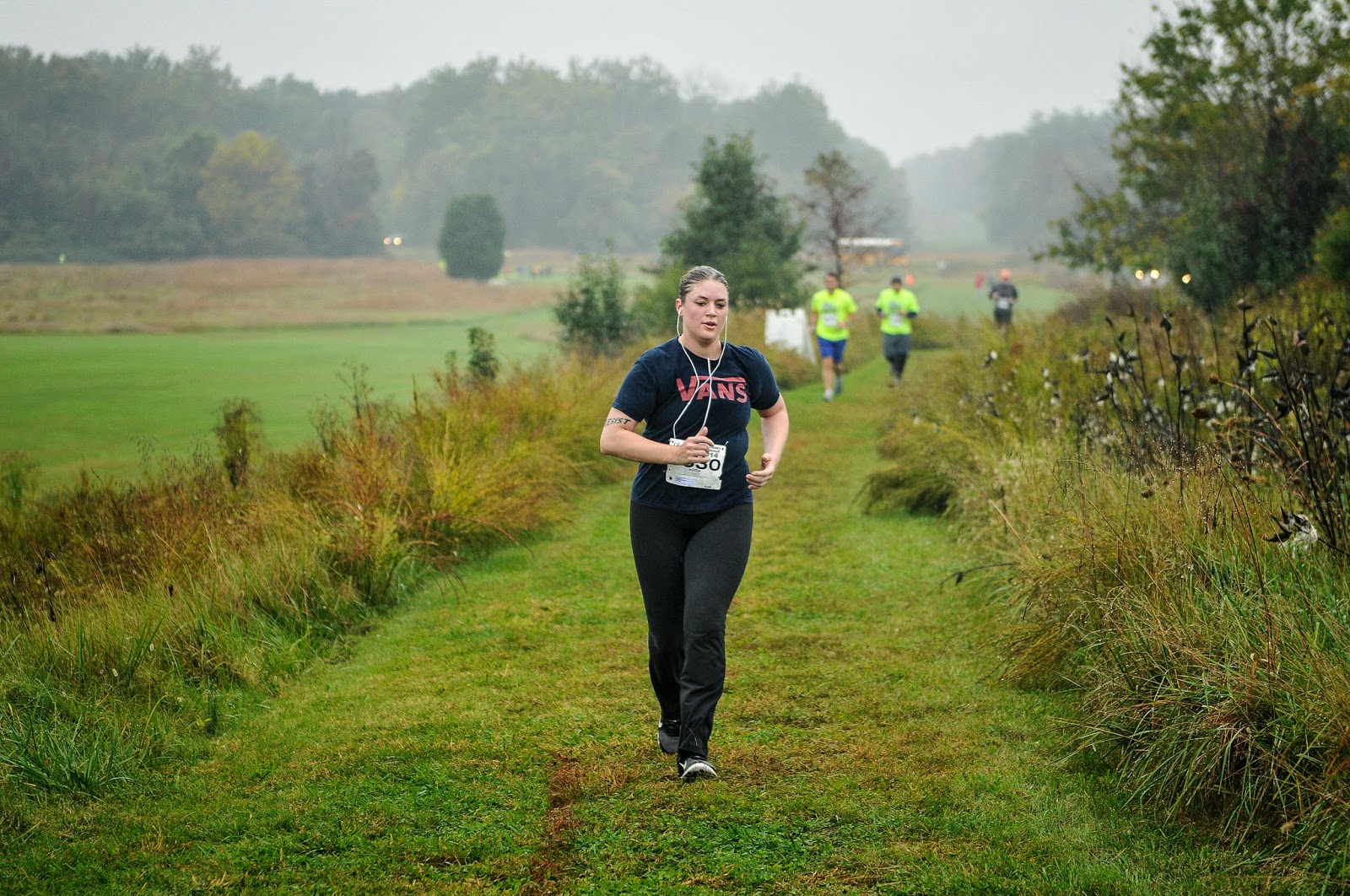
By the way, Emily finished in 33:38 in her first 5k, her first XC race, and her second event ever!
Saturday, October 18, 2014
Weekly Updates, Whatever Happened to Those?
You might assume I forgot that I ever had a blog.
I didn't forget; I just lost the motivation to post. I suddenly realized that, in spite of my earlier aspirations, I have no desire to be a social media rock star, or to have a wildly popular blog, or to achieve any level of fame at any time ever.
That said, I do appreciate those of you who read my blog, and I'll continue to post (more regularly, even).
We moved on May 17. Since then, I've done two international distance triathlons, one half iron distance, and a 5k. I'll write up race reports on those with what I can remember of each race. Here's a preview: they were all difficult, I was undertrained, my times were way slower--some of my slowest ever--but I still managed to come away with a few awards. Easy age group, I guess.
I never really got my feet under me with training this year. First there was the cat-scratch fever scare, then the twisted ankle. Between those two medical interruptions, I had absolutely no base building this season. By the time I was back to a point where I could ride and run, we were in the process of moving. After the move, I was able to train regularly--I hardly missed any workouts! There were still inconsistencies, mostly because I was trying to establish a routine in a completely new area. And after losing most of the spring to sickness and injury, all I could do was put in as many miles and as much time as possible, and hope it was enough to get me through.
It was enough, but just barely.
Anyway, I'll leave that to the race reports. I'm just realizing that I have a lot to catch up on, so I'll split it into multiple posts. Here's a preview of what I have coming:
Sunday: race report for Glory Days XC 5k (my most recent race)
Monday: a new FREE CYCLING WORKOUT! It's been forever since I've published one!
Tuesday: info on my current training plan and upcoming goals
Wednesday: info on my current eating plan
Thursday: recipe for a "semi-splurge" meal--a fancier meal that takes longer to prepare but is still reasonably low-cal and incredibly delicious
Friday: maybe a Friday Funny, like Steve in a Speedo does. We'll see.
Saturday, May 17, 2014
Weekly Update: Weeks 2-4
Ah yes, training. It has not been going well.
I got sick again, and that took me out for a good week. Then I was fine, and started training again, when I twisted my ankle badly during a thirty-minute run. I stayed off the ankle completely for three days, then went back to work. It's been a week and a half since the injury, but my ankle is still black and blue and swollen. I'm not going to be running anytime soon!
Also, I moved to Virginia. My "roommate" got a job with CapitalOne--a very good job!--and so I quit QuikTrip (which did not make me sad at all) and moved out here with her. We are living in Falls Church, just outside the Beltway, in a beautiful area with plenty of trees. There's a Trader Joe's, a library, a park, and a running store just a short walk away. This area has beautiful running and biking paths, along with what seems like a vibrant running and triathlon community! One of the top women's rugby clubs in the country is in D.C. Basically, this is the perfect place for me to live.
I don't have a job yet, and my "roommate's" job pays well enough that I need not rush out to find employment. If you live in D.C. or the surrounding area and know of anything, I'd appreciate any help in finding employment.
I'm strongly considering a doctoral program in physical therapy, and will start looking into available programs in this area next week.
I feel like the world has opened up once more, and it's full of possibilities!
Thank you all for supporting me and reading my blog!
I got sick again, and that took me out for a good week. Then I was fine, and started training again, when I twisted my ankle badly during a thirty-minute run. I stayed off the ankle completely for three days, then went back to work. It's been a week and a half since the injury, but my ankle is still black and blue and swollen. I'm not going to be running anytime soon!
Also, I moved to Virginia. My "roommate" got a job with CapitalOne--a very good job!--and so I quit QuikTrip (which did not make me sad at all) and moved out here with her. We are living in Falls Church, just outside the Beltway, in a beautiful area with plenty of trees. There's a Trader Joe's, a library, a park, and a running store just a short walk away. This area has beautiful running and biking paths, along with what seems like a vibrant running and triathlon community! One of the top women's rugby clubs in the country is in D.C. Basically, this is the perfect place for me to live.
I don't have a job yet, and my "roommate's" job pays well enough that I need not rush out to find employment. If you live in D.C. or the surrounding area and know of anything, I'd appreciate any help in finding employment.
I'm strongly considering a doctoral program in physical therapy, and will start looking into available programs in this area next week.
I feel like the world has opened up once more, and it's full of possibilities!
Thank you all for supporting me and reading my blog!
Subscribe to:
Posts (Atom)