Eventually, Wednesdays will (I hope!) become recipe days. Or at the very least, FOOOOOD days. Because (honestly) most of my recipes just involve rooting around in the refrigerator, throwing anything good I find in a pot, and pouring it over brown rice or whole-wheat pasta.
Anyways. This week I have something MUCH more interesting to relate. So pull up a floor pillow and I will magically read you the book AND show you the pictures at the same time (seriously, didn't you always wonder how your kindergarten teacher could do that?) . . .
(By the way, the little squatty guy represents where I got hit by the car.)
Monday morning. I'm running east on Central at about 7:40 a.m. (you know, before the UNGODLY heat set in). I hadn't brought my sunglasses, so I had my hat pulled low over my eyes to keep the sun out of my face. In other words, I can't see much more than five feet in front of me. I'm crossing a driveway (and there are like a dozen driveways there) when I notice that there is a car RIGHT NEXT TO MY FREAKIN' LEGS. My first thought is "What a jackass, stopping so close to me like that!"
But then I realize that he isn't stopping. I'm still running, trying to get past the front bumper of his car, and start banging on the hood and saying, "HEY! I'M HERE! STOP!" But still doesn't see me (um, or hear me, wtf). I look through the windshield, and he has his head turned right and his attention focused that-a-way.
He does NOT see me.
And all this time, the car's still moving forward, and I'm still trying to get past him. Finally, his car nudges my legs out from under me, I go tumbling over the hood, and land on my right hand. Still doesn't stop. I see him turn left into one of those driveways on the south side of Central (I was on the north sidewalk), and I'm still standing there, giving the now-empty road this look like, "What the fuck, jackass?!"
A lady pulled into one of the driveways--she'd seen the whole thing--and asked if I was okay. And I was. But I was MAD. It's a good thing he didn't stop, because I was not in the mood to say anything very nice, and I don't think that would have made the situation any better (even though it was totally well-deserved). But as it was, I didn't have to worry about it, so I just ran the rest of the way back to the gym.
Later that day, I went to the police department to file a report. And they said that he had called in his side of the report also, so I guess he wasn't a jackass after all. I figure he probably turned around and came back, but by that time I was already gone. I have his phone number (the police gave it to me). Now I just need to figure out what the hell to say to someone who ran over me with his car.
I have a little bruise on my index finger, a big bruise on my elbow, and the right side of my neck and shoulder is really tight (I landed on my right arm when I dove over the hood of his car)--knotted up all over. I was sort of freaked out once my neck tightened up like that (didn't happen until yesterday morning), but it's starting to fade away now (helped along by my awesome masseuse), so I think that it's all superficial. I don't have health insurance right now, so I'll have to call the guy who hit me and figure out that whole mess so I can go get the ol' neck looked at.
Also I have a blister on the little toe of my right foot. But that is unrelated :-)
And that, boys and girls, is the story of the second time I've been hit by a car. Both times I've been remarkably lucky. Let's hope that there's no "third time's a charm" principle at work here.
Wednesday, August 6, 2008
Sunday, August 3, 2008
"Stop Slouching!": Pronation

I never used to pay attention to articles about pronation. Why? Because I didn't think I overpronate (but those are my feet up there). In fact, I tend to walk on the blades of my feet. Which made me think that I supinate. But there's more to pronation than just the way your ankles tilt, or whether your toes turn in or out (mine turn in). Additionally, I have some clients who are guilty of absolutely criminal pronation. So I've had to do a lot of research to figure out pronation, why it's bad, and what (if anything) we can do to correct it. I'm pretty excited about writing this article, and I hope it's helpful.
Diagnosis
You probably recognize pronation, even if you don't realize it. Pronation, which is also sometimes called being flat-footed (although they're two separate phenomena, if you ask me), refers to the inward, medial rotation of the foot at the ankle. The main symptom is an arch that collapses as you put weight on your foot. Here's a video to watch (and I'm sorry if you don't like feet).
Note how the arch collapses and the ankle rolls in. Gross, yeah? To see if you overpronate, check to see if the arch is collapsed (or possibly non-existent), if the inside edge of your foot bulges when you're standing relaxed, or if your ankles noticeably roll in as you put weight on them.
Neutral Foot Position

Pronation/overpronation and supination/underpronation are both caused by an ankle that cannot retain neutral position. So in order to correct any functional over- or underpronation, you have to learn how your foot is supposed to sit, and how that's supposed to feel. I've found two practical ways to do this--one with a trainer or coach (or partner or training buddy), the other alone.
Here's the first, taken from a great article by Justin Price on ptonthenet about overpronation:
There are two small indentations at the base of the ankle just below the ankle joint. Place your thumb on the dimple on the inside of the ankle and your forefinger on the dimple on the outside (see Figure 4). Ask your client to roll her foot and ankle inward (overpronate). You will feel pressure on your thumb. Ask her to roll outward (oversupinate), and you will feel pressure on your forefinger. This pressure is the talus bone moving in the ankle. Coach your client to pronate and supinate until you feel even pressure of the talus bone on both your thumb and forefinger. This is the anatomical neutral position for the foot and ankle. Most people will have to supinate to get to neutral from their dysfunctional overpronated position.This method is useful because it's more absolute, more technical. So if you're the typical Type A triathlete, this is the method for you, although you'll need another person's assistance to work it out.
The second method is much more intuitive, and I've derived it from yoga. Stand in Tadasana (Mountain Pose). Make sure your weight is evenly distributed through the three main points of contact between your feet and the floor (heel, joint of the big toe, joint of the little toe, i.e. first and fifth metatarsal). Once you're in a proper Mountain Pose (and if you don't know how to do this, shame on you! go to yoga!), lift your toes. You should feel your arches lift. Now lower your toes, but don't let your arches fall. If you're like me, you'll feel the muscles in your lower legs--really, like all of them--engage, and just standing like that will be exhausting. At this point, you should feel like the muscles underneath the plantar fascia on your feet are engaged, the weight is evenly distributed betwen the three points of the foot, and you have three natural arches (forming a triangle on each of your feet).
How to Fix it
You might notice that I strongly advocate the practice of yoga for strengthening the arches. It's a great place to start.
But what if you lack the time and money to attend yet another class every week (preferably multiple times a week)? After all, not everyone works at a gym!
Try these simple exercises to strengthen your foot muscles, relax your flantar fascia, and become a better person.
Golf Ball Roll
Exactly what it sounds like. You've used a foam roller before? Same idea here. You're using the golf ball to perform self myofascial release (your own personal deep-tissue massage!) on the plantar fascia in your foot. Roll the golf ball under each foot for 30-60 seconds, stopping on any painful places. As you do this, perform an active stretch of the muscles underneath the fascia by pulling your toes up towards your shins.
Big Toe Pushdowns
Stand with your foot in neutral position (see above). Push down through your big toe without allowing the ankle to roll in or the arch to collapse. Start by holding that for 5 seconds, 10 times on each side (or do both sides at once). As you get stronger, hold the toe down for longer stretches and fewer repetitions. You'll start to feel that muscle (flexor hallicus) contract under the arch of the foot. As it gets stronger, you'll be able to consciously engage that muscle whenever you're doing a weight bearing exercise.
Calf Stretch w/ Tibialis Anterior Activation
You've probably done this stretch plenty before, but this time you're going to do it with a neutral foot position, while pulling your toes up. One foot forward, one foot back. Press the heel of the back foot into the floor behind you. But don't let your ankle roll in, mkay? That kind of defeats the point. Pull the toes of the back foot up toward your shin. And hold. Feels nice, right? The other trainers and I always joke about how we love being stretched out. Until someone tries to stretch our calves. At which point we want to kill somebody. Hold for 30 seconds on each side, repeat 3-5 times.
Pronation and Yoga
Yoga is always practiced barefoot. The book I've been reading recently (Yoga Anatomy) connects the three natural arches of the foot to the muscle lock Uddiyanabandha, in which you pull your deep abdominals in and up. So I recommend doing some yoga practice to help your feet. Not only is it a great option for increasing flexibility and preventing injury, it's going to improve your biomechanics. And I speak absolutely 100% from experience. Do it; it helps; and it's a lot more fun to take a yoga class than to add a 1-hour stretching workout to your weekly routine (on top of swimming, biking, running, nutrition, weights . . .)
In addition, practice a mild Uddiyanabandha when you're running, walking, going up stairs, even when you're cycling. If nothing else, making the connection between arch and abs forces you to bring your mind back to what your feet are doing. And you can't go wrong with being more mindful in your running and cycling.
Why it Matters

Ankles, hips, and knees are all intimately related. If one of those joints is out of line, the others are going to suffer. That means that when you overpronate (or underpronate, for that matter), your hips and knees are going to feel the effects as well.
Pronation can also affect your performance in the bike, although the effects tend to take longer to appear. I attribute my achilles tendinitis to the excessive overpronation of my right foot. With each pedal stroke--every time I put weight on my right foot--the arch rolls in, which takes my ankle out of alignment, putting excessive strain on my achilles tendon. Note that this problem can also be caused by having bike shoes that don't fit properly, or by excessive amounts of rock in your shoe/cleat/pedal fit (especially with Speedplay).
Also? Plantar fasciitis. Bunions. Shin splints. IT band pain. Are those not enough reasons for you to do something about this problem?
Conclusion
A couple weeks ago at my local run shop, I asked the proprietor if there are exercises you can do to correct overpronation. He said no; in his mind, the only option is motion-control shoes and, if those don't work, orthotics. Based on the research I've done, I strongly disagree, with one caveat. In my mind, there are two kinds of pronation: structural (i.e. bones, tendons, ligaments) and functional (i.e. muscles and laziness). Some people are born with flat feet, and they will always need corrective aids to avoid overpronation. Most of us, however, are overpronators by circumstance. Our feet have evolved to move us (barefoot) over uneven ground. Instead, we stick our feet in shoes and push them around pavement. No wonder they don't know what the hell they're doing.
My biggest recommendation to you overpronators (and, consequently, to myself) is to get outside and play barefoot. Teach those muscles under your plantar fascia how to function again! Do some barefoot trail running. Run around the lawn barefoot with your kids. Heck, maybe even try a barefoot marathon
Price, Justin. "Corrective Exercise - Part 1: The Foot, Ankle and Knee." PTonthenet, 19 May 2008. http://www.ptonthenet.com/displayarticle.aspx?ArticleID=3043
Beginners' Guide: The Cost of Setting Out

And at this point in the year, you've probably already weighed the costs and benefits. But just in case you're still on the edge ("I don't know if I can afford this . . . or if I want to!") or thinking about getting more serious ("I really liked doing that race; maybe I'm ready to invest a little more deeply in this thing.") I'm providing this Beginner's Guide to choosing, purchasing, and paying for gear.
For the absolute first-timer n00b: The Bare Necessities
Believe it or not, you need very little to get started.
Swim
For swimming, get a pair of goggles. You can get them anywhere, any kind (I have one pair bought at a big box store on vacation that actually worked tolerably well), but keep in mind that you get what you pay for. My recommendation? Speedo Vanquisher. That's what I use, and I love them. The link takes you to the mirrored version ("Vanquisher Plus," fancy pants Speedo), which I like because they transition better to outdoor (i.e. race day) usage. A pair of those will set you back $15 at your local swim shop (I got mine at Amazon.com for $10.50 + shipping).
Swim cap? Eh . . . if you have long, floppy hair that won't stay in a ponytail, you'll probably need one. If you can handle practicing with your hair in your face, just wait until race day, when they'll probably give you one for free. After a few races, you'll have so many swim caps you won't know what to do with them all!
For swimwear (remember we're looking at the absolute bare necessities), here's what I suggest: Fellas, use an old pair of bike shorts. They're going to stretch out with the chlorine (and, if you're outside, they'll fade in the sun), so do not use your $100 Descente comp shorts (you know who you are, cyclists). If you'd like, you can drop the extra $20 for a jammer-style suit (looks like bike shorts without the padding). Or be super trendy and buy a speedo! Women, if you don't have a training swimsuit your cheapest option is a grab bag suit, which you'll probably be able to find for $20-$30. If you have a local swim shop, they might have that option, also. If you're picky about color, pay the extra $5 to pick your style. And I strongly recommend that you buy a 100% polyester suit; otherwise, you might be buying a new one every other month (I know I have!), as they stretch out considerably as the lycra disintegrates from exposure to chlorine.
Bike
Bike. Ah, the bike. The huge money sink-hole of our sport (but we love it, you know). For the absolute beginner, I recommend that you use your old 10-speed, your $50 big box bike, or borrow one. Unless you are doing a half ironman distance (or longer) for your first race, just use what you have. I can't tell you how many times I've gotten e-mails from cycling or tri mailing lists to the effect of
hey i bought a bike when i started training 5 months ago but i can't do it anymore will sell my bike cheap 1400 oboThese people, for the most part, bought bikes before they were sure they'd be able to commit to the sport long-term and end up selling their gear at a loss. A good bike is expensive (and buying a cheap bike is even more expensive), so save yourself some hassle and do a few races before you make such a big investment. Ideally, check around with people you know and ask if anyone has a bike you can borrow. I borrowed a bike for my second and third races, before I was ready to invest in my own (the first race I did on an old $20 ten-speed from Goodwill).
Bike shorts, I would argue, are an absolute necessity. Believe me, you do not want to be on a bike seat for any longer than 10 minutes without them (although I have dozens of insane people who take spinning classes in street clothes). You can probably find a pair for $20, but pay an extra $15-$30 ($50 is probably about right) to for more padding and nicer fit.
You absolutely positively need a helmet. It is not an option, when racing or at any other time. Figure $30.
Run
For the run, all you really need is shoes, but make sure that you get high quality shoes. Go to a running or triathlon specific store that employs knowledgeable, athletic associates. Have them watch you walk and run and then listen to their recommendations. Do not go to Dicks Sporting Goods, Sports Authority, or some other big box athletic store. Unless you've been running for years and know exactly what (kind of) shoe you need (i.e. motion control), get some advice; it's worth the extra cost. My shoes (I currently trade back and forth between a pair of Brooks Adrenaline and Mizuno Waveriders) cost around $100 (although I get a discount for being a member of the local tri club). You can run in your bike shorts on bottom and a sports bra (or nothing at all, if you're a fella) on top.
And for the first race, that's really all you need. Comes in at under $200.
Stepping it up
But what if you've had your first race, and maybe your second and third, and are ready to invest a little more in all the sweet, sweet tri gear? Where do you start? What gets you the most bang for your buck? And how much is it going to cost? Here's where I'll get a little more into my personal experience and let you know what worked for me. So here's a list of gear (what you need), cost (how many spare organs you'll need to sell), and explanation (why it's worth the arm and leg), in order of importance (that is, this is the order in which I wish I'd bought these items).
USAT membership - $35
Suddenly all of your races just got $10 cheaper! If you're going to do 4 or more races in one year, the USAT membership is worth it.
Bicycle - $500-$1500 (for a beginner set-up)
In almost every triathlon you do, you spend more time biking than doing anything else, so improvements in bike performance are going to give you the greatest improvements in race times. Here's my recommendation: buy a road bike, not a beginner-level tri/time trial bike. If you get a beginner-level tri bike and get really into the sport, I guarantee you're going to want to upgrade that bike later. If you buy a road bike, you'll (probably) eventually end up with two bikes: one for tri racing, and another for weekend rides, local tours/centuries, or commuting. I bought a Fuji Ace on ebay two years ago, and I love it. I'm upgrading to a Cervelo P2C, but you better believe I'm holding on to my $300 road bike (even though it weighs 1.5 metric tons).
Cycling shoes - $60-$120
This is what I bought. Very easy to get in and out of these in transition. Cycling shoes are going to make a big difference in your bike performance, as well. Besides which, if you go to spinning classes, suddenly you look like a "serious" athlete.
Cycling tools - $50+
I recommend buying a multi-tool, a small pump for your frame, and tire levers. That price doesn't include extra tubes and tires. Also, you should learn at this point how to change your own tires (but I can't put a price on that).
Body Glide - $7
Body Glide is a lube that is very (very very very) popular with endurance athletes. Yeah, you can use vaseline, but this feels better.
Race belt - $5
A race belt holds your race number on, so that you don't have to pin it onto your jersey/shorts. Does it make a huge difference in race times? No, not really. It's more for convenience than anything else. This way, you don't have to worry about pinning your number on or putting on a shirt in transition. And it's not like it's a huge investment, anyway.
Heart rate monitor - $80-$200
You might already have a heart rate monitor, but this is a good point to upgrade to a model with more bells and whistles. Is it necessary for your training/racing? Absolutely not; there's plenty of evidence that a scale of perceived exertion is every bit as useful as heart rate monitoring. But it is sort of a cultural thing within the sport. Triathletes just love having numbers to look at and play with, and a heart rate monitor provides those (for a much more economical price than a power meter).
Tri-specific clothing - $80-$150
Tri shorts have a thinner chamois for quicker drying. Tri tops tend to be lighter and more breathable than most cycling jerseys. But--as with the HR monitor--we're moving into matters of style and culture, rather than pure performance boosters.
Wetsuit - $200-$500
By the time you buy a wetsuit (unless you live near the ocean or in a very cold climate), you've arrived. I would consider a wetsuit a transitional purchase; if you're going to drop a couple hundred dollars here, you're probably experienced enough to do your own research.
Conclusion
So that's kind of the quick-and-dirty guide to what it'll cost to get started in the sport. For your first race, assuming you're starting completely from scratch (i.e. most people already have goggles, running shoes, and maybe even bike shorts), figure about $200 for equipment, $50 for race entry, and $10 for training aids like gels and sports drink. After that initial foray into triathlon, your gear upgrades can be much more spread out (i.e. I bought a bike two years ago and a wetsuit last year), so you don't have to worry as much about up-front costs.
In the long run, though, how much will this sport cost you? Here's a rough approximation of what I've spent on triathlon in the last three years (and this is with minimal research, so I'm probably low-balling it):
Gear: $2,010
Races/travel: $1,230
Memberships, maintenance, and miscellaneous: $350
And looking at those numbers . . . those are pretty big. Have I really spent almost $4,000 on my hobby? Yes, over the past 3 years. I absolutely have.
And I can say with no hesitation whatsoever that it's totally worth it.
Fellow veterans, do you agree? Newbies (and tentative explorers), what do you think?
Friday, August 1, 2008
"Runner's High": Beyond Human
First off, watch this:
Michael Phelps beat the world record by a full body length. He took almost 2 seconds off of it. 2 seconds is huge in the world of swimming.
What I really want to talk about, though, is his turns. Look at him come off that wall. Look at the streamlining. Look at the undulation of his body. Take a look at the whole unit. He doesn't look human. But he doesn't look like anything else, either. He doesn't look like a dolphin (or a butterfly), and that's surely the closest thing to which you could compare him. So he's not quite animal.
I think the only thing you can say is that he's beyond human.
And I think we athletes have all experienced this, or can at least all aspire to do so. Have you ever been running and felt like you were flying? Have you ever been cycling and forgot you were even on a bike? Have you ever been swimming and felt almost like you had dissolved into the water? Have you ever forgotten yourself in that moment?
See, I may not be able to do it with as much panache as Michael Phelps. I know I can't (I'm not tall enough). In fact, watching me swim, bike, and run, no one will ever mistake me for anything more than human (except maybe , as some of you have noted, in transition).
But in my mind . . .
In my mind is another matter.
What I really want to talk about, though, is his turns. Look at him come off that wall. Look at the streamlining. Look at the undulation of his body. Take a look at the whole unit. He doesn't look human. But he doesn't look like anything else, either. He doesn't look like a dolphin (or a butterfly), and that's surely the closest thing to which you could compare him. So he's not quite animal.
I think the only thing you can say is that he's beyond human.
And I think we athletes have all experienced this, or can at least all aspire to do so. Have you ever been running and felt like you were flying? Have you ever been cycling and forgot you were even on a bike? Have you ever been swimming and felt almost like you had dissolved into the water? Have you ever forgotten yourself in that moment?
See, I may not be able to do it with as much panache as Michael Phelps. I know I can't (I'm not tall enough). In fact, watching me swim, bike, and run, no one will ever mistake me for anything more than human (except maybe , as some of you have noted, in transition).
But in my mind . . .
In my mind is another matter.
Guess What
Looks different, doesn't it?
Tell me what you think. Let me know if you see any problems, or if I need to add anything else.
And good luck to everyone who is racing this weekend!
Tell me what you think. Let me know if you see any problems, or if I need to add anything else.
And good luck to everyone who is racing this weekend!
Wednesday, July 30, 2008
"Stop Slouching!": Winged Scapula - THE MOVIE
It has been long-promised. Long-anticipated. And now it is here.
Monday, July 28, 2008
"Stop Slouching!": Kyphosis
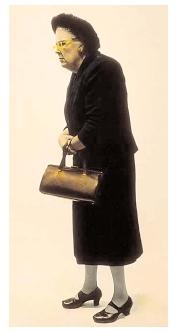 We're talking today about what one of my clients refers to as "The Dowager Hump" (which her dad has, and which I think sounds dirty): Kyphosis.
Kyphosis is the opposite of lordosis, and basically means that your spine loses part of it's natural curve. That means that there are a couple different kinds of kyphosis, but the one that I want to talk about is basic postural kyphosis, or the dowager hump variety. Normally, dowager humping (mind out of the gutters, guys) is relegated to the very young and the very old. I have one lady in one of my water aerobics classes who is so severely kyphotic (as a result of osteoporosis and several compression fractures) that she looks as if God put his hand on her head and squished her down.
But in spite of their almost uniform lack of extreme old age/youth (I know there are a few exceptions), I believe that triathletes are uniquely susceptible to this postural deformity because of two things: extended cycling followed by fatigued running. A little bit of rounding in the back (shallow thoracic kyphosis, to be precise) is normal. But--and this goes hand-in-hand with winged scapula--I have seem some pretty severe cases while watching triathletes at races, particularly longer races like Kansas 70.3.
So you're kyphotic. What do you do about it? So glad you asked!
Stop slouching!
This is the most obvious one. If you practice better posture, you will have better posture. So straighten up! Do it right now! I know you're probably slouched over your keyboard and mouse as you're reading this (I am as I'm writing it). Tighten your lats, rhomboids, and lower trapezius muscles, square your shoulders, and regain the natural curve of your back. When cycling, roll your shoulders back and down. Actually, when doing anything roll your shoulders back and down. When running, shake out your arms to loosen them up. Then roll them back and down. Believe me, once you become aware of how often you slouch when working out, you'll be doing this every five minutes.
Uddiyana Bandha
This is a Sanskrit term used in Yoga. It means "flying up muscle lock." It has helped me immensely with my posture in swimming, cycling, and running (as well as in Yoga, natch). Stand tall with chest lifted and shoulders down. When you're standing properly, you should feel like you're holding your thorax up off of your abs and vital organs. Lungs should feel expanded. Now suck your stomach in and up--that is, pull the innermost abdominals (the transverse abdominus) in and up towards the heart. That's why it uses the term "flying up" (Uddiya); it's like your muscles are flying up into your body. When you're swimming, biking, and running, try to hold onto that feeling. It'll engage the transverse abdominus, and the multifidus (tiny little muscles along your spine) will fire along with it to support your spine from the inside out. And if you have stamina with this muscle lock, it'll enable you to keep your chest lifted up and off your stomach even when fatigued, which will make it easier to get breath in.
Shoulder pinch
Stand with your arms held directly in front of your shoulders. Squeeze the shoulder blades together without abducting the arms or raising the shoulders. Try to feel the muscles working. Those are your rhomboids, and chances are good that they could stand to be stronger.
Any kind of row
Seated cable row. One arm dumbbell row. Standing row with rotation. Use weights. Use tubing. Use a cable. Whichever you do, focus on keeping your shoulders down and back, your chest lifted, and keep squeezing your shoulder blades together. Pretend that your arch-nemesis stuck their finger in the middle of your back and you're trying to hold them there so you can kick them where the sun don't shine. Or, as my training mentor says, pretend you're crushing a pop can between your shoulder blades. Either one. It's up to you.
Why bother with all this? Why correct a postural deformity that is becoming so common you look weird if you're not doing it?
In my mind, it's a matter of performance. When you let your upper body collapse down into itself, you're reducing your body's ability to effectively take in air. That means less oxygen in the lungs, less oxygen in the blood, less oxygen to the working muscles when it's late in a race and you're tired. Good posture--what Marc Evans refers to as "athletic posture"--is key to athletic performance. That's why the first chapter of his book, Triathlete's Edge, is all about analyzing and diagnosing possible postural deficiencies. He begins there because he recognizes it as an important first step to improved running, biking, and swimming performance.
Besides which, you definitely do not want "Dowager Humper" to be your tri nickname.
Sunday, July 27, 2008
Re-Launching August 1!

Saturday, July 26, 2008
Excuses
I peaked too early.
I haven't trained enough.
I didn't do enough bricks.
I didn't put in enough volume.
It was too hot.
The field was too competitive.
The course was too difficult; if the course had been flatter, I would have killed.
We all make excuses. I try to keep mine internal, as much as possible (so as not to annoy certain people). But at some point, I have to look at myself, look at my times, look at my training, and admit that I'm not where I want to be, and it's my fault. Not in a self-deprecating, guilt-ridden way. In an I'm-responsible-for-my-own-actions way. If I don't put in enough volume, if I don't train enough, if I don't do enough bricks . . . that's my responsibility.
And knowing that, I am empowered to change.
I haven't trained enough.
I didn't do enough bricks.
I didn't put in enough volume.
It was too hot.
The field was too competitive.
The course was too difficult; if the course had been flatter, I would have killed.
We all make excuses. I try to keep mine internal, as much as possible (so as not to annoy certain people). But at some point, I have to look at myself, look at my times, look at my training, and admit that I'm not where I want to be, and it's my fault. Not in a self-deprecating, guilt-ridden way. In an I'm-responsible-for-my-own-actions way. If I don't put in enough volume, if I don't train enough, if I don't do enough bricks . . . that's my responsibility.
And knowing that, I am empowered to change.
Race Report: Mudwater
I have so many questions right now, I hardly know where to begin.
How did I end up in the toughest age group? Why did I let myself get so slow? When will I get faster? And who would have thought that this race (of all races) would be the one to light a fire under my ass?
Pre-race
It stormed yesterday, and this morning the sky was overcast and ominous-looking. Off to the north and west, there was a huge mushroom cloud with sheets of rain pummeling the ground beneath it. The occasional lightning flash lit up the sky and made my mom renew her comments of "You guys are crazy."
Now this is the second race that we've driven to as a family. And this is the second race at which I arrived much, much later than I would have liked. The race was scheduled to start at 7:30. Packet pick-up began at 6:00, bodymarking at 6:15. And we left the house at 6:20, which had us pulling up to the parking lot at 6:40.
Fortunately, the race was very laid-back, although surprisingly bigger than I expected. I was thinking the race would draw around 100 athletes. There were upwards of 250 there, I believe (Edit: 150 triathletes, 30 duathletes). And, because it's a small, local race, I knew so many people! I've never had that experience before! At the most, I've had a few folks on my team to keep my company while we're waiting around for the start, but never have I been able to walk around transition chatting and introducing and laughing . . . That was a great experience.
The lightning was still flashing at 7:15, but the rain had yet to roll in. The race directors announced that the start would be delayed by 15 minutes, and then we'd see how it looked. Which was fine with all of us. We were standing around, talking, having a nice little coffee hour (GU hour) and enjoying each other's company. Of course, that's what I was doing when I should have been warming up. Which meant that when they finally called us to the water, I was stone cold. Stone cold. Hadn't swam, hadn't run, hadn't even ridden my bike from the parking lot to transition. I really quickly swam out and back a little bit, until they told us all to get out of the water. And then it was time to start.
Swim: 750 meters, 15:36
I was surprisingly nervous; as I stood on the beach I thought, "Why am I so nervous? This is just a little race! I wasn't going to care!" But it became quite evident to me as I stood there that I did care, and that I really wanted to kick some local, small-town, home-grown triathlon ass. I put myself right at the front, no one ahead of me, and got myself ready.
The swim was a standing beach start! That means that finally--after practicing for months at Lake Afton just because I enjoy it--I got to dolphin dive to start. And it was a good choice. While everyone else was wading into chest-deep water, I was already swimming at a good clip to the first buoy. But it did cause me to get a large quantity of sand in my top.
This was one of the more hectic swim starts I've experienced, however. Probably not quite as bad as Wildflower, where we're held in a bull pen and then released all at once, but still a very rough start. For some reason, everyone bunched up in the middle, whereas there are normally a good number of athletes who cheat out to the sides (to avoid the chaos of the middle, natch). In this race, seemed like everyone was contained within a 12 foot lane, and we were all hitting and kicking and slapping and sucking air together like a cross between a hydra and a leviathan.
For the first 200 yards, I settled in to get kicked in the face a lot, because it was entirely too crowded to try to pass. After that, people spread out a bit, and I was able to start making time back. I felt like the swim went pretty smoothly, after that. I got to draft a little bit, got to pass several people, and managed not to overexert myself. Plus I came out of the water ahead of the two women I coach who swim faster than me. I think it was because I positioned myself well at the beginning of the swim with the dolphin diving.
T1: 35 seconds
This is where I really started to feel tired. As I ran up a short hill (carpeted!), I glanced at my heart rate monitor. It blinked 177 at me. That might be the highest my heart rate got all day.
And hell yes I was booking it! This was the fastest T1 time on the day out of all the women, baby!
Bike: 12.4 miles, 38:24 (19.375 MPH)
By the time I was on the bike, I was huffing and puffing a little bit. The course took us out of the park, then west for an out-and-back. The initial segment out of the park is almost a mile long, though, which is a hard way to start the race, because that initial 1 mile feels a lot like transition. It's hard to pick it up, at that point.
As soon as we got out of the park, one of my athletes passed me (way to go, Katy!). I tried to take off after her, but my heart rate was already doing funny things, so I settled in and repeated to myself the mantra, "Your own race your own race your own race."
Bike was otherwise uneventful. The people whom I expected to pass me passed me (except for a couple of women who I thought would come out of the water ahead of me). I did my fair share of passing. Oh! And my bike computer wasn't working! I'm pretty sure I knocked it off track trying to get my bike off of the damn rack. So I had no idea how hard I was working, how fast I was going, or how much I was slowing down on the uphills. It was completely by feel, today. Which I didn't like at all, by the way.
I felt like I pushed sufficiently hard on the bike leg. I was wanting to go under 40 minutes for the 20k today, and I did that.
T2: 49 seconds
I felt a little bit draggy at this point in the race. I think my body wasn't really into the running thing today. I wasn't taking my time or anything, and I didn't sit down to put my running shoes on, but I could feel my momentum leeching away as I faced the prospect of the final 5k.
Run: 3.1 miles, 31:05
"I am a runner. I love running. I am a runner. I love running." I tried to repeat this to myself as I willed my legs to stride out a little more. It wasn't working, so I switched on my mental radio. "I would swallow my pride, I would choke on the rinds, but the lack thereof . . ." Then I tried "What you gonna live for? What you gonna die for?" Then I settled in to just keep going for the 3 little miles I had to endure before the end. I could see Katy about 100 yards ahead of me, but I couldn't reel her in; I tried to keep her in my sights, but somewhere around the first mile I got a little bit of tunnel vision and lost track of everything.
About a quarter of a mile into the race, a chick with "22" on her calf ran past me at probably about an 8:30 pace. I picked up my turnover, lengthened my stride, and tried to mentally draft off of her. But she was entirely too fast, and it was too early in the race for me to hope to keep up with that pace. A mile later, another woman in my age group (who works out at Genesis and is from my pokey, dinky little town) blazed past me like I was standing still. "Okay," I told myself. "That's back from third place. Better settle in, enjoy this race, and have fun."
And I did. I joked with the volunteers, encouraged other runners (as they passed me, natch), and cut up for the video camera I made my mom hold throughout the race. Just before I passed the second mile marker, I felt a little bit of life in my legs, and was able to pick up the pace a little bit. And that felt magnificent. I could tell I'd been crawling along the whole time, so to feel that reinvigoration made the first 2 miles (almost) worth it.
Coming around the last turn (which I know is about half a mile from the finish, because Lake Afton is where I do a lot of my training runs), I could hear heavy breathing and soft foot falls behind me. I looked back. There was a skinny little thing running in bike shorts and a yellow crop top. "No way," I thought. "Not this close to the finish." I put on the speed. I heard her fall back. I let up slightly, but maintained a quicker pace than I had held for the first 2.5 miles. A minute later, I looked back. She had gained on me again. I turned on the speed again, looking ahead at the huge red inflatable arch that marked the end of my suffering. She was probably 20 feet behind me. I yelled back at her, "I don't know if I can hold you off to the end!" She responded, "Probably not!" And I took off.
I brought it across the line in not quite a dead sprint, but it was enough to give me 8 seconds over her. As volunteers removed our timing chips, I said, "Thanks for pushing me at the end there!" Her response? "It doesn't matter. You're not in my age group."
Yeah, thanks a lot. I don't care how old you are. I still beat your ass. The number next to my name? It says 17. And next to your name? 18. That means I beat you. You almost caught me, but I held you off. And I beat you. So there.
Total: 1:26:31
I wasn't terribly happy with my performance right after the race. When I checked the results, I was 6 out of 11 in my age group. 6th place? WTF?!
Somehow, today, I ended up in the toughest age group. And we all know that 20-24 (or 22-24) is not the toughest age group (35-39 F was actually the smallest division, with only 3 entrants!). Unless you're in Tuscaloosa, Alabama, or some other major collegiate race. So I was happy for my friends, several of whom finished top in their respective age groups (45-49, 50-54), but I couldn't help thinking how much better I could do if my running were a little bit stronger. For this race, that was what really held me back--those 10 minute miles are just not conducive to winning anything. Ever.
But then I got home and checked my results. And you know what? I didn't do too bad. I placed 17th overall. With a 9 minute mile, I would have finished 12th. But I can live with 17th. I'm actually pretty happy with my results, now that I'm home and get to see the bigger picture.
This was a great race. Even with Miss Not in my Age Group, the whole feel was friendly and laid-back. This is exactly what a small-town race should be. I knew the course intimately. I had an excellent swim. I met my goals on the bike. And I was only 1:05 off my goal for the run. Plus I rocked transitions!
And for the first time in a long time I felt nervous at the start. I felt those butterflies fluttering and the adrenaline surging as the gun went off (a shotgun, by the way. Oh Kansas). I remembered why I love racing so much. I remembered what makes this sport special and essential and very very worth it.
I felt like a brand-new triathlete. Like a total n00b.
Yes, you might even say I felt like a virgin.
But without all the unpleasantness of not knowing what to do ;-).
How did I end up in the toughest age group? Why did I let myself get so slow? When will I get faster? And who would have thought that this race (of all races) would be the one to light a fire under my ass?
Pre-race
It stormed yesterday, and this morning the sky was overcast and ominous-looking. Off to the north and west, there was a huge mushroom cloud with sheets of rain pummeling the ground beneath it. The occasional lightning flash lit up the sky and made my mom renew her comments of "You guys are crazy."
Now this is the second race that we've driven to as a family. And this is the second race at which I arrived much, much later than I would have liked. The race was scheduled to start at 7:30. Packet pick-up began at 6:00, bodymarking at 6:15. And we left the house at 6:20, which had us pulling up to the parking lot at 6:40.
Fortunately, the race was very laid-back, although surprisingly bigger than I expected. I was thinking the race would draw around 100 athletes. There were upwards of 250 there, I believe (Edit: 150 triathletes, 30 duathletes). And, because it's a small, local race, I knew so many people! I've never had that experience before! At the most, I've had a few folks on my team to keep my company while we're waiting around for the start, but never have I been able to walk around transition chatting and introducing and laughing . . . That was a great experience.
The lightning was still flashing at 7:15, but the rain had yet to roll in. The race directors announced that the start would be delayed by 15 minutes, and then we'd see how it looked. Which was fine with all of us. We were standing around, talking, having a nice little coffee hour (GU hour) and enjoying each other's company. Of course, that's what I was doing when I should have been warming up. Which meant that when they finally called us to the water, I was stone cold. Stone cold. Hadn't swam, hadn't run, hadn't even ridden my bike from the parking lot to transition. I really quickly swam out and back a little bit, until they told us all to get out of the water. And then it was time to start.
Swim: 750 meters, 15:36
I was surprisingly nervous; as I stood on the beach I thought, "Why am I so nervous? This is just a little race! I wasn't going to care!" But it became quite evident to me as I stood there that I did care, and that I really wanted to kick some local, small-town, home-grown triathlon ass. I put myself right at the front, no one ahead of me, and got myself ready.
The swim was a standing beach start! That means that finally--after practicing for months at Lake Afton just because I enjoy it--I got to dolphin dive to start. And it was a good choice. While everyone else was wading into chest-deep water, I was already swimming at a good clip to the first buoy. But it did cause me to get a large quantity of sand in my top.
This was one of the more hectic swim starts I've experienced, however. Probably not quite as bad as Wildflower, where we're held in a bull pen and then released all at once, but still a very rough start. For some reason, everyone bunched up in the middle, whereas there are normally a good number of athletes who cheat out to the sides (to avoid the chaos of the middle, natch). In this race, seemed like everyone was contained within a 12 foot lane, and we were all hitting and kicking and slapping and sucking air together like a cross between a hydra and a leviathan.
For the first 200 yards, I settled in to get kicked in the face a lot, because it was entirely too crowded to try to pass. After that, people spread out a bit, and I was able to start making time back. I felt like the swim went pretty smoothly, after that. I got to draft a little bit, got to pass several people, and managed not to overexert myself. Plus I came out of the water ahead of the two women I coach who swim faster than me. I think it was because I positioned myself well at the beginning of the swim with the dolphin diving.
T1: 35 seconds
This is where I really started to feel tired. As I ran up a short hill (carpeted!), I glanced at my heart rate monitor. It blinked 177 at me. That might be the highest my heart rate got all day.
And hell yes I was booking it! This was the fastest T1 time on the day out of all the women, baby!
Bike: 12.4 miles, 38:24 (19.375 MPH)
By the time I was on the bike, I was huffing and puffing a little bit. The course took us out of the park, then west for an out-and-back. The initial segment out of the park is almost a mile long, though, which is a hard way to start the race, because that initial 1 mile feels a lot like transition. It's hard to pick it up, at that point.
As soon as we got out of the park, one of my athletes passed me (way to go, Katy!). I tried to take off after her, but my heart rate was already doing funny things, so I settled in and repeated to myself the mantra, "Your own race your own race your own race."
Bike was otherwise uneventful. The people whom I expected to pass me passed me (except for a couple of women who I thought would come out of the water ahead of me). I did my fair share of passing. Oh! And my bike computer wasn't working! I'm pretty sure I knocked it off track trying to get my bike off of the damn rack. So I had no idea how hard I was working, how fast I was going, or how much I was slowing down on the uphills. It was completely by feel, today. Which I didn't like at all, by the way.
I felt like I pushed sufficiently hard on the bike leg. I was wanting to go under 40 minutes for the 20k today, and I did that.
T2: 49 seconds
I felt a little bit draggy at this point in the race. I think my body wasn't really into the running thing today. I wasn't taking my time or anything, and I didn't sit down to put my running shoes on, but I could feel my momentum leeching away as I faced the prospect of the final 5k.
Run: 3.1 miles, 31:05
"I am a runner. I love running. I am a runner. I love running." I tried to repeat this to myself as I willed my legs to stride out a little more. It wasn't working, so I switched on my mental radio. "I would swallow my pride, I would choke on the rinds, but the lack thereof . . ." Then I tried "What you gonna live for? What you gonna die for?" Then I settled in to just keep going for the 3 little miles I had to endure before the end. I could see Katy about 100 yards ahead of me, but I couldn't reel her in; I tried to keep her in my sights, but somewhere around the first mile I got a little bit of tunnel vision and lost track of everything.
About a quarter of a mile into the race, a chick with "22" on her calf ran past me at probably about an 8:30 pace. I picked up my turnover, lengthened my stride, and tried to mentally draft off of her. But she was entirely too fast, and it was too early in the race for me to hope to keep up with that pace. A mile later, another woman in my age group (who works out at Genesis and is from my pokey, dinky little town) blazed past me like I was standing still. "Okay," I told myself. "That's back from third place. Better settle in, enjoy this race, and have fun."
And I did. I joked with the volunteers, encouraged other runners (as they passed me, natch), and cut up for the video camera I made my mom hold throughout the race. Just before I passed the second mile marker, I felt a little bit of life in my legs, and was able to pick up the pace a little bit. And that felt magnificent. I could tell I'd been crawling along the whole time, so to feel that reinvigoration made the first 2 miles (almost) worth it.
Coming around the last turn (which I know is about half a mile from the finish, because Lake Afton is where I do a lot of my training runs), I could hear heavy breathing and soft foot falls behind me. I looked back. There was a skinny little thing running in bike shorts and a yellow crop top. "No way," I thought. "Not this close to the finish." I put on the speed. I heard her fall back. I let up slightly, but maintained a quicker pace than I had held for the first 2.5 miles. A minute later, I looked back. She had gained on me again. I turned on the speed again, looking ahead at the huge red inflatable arch that marked the end of my suffering. She was probably 20 feet behind me. I yelled back at her, "I don't know if I can hold you off to the end!" She responded, "Probably not!" And I took off.
I brought it across the line in not quite a dead sprint, but it was enough to give me 8 seconds over her. As volunteers removed our timing chips, I said, "Thanks for pushing me at the end there!" Her response? "It doesn't matter. You're not in my age group."
Yeah, thanks a lot. I don't care how old you are. I still beat your ass. The number next to my name? It says 17. And next to your name? 18. That means I beat you. You almost caught me, but I held you off. And I beat you. So there.
Total: 1:26:31
I wasn't terribly happy with my performance right after the race. When I checked the results, I was 6 out of 11 in my age group. 6th place? WTF?!
Somehow, today, I ended up in the toughest age group. And we all know that 20-24 (or 22-24) is not the toughest age group (35-39 F was actually the smallest division, with only 3 entrants!). Unless you're in Tuscaloosa, Alabama, or some other major collegiate race. So I was happy for my friends, several of whom finished top in their respective age groups (45-49, 50-54), but I couldn't help thinking how much better I could do if my running were a little bit stronger. For this race, that was what really held me back--those 10 minute miles are just not conducive to winning anything. Ever.
But then I got home and checked my results. And you know what? I didn't do too bad. I placed 17th overall. With a 9 minute mile, I would have finished 12th. But I can live with 17th. I'm actually pretty happy with my results, now that I'm home and get to see the bigger picture.
This was a great race. Even with Miss Not in my Age Group, the whole feel was friendly and laid-back. This is exactly what a small-town race should be. I knew the course intimately. I had an excellent swim. I met my goals on the bike. And I was only 1:05 off my goal for the run. Plus I rocked transitions!
And for the first time in a long time I felt nervous at the start. I felt those butterflies fluttering and the adrenaline surging as the gun went off (a shotgun, by the way. Oh Kansas). I remembered why I love racing so much. I remembered what makes this sport special and essential and very very worth it.
I felt like a brand-new triathlete. Like a total n00b.
Yes, you might even say I felt like a virgin.
But without all the unpleasantness of not knowing what to do ;-).
Friday, July 25, 2008
Pre-Race: Mudwater
So I'm here, filling up my water bottles at home and wondering how high I can go tomorrow.
Podium in age group? Top of my age group? Top ten overall women? Top ten overall?
Although after the workout Logan (new trainer at work) gave me today, I'm sort of wondering if I'll get through it at all.
This season has been too long, I think, and I'm starting to wind down. I'm transitioning to my next project (which I'll probably exposit in the next couple weeks or so) and doing only minimal maintenance work on swimming and biking.
But this season hasn't entailed a ton of racing for me, I feel, especially not relative to the amount of training I've done.
Besides, I like racing.
So I'm going to keep doing it, even though my big push for the season (i.e. Shawnee Mission) is over.
And I'm going to keep wondering with one half of my brain how well I'll do, while the other half is wondering if I can still even make it through.
Edit: I should probably mention that my dad is doing the duathlon tomorrow, which will be his first ever multisport race. And damn guys, he is nervous. Pretty cute, actually.
Podium in age group? Top of my age group? Top ten overall women? Top ten overall?
Although after the workout Logan (new trainer at work) gave me today, I'm sort of wondering if I'll get through it at all.
This season has been too long, I think, and I'm starting to wind down. I'm transitioning to my next project (which I'll probably exposit in the next couple weeks or so) and doing only minimal maintenance work on swimming and biking.
But this season hasn't entailed a ton of racing for me, I feel, especially not relative to the amount of training I've done.
Besides, I like racing.
So I'm going to keep doing it, even though my big push for the season (i.e. Shawnee Mission) is over.
And I'm going to keep wondering with one half of my brain how well I'll do, while the other half is wondering if I can still even make it through.
Edit: I should probably mention that my dad is doing the duathlon tomorrow, which will be his first ever multisport race. And damn guys, he is nervous. Pretty cute, actually.
Thursday, July 24, 2008
Lesson Learned: Assembling the Week
I should know better.
I'm a personal trainer. I'm a coach. I've been doing this endurance sports thing for a couple years now. Not long in the grand scheme of things, but long enough to know better.
Never ever ever schedule a long run for the day after your first weight workout in months. Not unless you want to run ridiculously slowly (even for a long run) and make it less than halfway through your planned mileage for the day.
Ah well. Lesson learned.
I'm a personal trainer. I'm a coach. I've been doing this endurance sports thing for a couple years now. Not long in the grand scheme of things, but long enough to know better.
Never ever ever schedule a long run for the day after your first weight workout in months. Not unless you want to run ridiculously slowly (even for a long run) and make it less than halfway through your planned mileage for the day.
Ah well. Lesson learned.
IM Training: Ironman Triathlon and Me: The Last Thing I Saw
It only takes a careless second, a single moment of inattentiveness. And that's saying nothing of the level of malice required to attack another human being with a ton and a half of metal and glass.
Every single time this issue comes up, I find myself flabbergasted by how anyone could come to the point where they're effectively willing to risk another person's death. My cousin struck a pedestrian once, late at night. She had been drinking (working up the courage, I believe). She jumped in front of his car while he was driving at about 45 MPH. He killed her. And he felt terrible. Hasn't been the same since then.
And that was an accident.
How could someone--anyone--take even the slightest chance that their actions, whether careless or malign, might kill another person? Can you imagine the guilt?
If I am fortunate enough to have any non-cyclists in my audience, let me clarify for you: As cyclists, we are almost defenseless. Yes, we can carry mace or an airhorn or one of those ridiculous little bells. We can bike defensively. Hell, I've been known to give motorists the finger.
But when it comes down to it, you are encased in several hundred pounds of metal. And we are encased in lycra. And if you hit us, whether by accident or design, whether by inattentiveness or ignorance or frustration or downright hatred, you run the risk of killing us. Not making us angry. Not damaging our precious bicycles. Killing us.
Even if you think we shouldn't be on the road in the first place, do you really want to take that kind of risk?
Thanks to J for publishing on this topic in the first place. As more and more people trade cars (ahem, gas) for bikes, this issue will become more and more important for all of us.
Wednesday, July 16, 2008
My Client Who is Amazing
I have a client who is amazing.
Which sounds like the beginning of a poem.
It is not a poem, however. It is the truth. I have a client who absolutely amazes me.
She's never done a triathlon before. She wanted to last year. But the fact that she doesn't know how to swim sort of, you know, deterred her.
But she came to me two weeks ago and said, "I'll do whatever. But I'm a very unstructured person, and in order to get in shape, I'm going to need some structure. So just write down what I'm supposed to do everyday and I'll do it!"
She said she'd do whatever.
So she's going to do a triathlon, guys. She's learning how to swim, she's running, she's taking group cycling classes, and she's lifting weights.
And it's kicking her butt.
But she's kicking some butt, too.
And it's really, truly inspiring me.
But obviously not quite enough to write actual poetry.
Which sounds like the beginning of a poem.
It is not a poem, however. It is the truth. I have a client who absolutely amazes me.
She's never done a triathlon before. She wanted to last year. But the fact that she doesn't know how to swim sort of, you know, deterred her.
But she came to me two weeks ago and said, "I'll do whatever. But I'm a very unstructured person, and in order to get in shape, I'm going to need some structure. So just write down what I'm supposed to do everyday and I'll do it!"
She said she'd do whatever.
So she's going to do a triathlon, guys. She's learning how to swim, she's running, she's taking group cycling classes, and she's lifting weights.
And it's kicking her butt.
But she's kicking some butt, too.
And it's really, truly inspiring me.
But obviously not quite enough to write actual poetry.
Sunday, July 13, 2008
Race Report: Shawnee Mission '08
First off . . .

And now that that's out of the way, let me tell you about the race!
Pre-Race
I was simultaneously nervous and confident about this race. I knew that I was prepared. I knew that I had trained well. I was confident in my ability to complete the race. But I didn't know if I could finish in the time and placement that I really wanted. I was afraid even to voice my goals, for fear that I would destroy myself from the inside out if I didn't meet them.
Of course, I covered all of that up with swaggering bravado. I acted like I knew I was going to win the race, even though I was in profound doubt of my availability to compete in this field. I spent our extra day in Kansas City (which we should do every year, by the way) cool and confident, for the most part having put the race into a small, jittery corner of my brain.
First thing I did after waking Sunday morning was take a shower. I'd never done that before. It felt amazingly invigorating to have a hot shower. And I'd had problems with stiffness and cramping all week, so the pulsing of the water on my neck and shoulders helped to loosen me up. My parents came with me on this trip, and I fidgeted as they gathered their things. We headed to the race site around 5:50, about 20 minutes later than I had hoped. I kept yanking my mind away from thoughts along the lines of "Ack! I'm running late!" No reason to dwell on it if it happens. Race plan won't always go tic-toc as I want it to. I put my ipod on and listened to my pre-game music, tuned the rest of the world out, and got excited to race.
It took me all of 5 minutes to set up transition, another 10 to get body marked and be-chipped, then I got out on the course for a quick bike warm-up. I had to keep reining myself in on the bike, reminding myself to soft-pedal up the hills, that there would be plenty of time for racing later. The air was cool--almost chilly--and refreshing as I pedaled around the lake. Mist rose off the surface of the lake and fog blanketed the meadows. I passed deer. It was a beautiful morning to be out on a bike.
It was 5 minutes to 7:00 when I got back into transition, which left no time for a short run. Instead, I grabbed my goggles and my swim cap and hopped into the lake to swim over to the start. I got a decent warm up in, then settled into the water (because the air felt downright cold) to wait for the first three heats to go.
Swim
Somehow, I ended up at the front. Not near the front or towards the front; in the very, very front. One of the women I coach was at this race, and she's a quick swimmer, so I stood with her. I figured everyone could pass me if they wanted to.
And they did.
I don't know what was wrong with me this time, but I got passed by everyone. In the first 50-100 meters, I put on a sprint, trying to get past the crowd. And everyone else sprinted past me like I was standing still! It bothered me a little bit, that my swim was so obviously mediocre, but I couldn't dwell on it because I had to race.
The crowd got past me within 200 meters. I got hold of a couple ankles, and had a few full-on body grabs (let's call them accidental hugs), but past the first quarter of the swim, I didn't really have any trouble.
Except for this one chick who was swimming the exact same pace as me. Seriously. We were going stroke for stroke. And I don't swim perfectly straight. And I'm absolutely POSITIVE that she wasn't swimming straight. Which meant that every four strokes or so one of us HIT the other one. And I couldn't get away from her! I tried to pass her and couldn't. I tried to swim farther off to the side and she followed me. Eventually, I let her go around me.
And hopped onto her feet. I probably got a couple hundred meters free from her before I started hitting her feet, realized that she was slowing down, and went around her. I didn't look back to check on her after that--I was in clear water and was enjoying it!--but I'm pretty sure she drafted off me for the rest of the race, because we came into transition at about the same time.
Goal: 18:30; Time: 22:29; Last year: 23:04
T1: 1:41
Bike: 18 miles
Every year, I forget what a ball-buster this course is. Seriously. There are 5-6 hills (depending on whether you count the Dam Hill as one or two), which wouldn't be such a big deal if it weren't on a 4.5 MILE LOOP. IN KANSAS. North-eastern Kansas, but still. KANSAS. So every year I think I'm so much stronger (and I am) and I'll ride so much better (and I do), but the course absolutely kicks my ass. And this year was no exception.
I went out too hard. I always go out too hard. It's difficult not to, when you start off on a slight downhill then cruise through the flats at 23 MPH. Then this little hill appears before you and you think, "Oh, that's not so bad. Look at how short it is! I'll have no problem powering up that thing." So you start climbing, maybe shift down a few gears to keep up a good cadence. But you keep going. Because it's steep, but it's short, right?
Yeah, sure. Except that first hill--the Infamous and Almighty Dam Hill (just ask anyone who's ever done this race about it; they'll know exactly what you're talking about)--is positioned on the second big curve of a circular course. So as you're climbing along (la di da di da), you round this corner and HOLY CRAP THERE'S MORE OF IT. So you re-evaluate, maybe drop another gear and settle in for a steady climb, but still a relatively short climb. Not short enough to power up it, but short enough not to be concerned. Except when you get over the hill, you see maybe 50 yards of nice, flat pavement before there's ANOTHER hill.
And then you spend the rest of the 4.5 mile loop trying to get your heart rate to come back down from that first hill.
So that's the course.
I felt like I pushed a little too hard coming out of T1, but I settled into my pace by the third lap. I was frustrated by how weak my climbing was (which I'm sure is not helped any by the aluminum and steel masterpiece that I ride). There were two women whom I kept passing in the flats only to be dropped on the climbs. One of these women was in my age group, which was particularly frustrating. I spent entirely too much time looking at her ass (which wasn't necessarily a terrible view).
In the end, I came off the bike feeling like I had done my best. But I wish that my best was better.
Goal: 1:00; Time: 1:00:14 (18 MPH); Last year: 1:05:02 (16.6 MPH)
T2: 1:05; Last year: 50 seconds
Run: 4.5 miles
I don't know if you guys have picked up on this, but I'm not a strong runner. I don't think that I particularly like running. I have an awful lot of trouble getting myself psyched up to go propel myself along the ground for 8 miles. Or 4 miles. Or anything more than 2 miles, really. I would rather be biking. Or swimming. Or lifting weights. Or going to the dentist. Okay, maybe not the dentist. And I do tend to enjoy myself once I get going. It's that initial push to get myself out the door that keeps me from running.
Anyway, I am generally not thrilled to get to the running part. And this race was no exception. The hardest part for me was coming out of transition and seeing a girl in my age group running away from me. I had thoughts of going after her; I accelerated to keep her within my sights. But I knew that if I tried to hold that pace, I would blow up after two miles, if not one. So I settled in and ran my own race. Le sigh.
Another thing I conveniently forgot was that the run course is almost as difficult as the bike course. First off, there's the Dam Hill again. Keep in mind, the run course and the bike course are not the same (even though they are both 4.5 miles). Which means that some sadistic bastard decided to route the run course up the Dam Hill for no good reason other than to make people suffer and want to die.
I suffered. I wanted to die.
But I didn't frickin' walk (I started to, but then it hurt so bad that I went back to running).
I definitely felt better about my run, this year. I felt like I held a good pace, ran my own race, and didn't wimp out too badly. But I also felt like I never really pushed through the general hurt and whiny-ness into new territory, which--come to think of it--has been my complaint about the past few races I've done.
The last mile of the run course includes three hills that aren't particularly long or steep, but at that point in the race feel. so. mean. I accelerated on the last one, only to find that SOMEONE (probably the same sicko who thought it would be a good idea to put the Dam Hill on the run course) had MOVED THE FINISH LINE! I swear, it was right at the top of the hill last year! This year, after topping the hill, I had to pick it up for another 100 yards!
Which, to tell you the truth, I loved. It gave me a chance to kick it at the end, sprint across the finish line, and empty the tank (figuratively speaking, although I did warn the volunteer who removed my timing chip to watch out). I love sprinting to the end. Downside of that sprint is that I don't pay enough attention with it; I do it because I love it, not because I'm trying to pass someone at the last second. Looking at the results, woman # 27 finished four seconds faster than me. Which means that if I had been paying more attention, I probably could have out-sprinted her and moved myself up one spot. Which isn't a big deal, really, except that then I would have been able to brag to you all about how I out-kicked someone in my race.
Goal: 41:30; Time: 46:44 (10:23/mile); Last year: 52:48 (11:44/mile)
Total: 2:12:12; Last year: 2:22:44
2nd place F 22-24; 28/58 overall
Not bad, I think. Knocked 10 minutes off of last year's time. I guess I'm pretty proud of that. I finished in the top half, which makes me much happier than last year's 47th place (out of 56). And hey! I got a trophy! I must say, I am very, very happy about the trophy.
And that's the biggest difference between this year and last: It's not enough for me to finish, or even to PR--I want to win. I really, really like winning. Don't know why. Not particularly competitive (at least I don't think I am). Never cared that much before. Maybe this drive to win is symptomatic of some deeper issue, like I need the affirmation of total strangers to make up for . . . something.
Or maybe I just really like to kick some ass.
I'll end by saying that this season began too early, with Shawnee Mission being my peak race. I feel tired and lackluster. My body is cramping up (and crapping out). I lack motivation for workouts (especially of the running kind). And it's not just overtraining; it's burnout. Even writing this race report, I can feel it. The writing lacks something. Soul. Passion. Desire.
In short, it is time for a break. I will continue to race, but with minimal training. My next project will be my first ever marathon (which is the perfect project for someone who's not overly fond of running, no?). But until my training for that endeavor begins, I'm going to lay low, rest as much as possible . . .
And write :-)
Friday, July 11, 2008
Pre-Race: Shawnee Mission

This is the big one. I have been looking forward to this race all year long. This is why I have been training. This is the race I've been thinking of when I need something to get me through the hard workouts. This is the one I've been dreaming of and mentally rehearsing since January (if not since last July).
This is the one I want to win.
But I'm not sure I can.
I hate to even give voice to that doubt. Really, how can I expect to win if I don't (you know) expect to win? I'm wondering now if I've done too little. If I've done too much. If I'm under- or overtrained. If I didn't hold back enough and peaked too soon. If I'll be able even to run, or if I'll just have to walk the whole damn thing.
In short, I'm more unsure about this race than I've ever been about anything.
With the possible exception of the first time I did it.
Goals
First place in 22-24 F age group
Top ten women overall
Swim: 1000 m, 18:30
Bike: 18 mi, 1:00
Run: 4.5 mi, 41:30
This is the one I want to win.
But I'm not sure I can.
I hate to even give voice to that doubt. Really, how can I expect to win if I don't (you know) expect to win? I'm wondering now if I've done too little. If I've done too much. If I'm under- or overtrained. If I didn't hold back enough and peaked too soon. If I'll be able even to run, or if I'll just have to walk the whole damn thing.
In short, I'm more unsure about this race than I've ever been about anything.
With the possible exception of the first time I did it.
Goals
First place in 22-24 F age group
Top ten women overall
Swim: 1000 m, 18:30
Bike: 18 mi, 1:00
Run: 4.5 mi, 41:30
Thursday, July 10, 2008
T minus 3
 Pre-race.
11:20. Have to be up in 5 hours.
All I can think is
I can I can I can I can.
I will I will I will I will.
And, as one of my athletes reminded me this evening, I am strong and well-prepared.
I can.
And I will.
Tuesday, July 8, 2008
Better Blogger
I'm currently re-tooling my blog's design. I'm starting from scratch and doing my own dirty work (Cascading Style Sheets, ick). And with all the free time I have, you can expect to see the new layout sometime within the next year.
No, it won't take that long. But in the meantime, I would really appreciate some feedback. I have a few questions . . .
- What brought you to my blog? Spinning workouts? Advice? Race reports? The lure of my general awesomeness?
- Why do you keep reading? What are your favorite parts?
- What would you like to see more of?
I really like writing, guys; I want to do more of it. And this blog is sort of the perfect venue, at this point. So thanks for being such an excellent audience!
Friday, July 4, 2008
Beginners' Guide: Warming Up
Introduction
Race day warm up is a highly individual, very personal affair. You can only discover the most effective method of pre-race routine for yourself through lots of racing, lots of trial and error. Unfortunately, your warm up is vitally important to your succes in any event. Does that you'll suck hardcore at every race you do until you find some magical formula for a calm, thoroughly-lubricated race-day routine? Um, maybe. But I'll try to give you a good enough starting point in this post that you'll not only not suck at your first (or next) event, you'll also be well on your way to establishing a warm up routine that works for you. So I'll give you a few reasons why you should take the time to warm up, share the routine that works best for me, and then add some suggestions as to how you can tailor that routine to your own needs.
Warming Up: Why Bother?
There are two basic reasons you should warm up. The first is physiological. Warming up gradually increases blood flow to the muscles, which become looser and more elastic. It primes your muscles and nerves to do what they need to do. It lubricates your joints, muscles, and connective tissues. Swimming, biking, and running cold puts you at an increased risk for injury. It allows the gradual (vs. sudden) increase of metabolic processes, which helps prevent an early accumulation of lactic acid and an early onset of oxygen debt. In other words, if you're properly warmed up, you're less likely to get the feeling that you went out too fast (and spend the rest of the race asking "Why am I doing this to myself?!"). The second reason is psychological. Warming up allows you to prepare your mind for competition, to run through strategies like self-talk that will help keep you sane (and moving) when your body says, "That's it; I'm done." Warming up gives you time to isolate yourself with your goals and think on what it is you want to accomplish.
The Time Frame
I begin my warm up about an hour from my wave start, if possible. First I give my bike the once-over, make sure the brakes are in place, cables are tight, chain is clean and lubed (which it should have been already, because you did that last night, right?), and so on. I practice my mount (shoes already on the bike) and wiggle into my shoes, just like I would do during a race. I try to ride for 20-30 minutes. Gradually getting my legs adjusted over the first 5-10 minutes, then settling into race speed. I try out different gearings, get in and out of the saddle, tuck into aero, and do a few sprints. As I reapproach transition, I shift to the gear I want to start in (if you're not sure, underestimate; better to start off in too low a gear than too large a gear). I practice my dismount and run into transition. Change shoes as quickly as possible, then take off for a quick run.
I prefer to do my run warm-up as a brick, because--duh--that's how I plan to do the race. Focus on beginning this warm-up in the same way that you would begin running off the bike in the race: keep a quick turnover, focus on good posture, find a rhythm as quickly as possible. Your metabolic and cariorespiratory systems--not to mention your legs--will already be fairly warm, so you don't have to be as concerned with starting slow and building up to pace, but avoid going all-out during this warm-up period. I try to run for 10 to 15 minutes.
I save the swim warm up for last. Ideally, you want a good 10 minutes of warming up, but at many races that's not possible. So do what you can with what you have. In ideal conditions, I like to start with a warm up that's similar to the first part of my swim workouts: 100 easy, 100 kicking, 100 IM (this is the key, for me), and 100 at a more moderate pace. In a lake or the ocean, just do a couple minutes of each. Your warm up is also a good time to check for any obstacles in the swim entrance/exit (I once had a friend cut her thumb pretty badly on the boat ramp at Wildflower's swim exit) and look for landmarks for sighting purposes (make sure you know where you're going!). I try to time my swim warm up so that I don't have to get out of the water before the start. Again, this isn't always possible; do what you can with what the race gives you.
Fine-tuning Your Plan
Although I feel like I have a pretty solid warm up strategy at this point, I also strongly encourage you to use my suggestions only as a starting point. For some, this warm up will be exactly what you need; for others, it won't work at all. But there's so much involved in your first (few) races that there's no need to stress out over what the heck you're supposed to do in the 90 minutes between when you've arranged your transition area and when your swim starts. As you race more, you can experiment in some of the following areas to find a warm up that you can rely on.
- Order of activities: There's nothing to say that your warm up should follow a bike-run-swim progression; you can reasonably follow any pattern you want. You could just run, or just bike, or just swim. Maybe you prefer to do your warm up in exactly the opposite order of the race. I would say, however, that you're probably going to get the most out of swim warm up by having it immediately before you start swimming.
- Length: The longer your event is, and the longer your workouts leading up to a race have been, the longer your warm up should be. For example, most of my bike workouts last less than two hours. If you regularly ride four or five hours at a time, you're going to need a longer, more gradual warm up. The same warm up probably won't work for both of us. The same distinction can be made along the lines of intensity. A short, anaerobic race will require a longer, more gradual warm up than a primarily aerobic effort. And (I have no scientific data to back this up but) different athletes with different constitutions and different strengths are going to need different warm ups. Like I said before, it's an individual thing. Don't be afraid to go out for a 30-40 minute ride, as long as you keep the progression of low intensity to race pace (and don't do more than a minute or two of race pace at a time, with plenty of rest between efforts).
- Level of interaction: Know what? Some people don't like to talk while they're warming up, or while they're setting up transition, or while they're hanging out at the swim start. If you're one of those people, know it, and put yourself in situations that will allow you to be alone with your thoughts without being rude.
- Finally, here are a few other resources I found on warming up pre-race:
Caveats and Additions
One thing I haven't talked about is stretching, drills, and dynamic warm ups. Should you use them? Yeah, sure. If you have the time and the energy, it certainly won't do you any harm, as long as you remember to stretch gently. Stretching the day of the competition probably won't drastically increase your range of motion, but even if you can loosen your muscles slightly (particularly the hip flexors, hip rotators, quads, and calves) it'll benefit you biomechanically. The more important thing is to work on adequate flexibility during your whole season. For my part, I like to do a few sun salutations before a race, as sort of a pre-warm-up, to focus my attention and warm my muscles. Especially appropriate if the sun is actually coming up.
As to drills, I like to throw them into my swim and run warm ups; just remember to keep the intensity low at the beginning and gradually ramp up over the course of your warm up.
One last thing: I've had some unfortunate situations where other athletes have arrived to transition after me and moved my equipment while I was out on the bike. First off, if you really want to avoid that, bring your trainer and use that instead of heading out on your bike (although I personally am not so anal about my transition space that I find it worth the extra energy of hauling my trainer to a race). If this happens to you, whatever you do don't get snippy with the other person. Just be friendly and reasonable. And by no means should you ever let someone get under your skin before a race! Just remember that you can't control their actions (or attitude), and move on. In the long run, having to readjust your area isn't going to make a huge difference in your results, but getting worked up over what someone else did just might.
Conclusion
Information and suggestions on triathlon-specific warm ups were surprisingly hard to find. Everyone seems to agree that it's a necessary thing, but no one has much to say about the practicals, the specifics. I hope this article fills that void a little bit, and provides you with a valuable starting point for that next race. Once more, keep in mind that these suggestions serve only as a starting point, and from here you still need to put in the work and reflection after races to figure out if a warm up worked for you, if it helped, and whether you might be able to improve upon it next time.
Feel free to ask any questions in the comments or via e-mail!
Tuesday, July 1, 2008
Pushing Over the Top
 You're in my cycling class. We've been climbing hard for two minutes straight. It's the last of four hills. Your quads are screaming, your soleus and gastroc muscles are screaming, your hip flexors and glutes are screaming. Your body is telling you it's done. From the front of the room I yell, "Alright! Final push to the top! Move those legs as fast as you can go!" And somehow, through the agonized objections of your body, you find a new gear and hit the end of the track at an all-out sprint.
"Good," I say. "Let's cool down."
I hope you've had this experience. The first time I felt it was at UCSB last year. It was an ocean swim. I couldn't feel my legs by the end of the 20k bike. I traipsed off onto the run and I was not. happy. to be there. There were steep, sandy hills on the course. My calves were burning like Malibu (too soon?). All I wanted to do the whole time was walk.
Then I got to the second mile marker, checked my watch, and realized I was on pace for a sub-30:00 5k. I had never run a 5k in under 30 minutes. I kept going. By the end, I was at an all-out sprint. I ran across the finish line smiling and flashing the "Fight On!" sign. It was the hardest thing I'd ever done. But it taught me quite convincingly that pain and fatigue do not rule my body; I can push through the desire to stop or to slow down, and have the performance of my life.
On Sunday, I went out to Lake Afton for a swim and a bike ride with a few of my athletes. We swam 1400 meters (the last 350 really slow, because we couldn't find Rich) then transitioned (very slowly, thanks Heidi) to our bikes. Rich told me to go out as hard as I wanted; he and Heidi would bring up the rear.
Now a few things you have to know about Rich. He's almost 60. He's just started doing triathlons this year. He's already asking about the USAT ranking system. And he's been cycling for twice as long as I have been alive. Give or take a few years. Rich has got power and ability and speed and endurance and form that I just don't have yet. Or didn't think I had.
For our bike ride, we did a quick 7 miles out and a quick 7 miles back. MacArthur road has a few short climbs, but not much elevation gain (natch, it's Kansas). I would call the terrain undulating. But there are a few short uphills steep enough to warrant dropping a gear or two. And on one of the first of these undulations, Rich comes zipping right past me like I'm standing still (at 17.4 MPH). I wasn't embarrassed, really, at being beat by someone almost 3 times my age; he did make me think I needed to work harder. Then he dropped back with Heidi and I took off through the flats at 20 MPH.
On the way back, I took it really easy; I wanted to chat with the group. But about 4 miles from the lake I realized that I had to pee, so I started booking again. Once again, on one of those little hills, I hear Rich coming up from behind, and he passes me (again! at almost 18 MPH!) like I'm standing still.
"Not this time, old man," I thought, and took off after him. I dropped my heels and dug into my pedals and kept accelerating until I started reeling him in.
And I was going 23.4 MPH. I did not know I could go that fast on an uphill, even with a little bit of tailwind.
I shocked myself. And the crazy thing is that (it was hard but) it wasn't that hard! I got out of breath; my legs didn't particularly want to hold that pace uphill for an extended period of time. But it felt good to put down the hammer like that. And inspiring to know that I have a little more potential than I thought. Maybe I've been holding myself back, taking it a little bit too easy; maybe I've allowed myself to be satisfied with the improvements I've made in my cycling speed this year, without realizing how much more I'm capable of.
It reminded me of those cycling classes, when I've had the group climbing out of the saddle for a whole song, then I demand that they sprint to the end. You know, I have to do that too, when I coach it. And it still surprises me, every time, when my body demonstrates that it is capable of finding a higher gear, beyond the pain and fatigue of muscles that seem like they're already shot. And the act of pushing through is almost like achieving Nirvana.
If you've never had that experience, next time you're out on a ride or a run, try picking up the pace just before you crest a hill; try to build momentum before gravity takes a hand.
See what happens and let me know.
Subscribe to:
Posts (Atom)