Note: Videos and pictures of exercises to come. Just really wanted to get this up today; I've been working on this one for weeks.
We talked a while back about kyphosis, or the "dowager hump" (which sounds like a new-fangled dance move) and some of the steps you can take to reduce that (stop slouching! I know you're slouching as you read this). Today I want to address a problem that I see occurring more frequently than kyphosis in the athletic population: lordosis.
Lordosis isn't exactly the opposite of kyphosis; it's the same thing in a different part of the spine. Where kyphosis describes an exaggeration in the primary curve of the spine, lordosis is an exaggeration of one of the secondary curves--the lumbar curve. Lordosis, like kyphosis, can be highly pronounced (don't click that unless you're ready to be grossed out), but you'll see much milder manifestations on a day-to-day basis. I get to see it everyday when I look in the mirror. You'll know that you have it if your butt sticks out (ghetto booty, natch), you thrust your stomach and hips forward when you stand, you've been told you're swaybacked, or if you've ever been mistaken for a pregnant person (if you're actually pregnant, chances are good that you're lordotic also, in which case you'll probably need to come back here in a few months and work on regaining correct posture after delivery).
What causes lordosis? There's a matrix of factors that can come together to produce this postural misalignment, but I'll focus on how it can happen for endurance athletes. At the most technical level, lordosis occurs when someone has tight hip flexors, weak abdominals, glutes, and/or hamstrings, and overactive spinal extensors (could be a combination of any of these factors). If you're reading this blog, it's totally safe to guess that your hip flexors are tight from cycling and running so much, your back extensors are overactive from swimming when you're tired, your hamstrings and glutes are weak because your run and bike form reinforce already existent biomechanical imbalances, and your abs are weak because you're too busy/tired/lazy to work in core strengthening and spinal stability with a full schedule of swimming, cycling, and running. Either that, or you're doing the wrong ab exercises.
For the majority of the population, the cure will involve strengthening the abs and glutes. And endurance athletes (particularly triathletes) will also need to do significant stretching and possibly myofascial release of the hip flexors.
But how do I do that, Jamie? Ah, fear not, gentle readers. I shall tell you how to work towards proper posture in ways that (primarily) will not require access to a gym. Here's a start:
Hip Flexor Stretch
I showed you this one a couple months back, when we discussed lumbo-pelvic stretches. Here's a refresher!
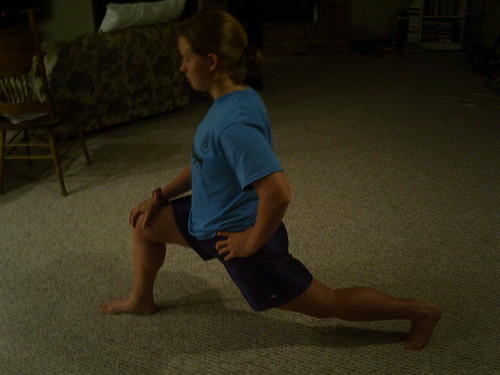
Stretch one leg back behind you, drop the knee, and tilt the top of the hips back (this is called a posterior pelvic tilt). Keep the chest lifted. Stand next to a wall if you need to hold on to something for balance. Variations: you can drop the back knee, continuing to maintain upright posture and a posterior pelvic tilt. In either position, you can lift your ipsilater (i.e. on the same side as the stretching hip) overhead and back behind you. That's a more advanced stretch, so be sure you can hold your balance before you try it. Hold that stretch 20-30 seconds 2-4 times on each side.
Pelvic Tilts
This is one of the safest and most basic abdominal exercises you can do. And I don't care if it looks too easy; it's going to be helpful for you, so do it even if you think it's too basic!
Begin by laying on your back, knees bent and feet 3-6 inches from your derriere. You'll need to keep your knees aligned with hips and feet, so if that's going to be hard for you, grab a yoga block (a thick paperback or two will also do the trick) and stick it between your legs. Squeeze together for a little bit of inner thigh work as well! Take a deep breath in, and direct the air into your stomach; make your stomach swell up with the air. As you exhale, force the air out of your stomach and keep tightening down (the rhythmic breathing is to make sure that you engage your deep abdominals). While holding your abs down (still exhaling), pull your hips towards you (posterior pelvic tilt, again) without lifting your bum from the ground. You should feel your low back press against the floor, but don't let your hips come up. On your next breath in, relax, then repeat. Do this 15-20 times, or for 30-60 seconds. Make sure you're engaging your abdominals with each repetition.
Bridge
This is the next step up from the pelvic tilts, and should activate your glutes and hamstrings along with the abs. Bonus? Do it right and you get a mild stretch through the hip flexors as well!
Start like you did with the pelvic tilts. You still need to keep your knees aligned, so keep using the block/books, if you need to. Also? Turn your toes in, a bit, so that you're pigeon-toed. Breathe in, fill the stomach with air. Breathe out, tilt the pelvis towards your chest, push through both heels at once, and lift your hips up into the air. Concentrate on squeezing your butt cheeks and pushing your knees forward (still holding them in alignment). Take a deep breath in at the top of the movement, and as you exhale press each vertebra deliberately into the ground. Repeat 6-12 times.
12 times feel too easy? Try these variations. At the top of your movement, take several deep breaths, focusing on filling your stomach with air on the inhale and tightening your abdominals down while pulling the pelvic floor up (tighten your sphincter muscles--the urethra and anus) on the exhale. You can put your feet on a bosu ("and the butt-ocks") or stability ball (and is it just me, or is that stability ball far too squishy?). You can lift one leg up (think of it as a continuation of the line of your body, i.e. don't lift it too high) and do a one-legged bridge (note that in the video the guy is lifting his leg too high) . . . Lots of options here, guys, if a plain old bridge seems too easy!
Back Extensor Stretch
First off, stop doing spinal extensions. Seriously. Stop it.
There are many stretches that will work to loosen up those erector spinae; most of them involve rounding the back like a cat. Here's my favorite one. Start in a standing position. Stretch both arms up overhead and cross one arm over the other. Flexing at the hips, knees, and back simultaneously, reach over and grab hold of your legs just above the knees (arms are still crossed). Anchor yourself there with your hands, then slowly extend the hips and knees. Allow the back to round. Do this stretch right, and you should feel it all the way up your spine, into your neck, even around the crown of your head and forehead. You might also feel the muscles across your thoracic spine and shoulder blades stretching. Hold for 20-30 seconds, then do the same thing with the arms switched. Repeat 2-3 times on each side.
Self Myofascial Release
Of the thoracolumbar fascia (hell yes, I just worked that into a blog post!). Too long to put it all in a heading. This is an above-and-beyond kind of exercise. If you have access to a foam roller, it'll probably help with the posture, and if nothing else it'll feel good.
But first, do you have lower back pain? If so, don't do this one. Too risky. Go back to stretching. If not, you may proceed.
Lay with the foam roller under your low back. Gently contract your abs to support your back. Roll slightly to one side, so that the foam roller isn't contacting your spine. Slowly roll yourself on the foam roller from the top of your hips to the base of your ribs. If you find a tight spot, pause there for 30-60 seconds. Look for those little spots, and hold yourself right on it; avoid rolling back and forth over those trigger points. Switch sides. Give yourself at least 5 minutes on each side; if it's too intense, switch back and forth, side to side. Try to relax into it a little more each time, but remember to keep the core lightly engaged to support your back.
But Why?
But Jamie, you say, this just occurred to me: you are a random person on the internet. It is entirely possible that you are full of shit. Why should I listen to what you say, let alone bother fixing my supposed excessive lumbar lordosis?
A fair point, my friend. And if you're concerned about following the advice of some random person on the internet, you can feel free to come in and see me at my gym. I will be happy to train you.
As to why you should bother with correcting your posture, the first is a structural concern. The excessive curvature of your spine indicates that the space between your lumbar vertebrae is decreased on the posterior side. Couple problems with this. First off, you're at increased risk of lower back injury, particularly when performing standing or lying hip flexion exercises, spinal flexion or stabilization movements, and weighted overhead activities. Additionally, if you have some pretty serious lordosis (the kind you see when female gymnasts finish their routines), the backs of your vertebrae--the facet joints--might actually be acting to support your spine. And they weren't designed for that; they were designed to sort of steer your spine. In short, you don't want those facet joints knocking together. And apparently (I didn't know this until I researched this article) if the facet joints get too close together, they can cause pain that is very similar to the pain or herniated discs, as well as sciatica; in fact, sciatic pain is more commonly caused by facet joints rubbing together than by bulging discs. So avoiding back pain is a pretty good reason to correct your posture.
For athletes, there's an additional incentive to improve posture, and therefore stability. Ever heard of the concept of energy leaks? The idea is that there are certain points where athletes lose energy. If you've got specific shoes for cycling, you've experienced what I'm talking about: the stiff soles of your cycling shoes allow you better power transfer to the pedals than the flexible soles of regular sneakers. Same idea with your body, whether you're running, swimming, throwing shot, or swinging a golf club. If you cannot use your muscles to maintain the structural integrity of your joints, you're going to lose some of the power that you could be delivering into propulsion at your extremities. I mean, you're going to lose some of the power anyway. But the more effectively--and, for endurance athletes, the longer--you can maintain appropriate biomechanics (in this case, posture), the better you'll perform as an athlete.
And I'd never really thought about it until I started researching this article, but this is a central concept for us triathletes. Possibly one of the most central concepts. Think about it: because we do three different sports, the one commonality between everything we do is posture. Everything comes back to that basic ability to keep your body functioning properly, and it happens from the core out.
It's for that reason that I intend to make my next installment in the "Stop Slouching!" series about spinal stability. It's a big project. It'll take a while. It'll take a lot of research. It may take multiple posts. But if we, as athletes, can nail the spinal and core strength and stability, we will all get much, much faster and be safer while we're doing it.
Other "Stop Slouching!" Articles
Lumbo-pelvic Stretches
Pronation
Kyphosis
Winged Scapula (and the MOVIE!)
Resources
http://www.pediatric-orthopedics.com/Treatments/Kyphosis_Lordosis/Lordosis/lordosis.html
http://www.ptonthenet.com/articleprint.aspx?ArticleID=2499&m=91418
http://www.exrx.net/Kinesiology/Posture.html
http://www.ptonthenet.com/displayarticle.aspx?ArticleID=3075
Showing posts with label posture. Show all posts
Monday, October 20, 2008
Sunday, August 3, 2008
"Stop Slouching!": Pronation
I never used to pay attention to articles about pronation. Why? Because I didn't think I overpronate (but those are my feet up there). In fact, I tend to walk on the blades of my feet. Which made me think that I supinate. But there's more to pronation than just the way your ankles tilt, or whether your toes turn in or out (mine turn in). Additionally, I have some clients who are guilty of absolutely criminal pronation. So I've had to do a lot of research to figure out pronation, why it's bad, and what (if anything) we can do to correct it. I'm pretty excited about writing this article, and I hope it's helpful.
Diagnosis
You probably recognize pronation, even if you don't realize it. Pronation, which is also sometimes called being flat-footed (although they're two separate phenomena, if you ask me), refers to the inward, medial rotation of the foot at the ankle. The main symptom is an arch that collapses as you put weight on your foot. Here's a video to watch (and I'm sorry if you don't like feet).
Note how the arch collapses and the ankle rolls in. Gross, yeah? To see if you overpronate, check to see if the arch is collapsed (or possibly non-existent), if the inside edge of your foot bulges when you're standing relaxed, or if your ankles noticeably roll in as you put weight on them.
Neutral Foot Position
Pronation/overpronation and supination/underpronation are both caused by an ankle that cannot retain neutral position. So in order to correct any functional over- or underpronation, you have to learn how your foot is supposed to sit, and how that's supposed to feel. I've found two practical ways to do this--one with a trainer or coach (or partner or training buddy), the other alone.
Here's the first, taken from a great article by Justin Price on ptonthenet about overpronation:
There are two small indentations at the base of the ankle just below the ankle joint. Place your thumb on the dimple on the inside of the ankle and your forefinger on the dimple on the outside (see Figure 4). Ask your client to roll her foot and ankle inward (overpronate). You will feel pressure on your thumb. Ask her to roll outward (oversupinate), and you will feel pressure on your forefinger. This pressure is the talus bone moving in the ankle. Coach your client to pronate and supinate until you feel even pressure of the talus bone on both your thumb and forefinger. This is the anatomical neutral position for the foot and ankle. Most people will have to supinate to get to neutral from their dysfunctional overpronated position.This method is useful because it's more absolute, more technical. So if you're the typical Type A triathlete, this is the method for you, although you'll need another person's assistance to work it out.
The second method is much more intuitive, and I've derived it from yoga. Stand in Tadasana (Mountain Pose). Make sure your weight is evenly distributed through the three main points of contact between your feet and the floor (heel, joint of the big toe, joint of the little toe, i.e. first and fifth metatarsal). Once you're in a proper Mountain Pose (and if you don't know how to do this, shame on you! go to yoga!), lift your toes. You should feel your arches lift. Now lower your toes, but don't let your arches fall. If you're like me, you'll feel the muscles in your lower legs--really, like all of them--engage, and just standing like that will be exhausting. At this point, you should feel like the muscles underneath the plantar fascia on your feet are engaged, the weight is evenly distributed betwen the three points of the foot, and you have three natural arches (forming a triangle on each of your feet).
How to Fix it
You might notice that I strongly advocate the practice of yoga for strengthening the arches. It's a great place to start.
But what if you lack the time and money to attend yet another class every week (preferably multiple times a week)? After all, not everyone works at a gym!
Try these simple exercises to strengthen your foot muscles, relax your flantar fascia, and become a better person.
Golf Ball Roll
Exactly what it sounds like. You've used a foam roller before? Same idea here. You're using the golf ball to perform self myofascial release (your own personal deep-tissue massage!) on the plantar fascia in your foot. Roll the golf ball under each foot for 30-60 seconds, stopping on any painful places. As you do this, perform an active stretch of the muscles underneath the fascia by pulling your toes up towards your shins.
Big Toe Pushdowns
Stand with your foot in neutral position (see above). Push down through your big toe without allowing the ankle to roll in or the arch to collapse. Start by holding that for 5 seconds, 10 times on each side (or do both sides at once). As you get stronger, hold the toe down for longer stretches and fewer repetitions. You'll start to feel that muscle (flexor hallicus) contract under the arch of the foot. As it gets stronger, you'll be able to consciously engage that muscle whenever you're doing a weight bearing exercise.
Calf Stretch w/ Tibialis Anterior Activation
You've probably done this stretch plenty before, but this time you're going to do it with a neutral foot position, while pulling your toes up. One foot forward, one foot back. Press the heel of the back foot into the floor behind you. But don't let your ankle roll in, mkay? That kind of defeats the point. Pull the toes of the back foot up toward your shin. And hold. Feels nice, right? The other trainers and I always joke about how we love being stretched out. Until someone tries to stretch our calves. At which point we want to kill somebody. Hold for 30 seconds on each side, repeat 3-5 times.
Pronation and Yoga
Yoga is always practiced barefoot. The book I've been reading recently (Yoga Anatomy) connects the three natural arches of the foot to the muscle lock Uddiyanabandha, in which you pull your deep abdominals in and up. So I recommend doing some yoga practice to help your feet. Not only is it a great option for increasing flexibility and preventing injury, it's going to improve your biomechanics. And I speak absolutely 100% from experience. Do it; it helps; and it's a lot more fun to take a yoga class than to add a 1-hour stretching workout to your weekly routine (on top of swimming, biking, running, nutrition, weights . . .)
In addition, practice a mild Uddiyanabandha when you're running, walking, going up stairs, even when you're cycling. If nothing else, making the connection between arch and abs forces you to bring your mind back to what your feet are doing. And you can't go wrong with being more mindful in your running and cycling.
Why it Matters
Ankles, hips, and knees are all intimately related. If one of those joints is out of line, the others are going to suffer. That means that when you overpronate (or underpronate, for that matter), your hips and knees are going to feel the effects as well.
Pronation can also affect your performance in the bike, although the effects tend to take longer to appear. I attribute my achilles tendinitis to the excessive overpronation of my right foot. With each pedal stroke--every time I put weight on my right foot--the arch rolls in, which takes my ankle out of alignment, putting excessive strain on my achilles tendon. Note that this problem can also be caused by having bike shoes that don't fit properly, or by excessive amounts of rock in your shoe/cleat/pedal fit (especially with Speedplay).
Also? Plantar fasciitis. Bunions. Shin splints. IT band pain. Are those not enough reasons for you to do something about this problem?
Conclusion
A couple weeks ago at my local run shop, I asked the proprietor if there are exercises you can do to correct overpronation. He said no; in his mind, the only option is motion-control shoes and, if those don't work, orthotics. Based on the research I've done, I strongly disagree, with one caveat. In my mind, there are two kinds of pronation: structural (i.e. bones, tendons, ligaments) and functional (i.e. muscles and laziness). Some people are born with flat feet, and they will always need corrective aids to avoid overpronation. Most of us, however, are overpronators by circumstance. Our feet have evolved to move us (barefoot) over uneven ground. Instead, we stick our feet in shoes and push them around pavement. No wonder they don't know what the hell they're doing.
My biggest recommendation to you overpronators (and, consequently, to myself) is to get outside and play barefoot. Teach those muscles under your plantar fascia how to function again! Do some barefoot trail running. Run around the lawn barefoot with your kids. Heck, maybe even try a barefoot marathon
Price, Justin. "Corrective Exercise - Part 1: The Foot, Ankle and Knee." PTonthenet, 19 May 2008. http://www.ptonthenet.com/displayarticle.aspx?ArticleID=3043
Saturday, June 28, 2008
"Stop Slouching!": Winged Scapula
Winged scapula is a common biomechanical deficiency which is caused by two things: short (tight) pectoralis minor and long (weak) serratus anterior/lower trapezius. In severe cases, it looks like a person's shoulder blades are poking up out his or her back. I saw one guy on the bike course at Lawrence 70.3 who made me cringe, his scapulae were so poky. But in a less severe case, the condition will show itself if you push hard against a wall with palms flat at waist level (not sure on the biomechanics of why this is the case, beyond the fact that this movement should use the serratus anterior and if they're weak it'll show up here). One of the other trainers at my gym did this once and completely grossed me out. He looked like a frickin' gargoyle.So why should you care that your shoulder blades stick out like a pterodactyl's? First off, it destabilizes your shoulders. The shoulder is a pretty intricate area, and little things that might seem small (like an imbalance in the muscle that holds the shoulder blade against the ribs) can really FUBAR the joint in a dozen years or two. Injury is the first and primary concern with any imbalance I bring up.
But in a more immediate sense, it can also impede your performance; not like having no shoulders in twenty years isn't going to impede your performance (yeah, I have some athletes you might wanna ask about that . . .) The serratus anterior is a muscle you need for swimming, especially if you want to get that nice Serape Effect rotation going. Besides which, it's totally common for winging scapulae to go along with a protracted shoulder girdle, which probably means your rhomboids are weak too. And guess what other muscles operate in that Serape Effect thing. That's right . . .
What do you do about winging scapula? Here are some exercises and stretches that will probably help you (unless your problem arises from an impinged nerve in your neck/traps, but in that case you'd probably only have one wing).
Incline Shoulder Raise
Lie on your back at a slight incline. If you're at a gym you can use an incline bench. Otherwise, you can lean against a stability ball. Hold dumbbells (always start light!) in hands with arms extended. Your hands should be positioned directly above your shoulders. Now without bending your elbows, raise your hands; the movement should come from scapular protraction (pulling your shoulder blades apart). You can also add this exercise onto the end of a bench press--that is, protract your shoulder blades at the top of your bench press, using your serratus anterior to extend your range of motion. Although if you have winged scapula, you probably shouldn't be spending a lot of time on bench press; your pecs are too strong, remember?
Standing (Dumbbell) Scaption
Don't start with dumbbells. This is not an exercise that you use to pack meat onto your deltoids. This exercise is not intended to give you a good cut. It primarily strengthens the supraspinatus, which has got to be one of the most exposed and vulnerable muscles in your body. So do yourself a favor and take it easy when you begin this exercise.
Stand in a stable position, hands at your sides, thumbs facing forward (palms turned towards your body). Make sure your shoulders are back and down, your chest is lifted, and your back is in a neutral position. The movement is halfway between a front raise and a lateral raise. Raise both arms to the front and sides at about a 45 degree angle, simultaneously rotating your thumbs to face behind you (palms still rotated medially). Combination flexion, abduction, and external rotation! Whee!
Supine PNF Patterns on Ball
Lie with a stability ball under your shoulders and upper back, thumb of your right hand on your left thigh. Lift your arm up and over your head, rotating your thumb to face down. Similar to the above movement, except the movement is diagonal and you're reclining.
Isometric Wall Press
Stand about two feet from a fall. Raise your arms to roughly shoulder level and place them on the wall. Make sure shoulders are back and down, chest is lifted, back is neutral. Press into the wall by protracting the shoulders (not by leaning forward!) and hold. This is an isometric contraction for the serratus anterior.
Doorway Modified Chest Stretch
Stand next to a doorway or wall of some sort. Bend the shoulder and elbow and place the the forearm against the wall. Lean into the wall slightly and turn the body away from your arm. You should feel the stretch in your upper chest and arm. This is to stretch the pectoralis minor.
Cobra
During this yoga pose, focus on lifting yourself with your back extensors, rather than pushing yourself up with your arms. Keep the shoulders back and down, the shoulder blades retracted, and the chest broad and lifted. Stretch long through the spine and then try to pull the breastbone away from the hips. Yoga poses are really too complex for me to adequately explain in this manner; follow the link for a more complete set of directions. Or--even better--go to a yoga class and have an actual yoga instructor help you! You should be going to yoga anyway.
Downward Facing Dog
Same note as above; I can't adequately explain a yoga pose in this blog. Partly because it's too complex, but partly because I'm not qualified. I can tell you that one of the many, many benefits of this posture is that it causes a continuous eccentric contraction in the serratus anterior, as long as you remember to keep your shoulders broad and low. Follow the link (or your yoga instructor's instructions) for more help than I've given you!
I should mention at this point that my scapula wing. You can't tell just by looking (they're not that bad), but if I do the wall test, you can definitely see my wings ("Every time the dumbbells clank, a bodybuilder gets his wings!"). So these are exercises and stretches that I do on a regular basis. And Downard Facing Dog is very difficult for me in yoga class, because my serratus anterior doesn't much care to hold an eccentric contraction for very long.
I really hope that these exercises provide useful material for your weight training programs, and help prevent injury and enhance performance. If you have particular questions or suggestions for this series, sound off in the comments or send me an e-mail!
Note: Videos for the exercises can be found here.
Subscribe to:
Posts (Atom)

