Got a box in the mail from Skinny & Co. last week. When I opened it up, here's what I found:
I'll be using the products this week. Look for my review next Friday!
Showing posts with label nutrition. Show all posts
Showing posts with label nutrition. Show all posts
Wednesday, August 10, 2016
Wednesday, October 22, 2014
Eating for Success
My roommate and I have both felt a little . . . weighed down, so to speak. Before we moved to Virginia in May, we were both working low-wage jobs where high-calorie food was readily available. I ate a few too many hot dogs and taquitos, and she ate a few too many comped meals (not to mention cheesecake slices). We'd been making much healthier decisions since moving, but we were maintaining weight when we really needed to lose some.
We'd been kicking around the idea of trying a stricter eating routine for a short duration, like six weeks. We decided to take the two months until Thanksgiving to lose as much weight as we can. Primarily, we agreed to swap out a starch at dinner (I normally cook a tried-and-true combo of protein, starch, and vegetable) for a second vegetable, and choose leaner meats. We minimized processed grain options (including breads, crackers, and other flour-based foods), and tried to cut out industrialized foods as much as possible (although Emily does still take Weight Watchers frozen meals to work for lunch, sometimes). We also allow ourselves one "splurge" day per week, every Saturday. Normally, Saturdays involve pizza delivery, diet soda, and beer. There may have been a trip to On the Border, as well.
So far, the plan has been very successful! In the past three weeks, I lost three pounds and Emily lost seven. This past week has represented a departure from the plan, however; I think we're both getting a little burned out. PMS may also play a role. We've decided to have a recovery week every fourth week. We don't eat whatever we want, by any means, but we have eaten more, and we bought a loaf of bread the other night. We'll see if this week undoes what we've accomplished in the past month of hard work.
The biggest challenge for me is in balancing my calorie expenditure with my calorie intake. Especially during the first two weeks, I'd eat about the same number of calories on really heavy workout days (i.e. teaching cycling, lifting weights, and a hilly run) as on easy days (i.e. just teaching yoga). I felt weak and tired and unmotivated for a few days, until I remembered that I have to cut caloric intake in relation to my exercise level. Since then, I've felt fine.
Monday, May 20, 2013
Eating From the Field: Benefits of Pasture-Raised Chicken

Our main product here on Prairie Om Farm is pastured chicken, although I also raise grass-fed lamb and am getting some pigs for pastured pork this summer. If you're a health-conscious eater, you've probably already read many reasons why pastured meat products are better for you. But if you haven't been exposed to this information yet, I'll try to provide a little information on the subject.
First off, "pastured poultry" is different from organic, free range, or cage free.
- Organic chickens are raised on organic feed (the grains and supplements that make up their feed have been grown organically without pesticides, irradiation, sewage sludge, synthetic fertilizers, or genetically-modified organisms/GMOs), are never given hormones or antibiotics, and are provided access to the outdoors. Organic chickens are good. But, although they have access to the outdoors, they may not ever venture outside; they still eat a grain-based ration almost exclusively; and they can still be housed in over-crowded intensive production facilities.
- Free-range chickens are chickens who are raised with access to the outdoors. Again, this doesn't necessarily mean that the chickens go outside; it means only that they could if they wanted to. Free-range chickens are still raised in houses, and their outdoor access is usually limited to a small yard. Because of the nature of chicken poop, even if their ranging yard begins as verdant pasture, it soon turns into a hard clay surface. Free-range chickens still derive all of their nutrition from a grain-based ration; they can still be housed in over-crowded facilities; and you don't have the guarantee that they've been fed organic or non-GMO feed, or are antibiotic and growth-hormone free. Still better than Tyson chickens, though.
- Cage-free eggs are produced by hens who are not confined to cages. That means they can engage in many natural chicken behaviors. Again, it's better than your standard grocery store eggs. But cage-free chickens aren't necessarily given access to the outdoors; they're still usually overcrowded in large production facilities; de-beaking is allowed (that's where producers cut off the beaks to prevent chickens from cannibalizing each other due to over-crowding and stress); and there's no third-party auditing system to ascertain how the animals are being treated.
Pastured poultry producers are usually small farmers raising relatively small numbers of birds (20,000 is the upper limit for exemption from USDA on-farm inspection); our farm raises less than 1,000 per year. Chickens who are raised on pasture have constant access to fresh grass. Joel Salatin of Polyface Farm, one of the the big kahunas of pastured poultry, moves his "chicken tractors" daily; we move ours as often as we need to keep them on fresh, poop-free grass (by the end of the production cycle, 2-3 times per day). In addition to eating a grain-based ration, pastured chickens eat grass, bugs, worms, snakes, frogs, and whatever else they can get their hands on. Because they're not overcrowded, they're not overstressed. And because they're not wallowing in their own feces, we end up with a much cleaner end product. Pastured poultry is very good.
But don't get me wrong; there are potential downsides to pastured poultry. First off, there's no official labeling or oversight of the term "pastured," whereas the terms "organic" and "free-range" are regulated by the federal government (at least in America). As a result, there are no regulations on what kind of feed may be used; some producers I know use only certified organic, we use certified non-GMO, and still others use standard commodity rations. And there's always the possibility that your farmer might be cutting corners, that his or her feed might not be up to snuff, that he or she is not taking good care of the birds. However, the other side of the coin is that most producers are small scale enough that you can go and check them out for yourself. In other words, this liability is only a downside if you're unwilling to make the effort to know the person who's making your food.
That's one way in which eating pastured meats is more costly--you have to put more time and effort into obtaining it. One of the other costs, of course, can be measured in dollar signs. Pastured chicken is more expensive, but I can tell you exactly why. First, there's the grain. We feed non-GMO grain, and it's about twice the cost of conventional grain. That's because farmers can't grow as much corn per bushel using traditional production methods as they can using the technologically advanced, biologically engineered versions produced by Monsanto. That means a lower return on their time and effort, from their land, seed, and fuel, so they have to charge more money. Feed costs are by far the greatest factor in setting our prices. There's also the fact that we are smaller-scale producers, and we can't get grain or even the baby chicks for the same price as vertically-integrated, large-scale producers. The labor plays a part, too, especially once it comes time to process the birds. It takes a lot of experienced hands to butcher chickens in a way that we believe is ethical, respectful, and clean (we have a group of Amish women who help us out, and we pay them well for it). All the costs add up, and contribute to a more expensive final product.
Those are the costs of pastured poultry; let me break down some of the benefits for you:
- Pastured chickens are cleaner. There's less poop on their feathers, less poop on their skin, less poop on their feet, less poop in their intestines. At standard, USDA-inspected facilities, the poop on skin, feathers, and feet comes off in the scalding water and chill tanks and gets re-absorbed into the chicken meat. Gross.
- Pastured chickens have better taste and texture. They move around and get more exercise than confinement house chickens, so they have better muscle tone. That contributes to a more chicken-y flavor and firmer, meatier texture.
- Pastured chickens have higher omega-3 fatty acid content, lower fat and saturated fat levels, and higher levels of essential vitamins and minerals (notably vitamins A and E).
- Pastured chickens are never fed arsenic as an appetite stimulant or preventative antibiotic.
- Pasturing chickens puts vital nutrients into the ground as all-natural fertilizer in small amounts that can be readily absorbed by the soil.
- Purchasing pastured chicken helps your local agricultural community, and farmers like me!
If you live in Missouri and would like some pastured chicken, please contact me! You can reach me by e-mail (jamielynnmorton@gmail.com) or by phone (316.841.6593). I make regular deliveries to Kansas City, Liberty, Independence, Cameron, Kirksville, Columbia, and Jamesport (where I live). If you live on the Kansas side of Kansas City and don't feel like driving to the Missouri side to pick up chickens, I can hook you up with some farmers on the Kansas side. If you live near Wichita, Kansas, I can recommend a farmer down there, as well.
Remember, as athletes, food is our fuel. Better food equals better fuel, and better fuel means better performance!
Wednesday, February 25, 2009
Why I Hate the Girl Scouts

Let's ignore, for a moment, my bad experiences with the Girl Scouts. Let's pretend that my troop leader's daughter was not an overachieving twit who always sold like a thousand boxes of cookies. I'll set aside the fact that said troop leader liked to publicly compare our relative achievements. ("Oh, looks like Jamie only sold 199 boxes of cookies; not quite enough to get [whatever the hell prize 200 boxes of cookies entitled you to]. Too bad.") And we can totally forget the fact that my dad was into camping and we did way more fun/cool stuff (camping! shooting GUNS!) as a family than I ever did in stupid scouts.
Why I really hate Girl Scouts is that every February, when I'm feeling down and draggy and really, really ready for spring, those damn be-sashed young women come bearing the comfort food of all comfort foods.
Those bitches bring cookies.
And between my pig-out on Oscar night (cheese! crackers! cosmopolitans!) and the boxes and boxes of cookies at my house (I got six, my brother got six, my parents each got four), I am going to gain back the five pounds I've lost in the last four weeks.
I'm off to the 24-hour Walmart to buy a padlock for the frickin' freezer.
Friday, January 9, 2009
Recipe File: No, really

It's a good thing I made a smart-ass recipe last time, because I have no idea what I would name this post otherwise.
This meal came about after I grabbed a can of tuna, looked in the refrigerator, and found that the mayonnaise we have at my house has high fructose corn syrup in it. Seriously. Why the hell does mayonnaise need high fructose corn syrup? It's not supposed to be sweet!
Anyway, tuna salad was out. So I thought back to the last time I made fresh tuna (which was during March Madness last year), and came up with this little recipe inspired by the sesame/ginger glaze I made for that. This wasn't as good as fresh, pan-seared tuna, but it was still pretty tasty, especially after I wrapped it in lettuce.
1 can of tuna
about 1/4 cup of sweet onion, diced
4-5 radishes, sliced
1-2 tbsp teriyaki sauce (read the label; you might find high fructose corn syrup in it, as well)
salt, pepper, and ginger to taste
4-5 leaves of iceberg lettuce
Heat a (very) small amount of oil in a pan or wok. When the oil's hot enough to run quickly around the pan, throw in the onions, stirring constantly (you want them to caramelize, but not burn). As the onions start to turn brown, add the radishes. Cook just until the radishes start to turn translucent around the edges, then add the tuna. Splash in some teriyaki sauce, ginger, and salt and pepper. Taste, and add seasoning if you need it. You only need to cook it long enough to heat the tuna, and you don't want to overcook it and end up with mushy radishes. Spoon the tuna stuff onto lettuce leaves (iceberg works best for wrapping, in my opinion), and eat as lettuce wraps. Without the lettuce, it ends up a little dry, but as a wrap, it's just right.
Let me know if you try it and come up with any variations (i.e. different spices). My next project (I think) is going to be a green tea protein shake. I'll let you know how that goes.
Wednesday, October 22, 2008
Recipe File: Buffalo Chili

I love this chili. It's adapted from a recipe I found in Men's Health. The taste is fresh and lean, and benefits greatly from sour cream, parmesan cheese, or corn chips. And I'm sure that crackers would also be delicious (if predictable).
Ingredients
3 Tbsp olive oil
1 lb ground buffalo chuck (or any ground/chopped game you have around. My family usually has some elk in the freezer. Rabbit would be nice. Beef is acceptable, but be sure it's grass-fed and organic, or else the flavor won't be sufficiently strong.)
1 jalapeño, seeded and diced
1 Poblano pepper, seeded and diced
1 serrano chili, seeded and diced (leave the seeds in if you want an extra kick!)
1 yellow onion, diced
3 garlic cloves, minced
1 green bell pepper, diced
1 big can (28 oz) of diced tomatoes (watch out for unnatural gunk in the ingredients list, and buy organic if you can. Or, even better, use fresh ones!)
1 can (8 oz) tomato sauce (again, be sure to check the ingredients)
2 cups beef stock (good luck finding all natural. Make your own if it concerns you.)
3 Tbsp chopped cilantro (I used dried, and it turned out okay. But I'm sure fresh would have been much better)
1 Tbsp paprika
2 tsp crushed cumin seeds
1 cup cooked black beans
Salt and pepper to taste
Coat a heavy skillet with the oil and heat it on medium-high. Cook the buffalo until it's brown. Add the jalapeños, onion, garlic, and bell pepper. Cook over medium until the onions turn translucent. Add the tomato sauce, beef stock, tomatillos, cilantro, paprika, and cumin. Boil. Then simmer for 1½ hours. Add beans. Season with salt and pepper. Serves 6
These directions are the basic version, for those of you who aren't fortunate enough to (have parents who) own a crockpot. If you are so blessed as to have one of these ingenious devices, brown the meat in oil. When it's mostly cooked, add the peppers, garlic, and onion. After the onions turn translucent, dump all remaining ingredients with the meat mixture into the crockpot. Cover, turn on, go to work, and come home to the delicious smells of chili in your home. Particularly satisfying if it's cold outside.
Wednesday, September 24, 2008
Recipe File: Chicken Cacciatore (sort of)
Really, this dish could be chicken or tofu or beef or swordfish or human elk or any other meat protein you have lying around. As with most of my recipes, this one is simple to a fault, and probably something you could make right now (unless you're reading this at work, and if you are, way to stick it to The Man).
*Your protein here* Cacciatore
2 cans of stewed tomatoes (remember to check the ingredients for added sugars!)
1 green bell pepper
About a cup of chopped mushrooms
About half a cup of onion
About 3 cloves garlic (totally optional)
About 2 tbsp olive oil
Oregano, pepper, salt, and tarragon to taste
Your favorite pasta
Be sure to use a saucepan with a lid for this one. Saute onions and garlic, if you're using it, in some olive oil. Cook those until they're translucent (about 5 minutes), and don't let them burn! Add in the green bell pepper and mushrooms, and cook them for a couple minutes, until the mushrooms start to brown and soften. At this point, add in your protein. Whatever you're using, you can pretty much just throw it in there, as you're going to be letting this thing cook for a long frickin' time. When all the ingredients are having a nice little party in the pan, cover it, turn the heat down to a simmer, and let it sit for 45 minutes to an hour. The longer it sits, the better it tastes. Serve it over your favorite pasta; bowties work really well with this.
You can sneak in all kinds of veggies to this one. So far I've only tried green bell pepper and mushrooms, because that's what I had around at the time. But I think spinach would be good, maybe zucchinni and yellow squash, some carrots, maybe some potatoes . . . Have fun with it. Keep in mind, though, that not all flavors are going to mesh with the cacciatore theme. For example, cucumbers? No, I wouldn't go there, if I were you. Additionally, some veggies aren't going to work well together. I wouldn't do spinach, zucchinni, and carrots all at once. If in doubt (i.e. if you have no intuition for this kind of creative cooking), comment or e-mail me and we'll discuss harmonious veggie combinations. Or you can just try it and never do it again if it ends up tasting like ass.
Also, this is a great dish for crockpot cooking. Saute the oil, garlic, and onions along with your protein to get the flavors going. Then dump everything into your slow-cooker/crockpot and let it sit there while you're at work (or on your long bike ride, maybe). When you get home, you'll be greated with delicious and nutricious smells, and the only thing you'll have still to do will be cook your pasta. And if you're like me, you probably have leftover somewhere in the refridgerator, anyway.
Try the food, guys. Let me know what you think.
Brief and unrelated note: I've got a lot of stuff in the works, but everything's taking way too long to get up on the site. I'm currently working on a couple of installments of the "Stop Slouching" series, I have a new series coming up (tentatively titled "The Dumbass Chronicles"), I have a video installment of Runner's High which will (cross your fingers) be up tomorrow, and I'm working on a fresh spinning podcast. Thanks for sticking with me while I've suffered through burnout, guys. It means a ton to me.
Friday, September 12, 2008
A Part of the World
As you may remember, I've just finished reading this book, and have been thinking constantly about what it means to live as part of the world, rather than in opposition to and dominion over it. My conclusion? Big, big, big changes are required. Perhaps too big for me to handle. Perhaps too big for the world to handle.
In these kinds of circumstances, I find it's best to make changes that are small, personal, and immediate. Is the world worth saving? And can it even be done? Hmm . . . jury's still out on that one (at least for me). But I do know that I can live slightly closer to being part of the world, and so can you. Here are three ways how:
Biomechanics
It came up in the pronation article. Whether you believe we evolved or were created, it's clear that our bodies were designed for a specific purpose. That purpose does not include wearing high heels or walking on concrete. Pavement and shoes separate us from the earth. Walking barefoot and working against the degeneration caused by not walking barefoot brings you that much closer to the original design. Pattern. Whatever. And that works in other parts of the body, as well. Strive for balance and stability in your body.
Appearance
As I mentioned before, I think that when you start to see your body as the enemy, as something that needs to be slimmed down (which basically means you need to eliminate part of it), you're falling into a trap of conquering your body. And guess what! If you win the battle against your body, you also lose. But the same is true of bodies that are, how shall I say, facing the opposite problem. Your body was meant to be lean and muscular, to a certain extent, because that's what hunting and gathering does to you. So instead of focusing on weight loss or gain, perhaps we should be looking at overall health. Not "skinny"--healthy.
Eating
Which brings me to the final point. Know something? Our bodies were not made to handle high fructose corn syrup. In fact, they weren't made to handle a lot of the things we put in them. So stop putting that shit in, already. Eat clean. I suppose you could argue that the way we're meant to eat is raw and vegetarian, but I disagree. The whole premise here is that we live and eat by the laws of nature, and one of those laws is to eat what you can find. You hunt. You gather. Sometimes there's slim hunting and you have to gather a little bit more to get fed. Sometimes there's slim gathering and you have to eat a lot of meat. Either way, my personal opinion is that we're designed to eat both, so I eat both. Besides, I was a raw vegan for a few weeks. Definitely wasn't working for me.
So that's the short version. If you believe that we have a responsibility to adjust the course of civilization, you now have three ideas of how to do it in your life. Small-scale. But these are just notions, right now. So over the next few weeks, I'll be digging more deeply into the practicals--how do we make these changes? What can be different in my life? And why does it matter?
Not sure, yet. I'm thinking about it. I'll let you know.
Friday, June 20, 2008
Vitamin B Fact Sheet
This is something new I'm trying: writing and publishing articles through Triond, in addition to this blog. I chose to publish this particular article elsewhere because it's not entirely relevant to
endurance athletes (although it's probably helpful).
I enjoyed learning about the B complex vitamins and what they do. I had no idea that they were so relevant to me personally. I've always been kind of confused about all those various letters and numbers.
A quick disclaimer: I'm not a dietitian. I'm not even a nutritionist. I can't prescribe. I can't even really suggest, other than to say very basic things like fast food is bad for you. I'm professionally obligated (and rightly so) to make you aware of that fact. The stuff I'm writing about Vitamin B is mostly from online sources, which means that you are every bit as capable as I am of coming up with this information.
And now that I've adequately disclaimed, let me say this: B vitamins--particularly B6 and B12--are one of a handful of supplements that I would consider taking (calcium, iron, and protein are the others). This is because it's difficult for me to get B12 and B6, which are found most plentifully in animal protein, in my normal diet, and I don't want to risk a deficiency in these important nutrients. However, for the most part, I strongly dislike the idea of taking pills instead of eating healthy food. I know that for some people it's necessary (or at least habitual). Definitely not judging anyone for taking vitamins. But I prefer to get my nutrients from real food.
Anyway, enough about nutrition (since I'm not even qualified to give advice in this area). Here's the link to the collected facts (as I've interpreted them, anyway).
Thursday, April 10, 2008
The Triathlete's Non-Sand Cookbook
Props to SpeedRacer for her recent foray into a thriving lifestyle. Like (I would estimate) many triathletes, Speedy would be totally willing to eat sand (or at least food that tastes like sand) for the next ten years if it meant she could be competitive, like really competitive (actually, come to think of it, how competitive, Speedy? Like qualifying for Kona competitive or like qualifying for the Olympics competitive?).
But Speedy is a much better person than I am. I would much rather not eat sand and be slow. But I think it's because I believe that it's possible to have the best of both worlds--that is, you can eat well for your body while still enjoying your food. To be sure, this attitude takes some readjustment of your taste buds. Personally, I can have a great time with a bowl of brown rice and some steamed vegetables without even salt and pepper. But I know that not everyone has such a highly developed palette (read: boring taste buds), so I submit a few of my favorites for your non-sandy dining pleasure.
For breakfast, I mix plain yogurt (if you get vanilla or some other flavor, check the ingredients for nasty additives like high fructose corn syrup) with a handful of berries (I currently have fresh blue and black) and a handful of nuts (currently almonds). The berries lend sweetness, the almonds add crunch. The yogurt is an awesome source of complete protein (sorry, vegans) and vitamin B12 (very important for athletes!). Bonus is that it's very filling.
My new favorite thing to take for lunch is a tomato soup (actually, it's kind of like gazpacho, now that I think about it) I make by combining one can of tomatoes (the kind that are pre-seasoned, either with Mexican or Italian seasonings) with whatever frozen vegetables I have around. I cook it until it's hot and the vegetables are cooked, then eat it. It's a great way to get a ton of vegetables, and it tastes awesome. You don't have to add any additional spices, either.
I also really enjoy making wasabi peas by microwaving some frozen peas then mixing in some wasabi and soy sauce. Delicious. I obviously use quite a lot of frozen vegetables. Not raw, sorry; if I'm going to go raw for lunch, I just eat a salad. Always keep ingredients for a salad around. Quicker and easier and more healthful even than whole grains.
I can't think of anything quick and easy that I do for dinner (by the time I get home from work, it doesn't make sense for me to eat a full meal, anyway), but I'll give you a quick recipe for a snack: green smoothie. Mix whatever fruit you have around in a blender (this morning I used an orange and a handful of frozen strawberries), adding enough water to get your preferred consistency. Then throw in 1/2 cup to a cup of leafy greens--I prefer spinach or romaine lettuce; Kale tastes funny to me. The color will be unpleasant, to say the least. Also, be very sure to add enough water to thin it out; otherwise you will want to vomit with every sip. Bonus points for adding superfood powders like spirulina, chlorella, maca, etc. (this morning I used some hemp protein powder). The key for the smoothie is to start with a good base of fruit that you'll enjoy.
For more ideas for healthy, quick, and easy recipes, check out Ben Greenfield's article on Trifuel. Those are all great ideas as well. Sound off with your favorite quick, easy, and nutritious recipes in the comments.
Sunday, February 24, 2008
RAW: Days 6 and 7
Yesterday was race day. I ate mostly raw, but scarfed up whatever was on hand, right after (oranges, bananas, granola bars, gatorade) and celebrated by having a nice (COOKED!) dinner with my dad. Race report to follow.
Today is not going well. I am sick of eating frickin' leafy greens, but trying to stay away from too much dried fruit to avoid the simple sugars. I'm currently munching on mushrooms. Furthermore, I feel hostile towards the entire raw community. I've been surfing message boards, reading chirpy posts, and wanting to punch all those raw food nuts in the face. Not so much enjoying this lifestyle, at the moment.
Finally, I've been trying to find some solid evidence on the benefits of a living food diet. I know the basic theory: heating food above 118 F for longer than 3 minutes denatures the protein, caramelizes the sugar, and destroys the enzymes that are built into the food to help it be digested. But I would like to see some data on the actual science behind this. Every article I've found on line strikes me as a knee-jerk, defensive, propagandistic, and even fanatical. I get that this is something people really believe in; maybe it's something I could believe in. I've even found a few good articles, and I think, "Okay, I can buy that . . . but if you have studies, show me references." Because I don't want to be preached at; I want some facts.
I hope things start looking up in the next 3 weeks, because at this rate, I'm never going to want to eat raw veg again!
Friday, February 22, 2008
RAW: Days 4 and 5
I can tell you, the amount of fiber in my body currently is really intense . . .
I feel sorry for whoever might be so unfortunate as to end up behind me at any point during the YMCA Central indoor tri tomorrow . . . because they're in for a stinky ride.
This raw thing comes in phases . . . sometimes it seems ridiculously hard, other times it's a breeze. For dinner tonight, I made some raw hummus using sprouted chick peas, and it tasted really good! Besides which, the friction from processing it in my food processor warmed it nicely. And I haven't had warm food in a while.
One of the most interesting parts about this whole process is wondering where I'm going to land: will I be so full of energy and healthy by the end of the month that I'll never want to go back to cooked foods? Will I be so sick of frickin' fruits and veggies that I'll cook everything forever, until all semblance of nutritional value is gone from whatever I eat? I'm betting that I'll end up halfway in between--glad to have had the experience, but ready to incorporate cooked foods (BREAD!) back into my diet. I could see myself being about 50% raw.
But it's thrilling, not knowing where I'll come down at the end of this experiment.
Wednesday, February 20, 2008
RAW: Days 2 and 3
Prompted by dinner with my grandmother last night (she's half-deaf, slightly senile, and loves me to death), I have decided that raw food rules do not apply in the following situations:
You think I'm kidding about that last one. I'm not.
I figure even with these exceptions, I'm still in great shape; if nothing else, I'm still well ahead of the 80/20 curve (you know, eat well 80 percent of the time, drink beer and eat oreos after the race--I mean, the other 20 percent of the time). Which led me along the following line of thought: I don't really care about raw eating. I respect people who are raw vegans and who find all kinds of creative things to do with dates, almonds, a food processor, and a dehydrator. But when it comes right down to it, I don't have the kind of spiritual connection with the idea of raw fooding that it takes to give up so much that is totally normal (Girl Scout cookies, anyone?).
Which pretty much parallels my attitude towards Ironman. I respect people who do it. I think it's awesome and bad ass. But I feel no compunction to go out and do 140.6 miles of work in one day.
At least, not yet.
There's the kicker--as sure as I am that I don't want to do Ironman right now, that it's not my thing, that I lack the emotional and spiritual desire to go out and push myself through that kind of journey . . . I know that it's only a matter of time. It might be in two years or in twenty, but I know beyond a shadow of a doubt that I will someday finish an Ironman race. I will. It's written into my future; it's part of my destiny. And I'm sure that I'll find the strength for the journey--the emotional and spiritual connection that I currently lack--as I travel that road.
And maybe that's the way it'll be with raw food, too. Yeah, I don't really have the emotional or spiritual conviction that raw eating is the way to go . . . I'm not even sure about the biological basis of raw eating. But I know that I want to see if I can go the distance. And maybe as I test my limits with endurance and discipline in eating, I'll find some connection to this lifestyle that pulls me in and makes me want to give up Girl Scout cookies.
Fortunately, I'll still have these recipes . . .
- Special family meals (because there's a special circle of hell reserved for people who turn down food prepared by doting grandmothers)
- Holidays and birthdays
- Race days
- Girl Scout cookies
You think I'm kidding about that last one. I'm not.
I figure even with these exceptions, I'm still in great shape; if nothing else, I'm still well ahead of the 80/20 curve (you know, eat well 80 percent of the time, drink beer and eat oreos after the race--I mean, the other 20 percent of the time). Which led me along the following line of thought: I don't really care about raw eating. I respect people who are raw vegans and who find all kinds of creative things to do with dates, almonds, a food processor, and a dehydrator. But when it comes right down to it, I don't have the kind of spiritual connection with the idea of raw fooding that it takes to give up so much that is totally normal (Girl Scout cookies, anyone?).
Which pretty much parallels my attitude towards Ironman. I respect people who do it. I think it's awesome and bad ass. But I feel no compunction to go out and do 140.6 miles of work in one day.
At least, not yet.
There's the kicker--as sure as I am that I don't want to do Ironman right now, that it's not my thing, that I lack the emotional and spiritual desire to go out and push myself through that kind of journey . . . I know that it's only a matter of time. It might be in two years or in twenty, but I know beyond a shadow of a doubt that I will someday finish an Ironman race. I will. It's written into my future; it's part of my destiny. And I'm sure that I'll find the strength for the journey--the emotional and spiritual connection that I currently lack--as I travel that road.
And maybe that's the way it'll be with raw food, too. Yeah, I don't really have the emotional or spiritual conviction that raw eating is the way to go . . . I'm not even sure about the biological basis of raw eating. But I know that I want to see if I can go the distance. And maybe as I test my limits with endurance and discipline in eating, I'll find some connection to this lifestyle that pulls me in and makes me want to give up Girl Scout cookies.
Fortunately, I'll still have these recipes . . .
Monday, February 18, 2008
RAW
The title says it all. I am sitting in front of a big bowl of salad with homemade dressing and raisins and tomatoes. I had salad and fruit for breakfast. There's some (homemade!) almond milk in the fridge, and mung beans sprouting on the kitchen counter.
Can't wait to see what happens next!
Can't wait to see what happens next!
Sunday, February 10, 2008
An Experiment
I'm not sure how I came to this decision.
I have decided to try out a raw foods diet for one month, just to see how it feels. I've been looking at some recipes and stuff. Looks pretty hard core. One of my primary concerns is that I won't be able to properly fuel my body for training and competition. But most of the proponents of raw food (who strike me as a little nutty, honestly) claim to have more energy, so we'll see.
However, I am concerned about when I should start this. I'd like to do it during my base building phase, since I'm absolutely sure that I'll lose a significant amount of weight, and I've read that it's best to lose weight during base phase, rather than specific prep or competitive phases. But that doesn't give me as much time to prepare as if I waited until, say, April.''
Currently, I'm thinking about starting for the second half of March, which will give me two weeks during base and two weeks during specific prep. And we'll see what happens.
Thoughts?
Monday, December 10, 2007
Product Review: Balance Bare
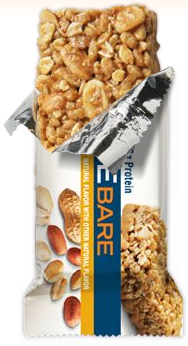 Some of you have probably already read my run-down of a selection of nutrition bars. This weekend, while shopping at Dillon's, I happened to read the back--more specifically, the ingredients--of a standard Balance bar. As soon as I saw "high fructose corn syrup," I despaired. Much like Iron Wil and her yogurt, Balance bars are one of my favorite options (although I often opt for the cheaper and less-filling Nature's Valley 36-packs) for on-the-go breakfasts.
Well, hard as it was to pass up such tempting new flavors as triple chocolate chaos, I decided to go the more disciplined route and tried the new (to me) Balance Bare bars. I bought three different bars, just to try them out: fruit and nut, chocolate chip, and cinnamon oats and honey. This morning for breakfast, I tried the fruit and nut variety.
The bar is surprisingly hefty, thicker and stouter than I would expect, whereas Balance bars are generally small and dense. The bar weighs 50 g, has 15 g protein, 7 g fat, and 23 g carbohydrate (16 from sugar, which seems to me really high). Like a standard Balance bar, the Bare has a healthy dose of vitamins and minerals, although I don't have a Balance bar around here right now to compare portions.
The bar has a very pleasant taste. It's sweetened with evaporated cane juice, which gives it a light, almost malty flavor and texture. It reminds of this really, really good trail mix I had once . . . I think it was called Mrs. Mayo's . . . and it was sweetened with pomegranate juice. This bar reminds me of that taste and texture. The bar is primarily crispy rice, I think. At least, that's what I think that textural element was. At any rate, the fruit and nut element was understated, but it was very tasty when I got a hit of dried cranberry or nut.
My main complaint was that the coating on the bottom of the bar gave the whole thing a crumbly, even grainy texture. I think that's probably from the added protein. So while the bar was actually pretty tasty, I didn't care much for the crumbly, malt-o-meal texture. And the fact that so many of the carbohydrates were sugars further deters me. So would I buy this bar again? Maybe if it's on sale; it was only a dollar, the other day. This definitely won't be one of my regular purchases, however. I guess if I want a nutrition bar that's all-natural, I'll go back to Clif (or just stick with my cheap, Sam's club bulk boxes of Nature's Valley).
I also recently tried a Muscle Sandwich bar (made by a completely different company than Muscle Milk, which also makes Cytomax). I'm sure it has plenty of protein and amino acids, but I will never put that in my body again. With enriched flour, partially hydrogenated oils, and high fructose corn syrup, it's no better than a high-protein candy bar, and if I want a high-protein candy bar, I'll buy a Snickers, pay less, and enjoy it a lot more. I would consider Muscle Sandwich a nutrition bar for muscle head amateur body builders who don't know any better.
Saturday, December 8, 2007
Don't Drink the Orange Juice
 It may be tempting.
Everyone in your office and home may be sick. You may be borderline overtrained. You may have gone running in 35-degree rain this morning. You may even have the start of an itch in your throat.
But whatever you do, don't drink half a quart of orange juice.
"Why every not?" you ask. Orange juice is full of vitamin C, potassium, folic acid, and flavonoids. It is naturally sweet, tangy, and nutritious!
It is also loaded with sugar.
And if you drink a quart of it, you're liable to get a searing headache.
By the way, anyone know how to tone down a sugar rush migraine?
Monday, November 26, 2007
Eat More Garlic!
A diet rich in garlic can have a significant positive effect on your health, according to the New York Times. It seems that garlic increases the production of hydrogen sulfide in your blood, which—in the short term—relaxes your blood vessels and increases blood flow. In the long term:
References here and here.
Garlic is also an antioxidant, which can help reduce muscular soreness after a workout by neutralizing free radicals in your bloodstream.
However, as the article notes, you have to eat A LOT of it if you really want to see the benefits; a clove is equivalent to about a teaspoon of chopped garlic (if you use the pre-chopped stuff like I do). So here's a recipe that uses a ton of garlic AND quinoa, which is my favorite super food, and a new recipe for those of you who have already tried my garlic cucumber quinoa salad.
On a related note, I dreamed earlier this week that I went to a school where they were trying to turn all of the students into vampires. So maybe eating plenty of garlic will also keep those crazy vampires out of my dreams.
The power to boost hydrogen sulfide production may help explain why a garlic-rich diet appears to protect against various cancers, including breast, prostate, and colon cancer, say the study authors. Higher hydrogen sulfide might also protect the heart, according to other experts.The downside (if you can call it that)? Benefits from garlic consumption in studies required an equivalent of two medium-sized cloves of garlic per day, and while some countries—namley Italy, Korea, and China—average as high as eight to twelve cloves a day—it may be a lot of garlic by your standards. Then again, if two cloves a day keeps the doctor away, I can deal with the bad breath in other ways.
References here and here.
Garlic is also an antioxidant, which can help reduce muscular soreness after a workout by neutralizing free radicals in your bloodstream.
However, as the article notes, you have to eat A LOT of it if you really want to see the benefits; a clove is equivalent to about a teaspoon of chopped garlic (if you use the pre-chopped stuff like I do). So here's a recipe that uses a ton of garlic AND quinoa, which is my favorite super food, and a new recipe for those of you who have already tried my garlic cucumber quinoa salad.
On a related note, I dreamed earlier this week that I went to a school where they were trying to turn all of the students into vampires. So maybe eating plenty of garlic will also keep those crazy vampires out of my dreams.
Friday, September 21, 2007
Surprisingly Delicious
I'm pretty sure this is delicious, although it's weird enough that I can't be sure. At any rate, it's been one of those nights where I come in from a run and eat anything that moves, so my judgment might be impaired.
Quinoa Peanut Butter Pilaf
1/3 cup quinoa (I use 1/3 cup because that's about as much as I can eat at one sitting)
1/4 cup all-natural peanut butter (unsweetened, unsalted)
1 Tbsp honey (good stuff, preferably organic and raw)
Salt to taste
Cook the quinoa by simmering it in twice as much water (in this case, 2/3 cup). It's done when the grains are translucent (you can see a tiny dot or squiggle in each one), the water's gone, and it's tender. Immediately add the peanut butter; you need the heat to melt it in. Then add in honey, and sprinkle with salt. I know it sounds weird (and it's not actually a pilaf), but it was pretty good. Unusual, but tasty.
Let me know if I'm truly crazy.
Health is my Addiction
Health is like a drug. Two years ago, I couldn't run more than two miles at a time. I ate sensibly, but I would never think of counting calories or grams of protein. And I certainly would never have given second thought to the idea of a weird diet like all raw foods.
Yet I find myself strangely drawn to this idea of a raw lifestyle. What I've read about it seems really promising. As far as health goes, it seems like a wise move. And the recipes . . . they look pretty good. Besides, it's not like I have to go 100%, all-out raw (at least not right away).
What I'm realizing is that health is addictive. At first, I was just working out. Then I started becoming so healthy and strong. I loved being in tune with the contractions of my muscles
going up stairs and lifting groceries. It was a new feeling, and I really enjoyed it. I had a new rapport with my body, and so I wanted to take better care of it. Which means that I'm willing to go to greater and greater lengths to . . . let's call it detoxifying. Partly I've realized how much of what we, as modern consumers, put into our bodies is harmful. Unnatural. Toxic.
I want to cut all of that out, and make my lifestyle as natural as possible. But reading about what's involved . . . no cooked foods? Sprouting? Dehydration? Wheat grass juicing? I waver between "This is a bit excessive," and "No, this is the way things are supposed to be; this is natural."
So . . . natural lifestyle. I've decided on one raw meal a day, less sucrose, less sodium chloride, less gluten. Which means less bread. Sigh . . .
And new raw recipes coming soon!
Subscribe to:
Posts (Atom)