I got a job offer on Tuesday! But it's just for a part-time job with Quiktrip. Great company, great benefits, but not enough to fund my triathlon habit.
So I'm trying to monetize my blog just a little bit more. Please forgive the blatant commercialization.
I can't bear to endorse just any product, so I'll only profile things I actually use.
TomTop Waterproof MP3 Player
I can't believe how much these things have come down in price! I first used the Finis SwimP3 for underwater music, and it cost around $125. Then I got a cheap, made-in-China player a few years ago from Amazon, and it was $45, and the cheapest I could find. Now you can get one for $20! It works perfectly well, too. I don't imagine it will last for very long, but that's to be expected. Besides which, my expensive SwimP3 only lasted for 18 months, before the chlorine and water corroded the connections. A cheap, waterproof MP3 player makes a nice investment for long, endurance-y swims.
Showing posts with label swim. Show all posts
Showing posts with label swim. Show all posts
Sunday, February 2, 2014
Friday, February 11, 2011
Strength for Swimmers
Hey all! Here's a little treat for you, as you're beginning to build a base for your season. I've integrated some personal training and yoga knowledge to give you a well-rounded set of swimming exercises that you can do with no equipment in very little time. This originated as advice I gave to one of my top-notch swimmers, who was struggling to keep his legs in line with the rest of his body while using a pull buoy. I gave him this assignment to strengthen his core and teach him better alignment.
p.s. Thanks to The Photographer for switching it up and being my videographer. Also, thanks to The Photographer's kids for being so quiet!
p.s. Thanks to The Photographer for switching it up and being my videographer. Also, thanks to The Photographer's kids for being so quiet!
Thursday, December 30, 2010
Strength for Swimmers
Hey all. Here's a little video with some strength and flexibility exercises for your swimming. Keep in mind that in between now and when you start your base building phase you have the perfect opportunity to improve your strength and flexibility in ways that will make your training more effective later. So take advantage of this time by starting to do these exercises in the next month or two!
By the way, the little noises in the background are The Photographer's kids :-)
By the way, the little noises in the background are The Photographer's kids :-)
Thursday, April 22, 2010
Beginners' Guide: First Race
First off, don't worry; it's perfectly normal to freak out in the swim on your first tri. For that matter, it's perfectly normal to freak out in the swim at your second tri. I have clients and athletes who are 3-4 years into their triathlon journey, and they still sort of freak out. So don't worry; that's normal.
One of the women I taught to swim this spring just did her first race (Emporia) on Sunday. And the swim did not go quite as well as she may have hoped or planned. First off, that time trial start can be a really crappy situation for the newer swimmers because they have a poor sense of how to pace themselves. So people who should be at the back of the line seed themselves too high, and people who belong more to the middle seed themselves to the back. Bottom line, my poor friend had to pass a guy who should have seeded himself waaaaay slower than he did. So she had to pass him after less than 50 m (of a 400 m swim, mind you). Passing--even passing someone way slower than you--is hard work, and after that, she had trouble recovering her breath and regaining her rhythm. From there, she was strictly in survival mode.
My first triathlon wasn't so bad. I did a lot of backstroking and sidestroking, but overall I managed to maintain a pretty good rhythm. My second tri? Not so much. It was Pumpkinman, and it was in Lake Mead, and it was frickin' cold. I was wearing a wetsuit (borrowed, natch) for the first time. I'd never swam in a wetsuit before. I had a minor panic attack right there when the gun went off. I couldn't put my face in the water; I couldn't breathe when I did. My body absolutely rejected the notion of normal freestyle breathing. So I did the elementary backstroke for the whole swim. Longest 750 m of my life.
So it's a normal thing. But what do you do about it? How do you move past that place of panic and into a place of calm?
First off, chill out. There's absolutely nothing wrong with getting pumped for a big event, but if you're new to racing and have trouble with the swim, you'll probably be better served by listening to Sounds of Meditation than the theme song from Rocky. That initial shot of adrenaline might give you the kick start you need at a bike or run race, but in a triathlon swim, it's going to freak you out. So try to get calm and Zen instead of pumped up before the swim start. There will be time to get pumped or highly focused after you've mastered the swim start.
Second, practice. This is especially important if you're going to be doing a mass start and an open water swim. If you'll be racing with a wetsuit, practice with a wetsuit. The first time you put it on, you'll be surprised at how constricting it feels, and you don't want to be starting a race feeling constricted. Not unless you enjoy hanging on to the sides of paddle boats or kayaks, anyway. If you'll be swimming in the ocean, you damn well better practice in the ocean. Nothing's going to freak you out worse than swimming through a patch of seaweed for the first time. If you're going to be starting from a beach, practice running into the water; figure out before hand how long you want to wait until you start swimming. And if there will be a mass start (if you're swimming in a lake or ocean, there will be), practice with some friends. You know, like this:
Okay. Maybe not exactly like that.
Third, know the venue. If you can, swim there before race day. You want to know how cold the water is going to be, how far it's going to look to that first turn buoy (seeing the actual distance can be freaky, the first time), what the major landmarks are, and how the swim entry/exit looks. You'll also want to acquaint yourself with any critters who might live in the water (fish and seaweed = freaky), and be familiar with the depth at various points on the course (there's a local race where you could walk most of the swim course, if you were so inclined).
And if you do all those things and you still freak out, don't worry. It happens. Now if you're into your fifth or sixth race and you're still freaking out, you might want to try something a little more advanced. I've had athletes go for hypnotherapy; I've done guided meditation with my podcast. Those are options. When it comes right down to it, though, some people are going to feel more comfortable in water than others, and it may be something that never quite comes naturally to you. If that's the case, don't worry; you'll catch 'em up on the bike and run.
Wednesday, April 14, 2010
Lactate Swim
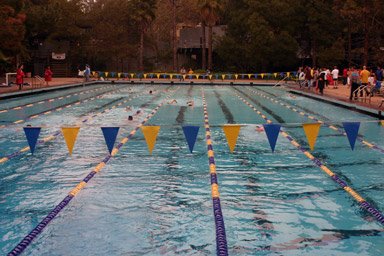
100 SKIPS (swim, kick, IM, pull, swim; can be shortened to SKP)
8 x 25 drill (I did one-arm, fist swim, and quick catch)
8 x 75 w/ :45 rest (I went on 2:00)
200 kick w/ fins
8 x 50 w/ :30 rest (I went on 1:15)
200 kick w/ fins
8 x 25 hypoxic (don't breathe until you're touching the wall)
100 choice (not free) to cool down
Fun, huh?
Note: 100 SKIPS is short-hand for 100 swim, 100 kick, 100 IM, 100 pull, 100 swim. It's my standard warm-up. A shorter warm-up is 100 swim, 100 kick, 100 pull. But then I don't get to practice my fly ;-)
Thursday, October 1, 2009
Head Position in Freestyle

So yesterday I was swimming with a pull buoy (because what else can I do with this damn bum ankle?). And I was doing drills and generally enjoying the feel of slipping effortlessly through the water. At any rate, I had my moments. And at one point I lifted my head just a little bit to look slightly ahead in the water. As soon as I did that, I felt my speed increase. It was instantaneous. It was amazing!
It's been a long time since I felt that kind of improvement in my swimming. Crazy thing is that I already knew to do that. I distinctly remember a clinician telling me to look 45* in front of me at a workout in college. And then after I got into Total Immersion and a different clinician told me to get my head down, I started focusing more on streamlining. I just assumed that was the fastest way to swim.
And it might be the fastest way for some people to swim. But apparently not for me.
Thursday, February 19, 2009
Runner's High: Pool to Myself

Yesterday morning, I did my (measly) 1200 meters in the pool and I had it all to myself. Truly, when there's no one in the pool, and the water is still and reflects everything so beautifully, it's all I can do to resist jumping in and disturbing the water myself. Having the pool to myself takes the workout to another level. Makes it totally worth waking up at 4:30 a.m.
Wednesday, January 28, 2009
It Really Does Make it Better
I have a Swimp3 player.
Keep in mind, this is something I would never have bought for myself. It's a device that costs over $100 (that's $100 that could be going towards my new bike, yo) that I will use for only one, specific purpose; in fact, it can't be used for any other purpose. So it's like a lot of products in triathlon--a cool toy, but not much more than that.
However, one of my dad's co-workers is a triathlete, and he suggested this as a gift for me.
So now I have one.
And let me tell you, I love it. Love love love. Don't get me wrong; I enjoy swimming, I don't mind long sets, and I have no problem losing myself in the meditative motions of glide catch pull recover slow smooth strong fast. But the music? It makes it even better.
And because I'm good at this sort of thing and I enjoy it, I decided to make a list of songs that seem (to me) perfect for swimming. This is probably a highly individual preference--even more so than biking or running music--but what the heck. Here's my swim playlist anyway.
23 by Jimmy Eat World (141 BPM)
In the Sun by Coldplay/Michael Stipe (123 BPM)
Chasing Cars by Snow Patrol (149 BPM)
Both Hands by Ani DiFranco (144 BPM)
Fireflies by Amy Cook (88 BPM)
And who knows? Maybe I'll even put together a swimming podcast, one of these days. Although, considering that this falls into the "cool toy" category, I might be the only one who ever uses it.
Does anyone else have one of these? What's the group's opinion of this nifty (but admittedly superfluous) device?
Sunday, October 19, 2008
Swimming Hack: Notecard technique

Ideally, I wouldn't need to keep notecards around with my favorite swim workouts on them; ideally, I would have a photographic memory and all of my swim workouts (not to mention my splits) would be memorized.
But I do not have a photographic memory. What I do have is a plastic baggy, a stack of notecards, and a rubber band.
Each of the notecards has a swim workout written on it. The rubber band keeps the notecards together, and the plastic baggy keeps the whole thing from getting soaked.
As I was thinking about my 1-page guide to swim technique, I realized that it would be very helpful to have a list of focal points for technique that would fit in with my workout. That way, I could keep track of my workout and my form simultaneously.
With that in mind, I present to you the Single Notecard of Swimming Excellence. Actually, it's just a PDF of swimming focal points, but if you print it out, glue it to a notecard, and stick it in a plastic baggy (or laminate it!), it may become the Single Notecard of Swimming Excellence.
Because your swimming is never too good.

Friday, June 6, 2008
Not Dead!
No, I'm not dead.
But I have been working some 16 hour days, which seriously impedes my ability to write and publish blog posts.
I have a few in the works, too: A playlist of pre-race music; a review of a research journal article about overtraining; and a financial post on exactly how much money it takes to begin triathlon.
However, I don't know when I'll finally have the time to refine these posts enough to publish them.
In the meantime, I'll leave you with these (previously written and published) love poems I wrote to (and about) triathlon.
Peloton
You see us in the mornings,
Lycra-clad and faces tight-clenched,
A brightly-feathered fleet of gazelles
Chasing down metallic bears
On the PCH.
You see our toned legs
Glowing with the hues
Of Santa Monica sunrises,
Strained in the pursuit
Of Mulholland Highway heights,
Legs thrusting in hypnotic circles
Like the movements of
A strange and sacred Hopi dance.
You see our honed bodies, our honed
Equipment, our honed technique;
You see our helmeted heads
And suppose that we are
Very experienced.
We see your rear fender
As you drift too close
And we eat tar
Like bulldozers
Scraping their buckets
Along a demolished road.
Dive
Gathered.
I feel calm as adrenaline swamps
my veins like its preparing them for
the coming onslaught of lactic acid.
Elites
Gather,
shaking out just-warmed arms
and legs, preparing themselves for
another chaotic mass swim start.
Goggles
prepared for entry, a dive into
this lake. Fucking cold
lake. No wetsuits--not that cold.
Holy shit. Look at those deltoids, toned
to pro levels. What am I
doing here?
5-second warning. Together
our whole bodies
tense--one monstrously muscular
athletic being.
At the buzzer we all
Gather
our limbs, hone our
extremities like water knives,
and leap. I fly
like a Power Bar-sponsored swan
and suspend myself
forever in the lens of some
sports photographer. And in
the last moments
before
I hit the water and
enter a painfully hazing world
of feet and elbows,
I float totally
Gathered.
A Jog
Sun-crisped words fall
To the rhythm of shoe-thumped pavement
Calloused hands that soften
Like the shining hairs that graze my arms and neck
Clench and tense, relax self-consciously
Percussive jolt of knees
Chased by laughing shivers
And the rushing pulse of deep-drawn breaths
The well-known beat of our bodies.
Sunday, April 6, 2008
50 Degrees
First open water swim of the year! Woohoo! It was frickin' cold, so cold that when I put my face in I got an instant headache. Brainfreeze. But after I got warmed up, it felt pretty nice. And I finally got to use my new wetsuit (which works beautifully).
Saturday, March 29, 2008
Ironmom: A Swim Workout to be Eager For
Thanks to Robin for this swim workout, which has kicked my butt for the last two weeks' interval swims, and has presented me with my fastest 100 splits EVER. Give it a try as you start to work speed and power into your swim sets:
6 x 100 Fast
2 x 50 Focus on technique
5 x 100 Fast
2 x 50 Technique
4 x 100 Fast
2 x 50 Technique
3 x 100 Fast
2 x 50 Technique
2 x 100 Fast
2 x 50 Technique
Robin didn't specify rest intervals, so here's what I did:
100 SKIPS (swim, kick, IM, pull, swim)
5x100 fast on 3:00 interval
2x50 for technique
4x100 fast w/ 1:00 RI (rest interval)
2x50 for technique
3x100 fast on 2:00 interval
2x50 for technique
2x100 fast w/ 1:00 RI
100 cool down
I think the 3:00 intervals were a little long; they enabled me to pretty much fully clear the lactate from my blood, starting each repeat fresh. The 1:00 rest interval was challenging; I saw my form and speed deteriorate over the course. The 2:00 intervals were frickin' hard, but I only lost :02 between the first and last repeat. I averaged about 1:38-1:39 on my splits, with the fastest being 1:35 and the slowest 1:44 (the very last 100). But the whole workout was fully awesome.
Thanks, Robin, for a wonderful workout!
Thursday, March 27, 2008
Quick Catch Video
I had a few questions about how exactly one does the Quick Catch drill which has been so helpful for me. And what better way to demonstrate than in film? Also see Dave Scott's video, which is actually filmed on a pool deck with real swimmers (not in a bedroom with a webcam)! Any more questions about this drill (or any others), just let me know in the comments.
Wednesday, March 12, 2008
Mental Training: A Break from your Regularly Scheduled Podcast
Well this is an experiment. I've read a few articles on mental training in the past few months. I'm guilty of not training the mental side of my racing hard enough, and I'm sure you are, too.
So I decided that guided meditation might work as a way to help us all prepare a little bit better for that next open water race.
Let me know whether or not this works for you: Is it helpful to have someone talk you through something we all should be doing anyway? What would make it more effective? More space between comments to absorb what I'm saying? Different conditions (i.e. a cold open-water swim, lake swim, river swim, swim through high surf, pool swim, etc.)? Corny Tai Chi music?
I would appreciate any feedback on this little project of mine. Let me know if you want more!
Mental Tri Training: Open Water Swim
"This audio file is a guided meditation for the use of open-water swimmers. In it, you will focus on relaxing and practicing good form. Try to visualize yourself completing each movement. The more real it is in your mind, the more beneficial the meditation will be in improving your neuromuscular performance in swimming."
Monday, March 10, 2008
Quick Catch
On my faster swim pace:
I've seen a 10-20 second decrease in the pace of my 100 yard repeats in the past month. I attribute the bulk of this new speed to one drill: the quick catch drill.
I spent all of last summer working on my balance on body position. I spent the off-season focusing on my recovery, entry, and breathing. By January, I was looking pretty good in the water. But I still wasn't going anywhere (at least nowhere fast). Focusing on my catch has allowed me to apply more power to the water using my arms, shoulders, back, and core. It took about a month of doing quick catch drills constantly--the first workout I tried it, I could only do about 30 meters before my arms were exhausted--for me to work the concept into my stroke, but it was definitely worth it.
I recommend doing the following sets (maybe not all at once, though) to help you incorporate the quick catch.
Drill Set 1
8x100 as
25 quick catch
25 fist swim
25 quick catch
25 regular swim
4x25 as fast as possible while maintaining the feel of quick catch
Drill Set 2
8x50 drill quick catch/50 swim (if you can't do quick catch for a full 50 to begin, do alternate 25 drill by 25 swim)
4x25 as fast as possible while maintaining perfect form
Drill Set 3
8x50 fingertip drag, incorporating the feel of quick catch (I love using fingertip drag as a base for focusing on other drill points, because it forces you to swim slowly with relaxed arms)
8x25 quick catch drill with high arm turnover
Quick catch drill isn't the secret to success for all mid-level swimmers, but it is the next step for many of the athletes I'm coaching currently, so I bet that it'll also apply to some of you.
For more on why quick catch is important, read this.
Friday, February 29, 2008
Brr . . .
Guess what.
It's still too cold for swimming in Lake Afton.
I know. I checked.
But it was plenty warm enough for biking!
It's still too cold for swimming in Lake Afton.
I know. I checked.
But it was plenty warm enough for biking!
Tuesday, February 12, 2008
Building Mental Toughness
A major goal that I set for this mesocycle is to build mental toughness. One of the ways I want to do that is by always working one minute longer than I have to. So if I plan to do an eight-mile run, I run eight miles, then one minute farther at the same pace.
Today, I had a breakthrough with mental toughness, I think. I was swimming 34 minutes straight in the SwimEx, and it was not going well. I actually considered ending early and trying later in the week, because I was having so much trouble holding my form. The main reason is that I'm trying to improve my catch, but my arms lack the strength to keep up. The way I've changed my catch dramatically improves my pace, but I get significantly fatigued and sore on the lateral side of my right hand, from the knuckle of my pinkie down into my forearm. Today I was also experiencing discomfort in my tricep and anterior deltoid, as well as the antecubital area of my left arm (translation: the side of my right hand and forearm, the back of my right arm, the front of my shoulder, and the front side of my left elbow). So in short, my swimming is improving, but I need to build upper body strength before I can really work it in. Which is why I kept swimming: I figured I needed to push those arm muscles so that they'll get stronger.
I was counting down the seconds by the end of this workout, focusing all my mental capacity on holding a passable form. Then the timer went to 00:00, the buzzer sounded, and I was done. Except that I kept swimming. My goal was to keep swimming for one minute. But at that point, it was like I couldn't stop. As soon as I was technically finished, I just wanted to keep going; I was enjoying it.
I don't know how long I kept swimming; I lost track of time. It probably wasn't more than a minute, maybe two. But I was surprised to find how easy it was to keep moving, as difficult as it had been before, as soon as my time was up.
Saturday, February 9, 2008
Mantra
Slow is smooth.
Smooth is good.
Good is fast.
Fast is slow.
I don't know why such a simple syllogism makes me swim better, but it works.
Try it.
Smooth is good.
Good is fast.
Fast is slow.
I don't know why such a simple syllogism makes me swim better, but it works.
Try it.
Monday, February 4, 2008
Beginners' Guide: 1-page Guide to Swimming
This is a compilation of everything I've read about proper swim technique, a synthesis, if you will. In the interest of exploiting your strengths and strengthening your weaknesses, I'll provide these guides, which I originally wrote for my multisport club at Genesis.
Head position: Look straight down, your nose pointing towards the pool floor, when you're practicing swimming. Your chin shouldn't be tucked or lifted, but held in a neutral position. Allow water to almost cover the back of your head; in other words, hide your head below the water. As you rotate from side to side, try to keep your face pointing at the pool bottom (except when breathing, of course).
Body Position: Always preserve a straight body line in the water; head, neck, shoulders, stomach, and hips should be in alignment, as though you have a steel rod passing from the crown of your head down to your hips. Don't allow your back to bow, or suck in your stomach too far. Press your lungs toward the bottom of the pool. Your lungs serve as a fulcrum for the rest of your body, so to get your body horizontal while swimming, you have to push extra hard on the head/torso end of the lever. The overall sensation should be one of swimming downhill. If your legs are low in the water, they will produce more drag (which means you'll go slower!) and pull you down, forcing you to spend extra energy by kicking in order not to sink. When swimming on your sides (or when rotating from side to side), focus on pushing your armpit down. Reach towards the pool wall immediately after your hand entry and before your catch (but not so far that your hips get out of alignment). Think about squeezing your body through the smallest hole possible.
Hand Entry: You swim with blades, not with fish. Your hand should slice into the water somewhere between your goggle line and a couple of inches in front of your head; they should not fully extend, then flop into the water. It is more efficient to finish extending your hand under water, rather than extending fully in the air. Your hand should enter directly in front of your shoulder, not at the center line of your body (i.e. in front of your head). Keep your arm from crossing over. Pinky should be highest of the fingers during entry.
Pull: Pull doesn't begin until just before your opposite hand enters the water. Don't let one arm sink as your opposite arm recovers (particularly as you breathe); one hand should always be extended in front of your body (this is called front quadrant swimming). Fingers of your hand should be together, thumb straight out to the side. Elbow should be higher than the hand at every point of the stroke. When initiating your pull, think of grabbing a handful of water, holding onto a chunk of “hard” water, or anchoring your hand and swimming past it. Use the rotational force of your hips and torso to pull yourself past your hand, rather than pulling your hand down towards yourself. Your hands should pull back past your hips, your thumbs brushing against your thighs as your hands exit the water. The last part of your stroke is a push back past your hips, not a pull up out of the water.
Recovery: Keep a high elbow throughout your recovery. Imagine that your elbow is attached to a puppet string that is pulling it up out of the water. Make sure that your whole arm is fully clearing the water with every stroke.
Breathing: Do not lift your head out of the water to breathe; raising your head will screw up your body position. Use a slow, controlled exhale throughout your stroke; do not (at any point) hold your breath. End your exhale before turning to the air to breathe. Every second of time you have your face exposed should be used to draw in air; don't waste it on finishing your exhale. Practice bilateral breathing (breathing to both the left and right side, not just to your dominant side) whenever possible by breathing every third or fifth stroke.
Kick: Avoid using an extra strong kick to make up for poor balance and body position in the water. Feet should stay just below the surface of the water, your heels barely kissing the air; you shouldn't be kicking up a lot of foam.
Tuesday, January 29, 2008
Zen and the Art of Swimming -or- How to Turn that Frown Upside Down
I have never gotten a ticket.
The closest I've ever come to a vehicular citation was when some power-trippin' USC campus parking official cited me for "parking" my car in a no parking zone (never mind the fact that everyone stops there to pick people up, and I was clearly standing just a few yards away, waiting for a friend to come down from her dormitory). So when I got pulled over for running a red light (you ever spend a couple seconds looking directly at a yellow light without realizing it's yellow? Yeah, I don't think that should seem too extraordinary at 5:15 am), it didn't exactly make my day.
In fact, it totally sucked. I didn't want to go into the gym and teach my track workout, I didn't want to cry (and I was crying, as I pulled into the parking lot) in front of all the awesome athletes I coach, and I really, really didn't want to do my scheduled endurance swim.
I dragged myself into the locker room, changed grumpily into my swimming suit, and clomped out to the aquatics area like a sulking four-year-old. I kept telling myself that I didn't want to be there, I didn't want to swim, it's recovery week anyway so what will it matter if I skip my workout . . . I forced myself to climb into the pool, thinking, "Aw, man, it's gonna be so cold" (the pool is never cooler than 81 degrees), and reassured myself, bracingly, that it's a short workout this week and I would only be in the pool for 45 minutes or so.
Warmed up 100 swim, pull, kick. Drilled for 600 yards, which went by sooooo slowly. Then got into my main set: 3x300 time trial to establish a T-pace for my swim intervals, which I start incorporating hardcore next week.
And I worked my ass off on those intervals. Somewhere in that first 300, I zoned out and could only feel my legs and arms swishing through the water, my heart and lungs pounding to get oxygen out to my limbs. It didn't feel effortless, by any means, but it felt good. And by the end of that workout, I felt awesome, and I didn't really care that I got my first ticket ever.
Also, I swam my 300s in 5:35, 5:25, 5:35, which--if you'll remember that I was swimming my 200s in 4:15 last week--I felt really proud of.
Subscribe to:
Posts (Atom)