It's been ridiculously cold all over the country (windchills of -15 here). I hope warmer weather is on its way. Really really. But until it is, we're all going to need some incentive to get our butts on the treadmill. Hope this workout helps!
I've been reading Joe Friel's blog. And one of the things that's really struck me, as I've been writing my training program for the next season, is his emphasis on speed drills.
Since we're dealing with running today, here's a break down of the concept as it applies specifically to running: the only ways you can become a faster runner are to take more steps and to take longer steps. So with this workout, we're trying to develop faster leg speed. How are we going to do that? Overspeed training!
For this workout, we start at a cadence of 88, which should be manageable. If it's not manageable, I've included a list of songs that are at an appropriate BPM for running in order to gradually up your cadence. As the workout progresses, you have intervals of faster and faster cadence, followed by recovery periods at 88-90 BPM. Intervals get longer and longer, too. If at some point, the cadence becomes too fast for you, just go back to a speed at which your comfortable. After a few weeks with the workout, you should be able to hit those faster cadences. Keep in mind that the taller and longer-legged among you will have more trouble holding a faster cadence, and will probably be more efficient at a slower cadence anyway. Hopefully, you'll eventually find a cadence that feels optimal.
The danger in this workout is in losing form due to fatigue. Remember to keep your body loose, especially your legs and knees. Maintain an athletic posture. Imagine that you're being hauled forward by a cable that's attached to your sternum. Relax your facial muscles. Align your breathing with your footfalls.
As far as when you do this, treat it like an early-season speed session. You're not doing intervals right now (probably), so do this instead!
Running Podcast 1 - Overspeed
Wonderwall (4:19) - Oasis (87 BPM)
Whole Lotta Trouble (2:27) - Cracker (87 BPM)
Extra Ordinary (3:42) - Better Than Ezra (90 BPM)
Inside Out (3:39) - Eve 6 (90 BPM)
The Swimming Song (2:33) - Loudon Wainwright III (93 BPM)
Cool Blue Reason (3:28) - Cake (88 BPM)
Soldier (3:46) - Eminem (95 BPM)
Healer (3:51) - Ten Shekel Shirt (90 BPM)
All My Life (3:37) - Shihan (97 BPM)
I am the Way (3:57) - Mark Schultz (90 BPM)
Don't Call me White (2:37) - NOFX (100 BPM)
Superstones Strike Back (2:42) - The O.C. Supertones (91 BPM)
Deeper Than Crying (2:38) - Alison Krauss (88 BPM)
Everloving (3:26) - Moby (90 BPM)
Tuesday, January 12, 2010
Monday, January 11, 2010
Runner's High - T-Shirt

I don't know if you guys have noticed, but it's been cold.
Florida? Cold. Dallas? Cold. Kansas? Really fucking cold.
It has been so cold that the weather actually constrained me to indoor running for a week and a half. Now I'm a pretty tough cookie, but when the wind chill is -15*, I take it as a sign and run on the damn treadmill. Or sometimes skip the run in favor of hot chocolate and donuts.
But today, when I walked out to my car in the morning, I smelled spring. It's not spring here in the Midwest, and won't be for some time. In fact, the air was so cold that I could barely breathe it in deeply enough to really taste the air. But there was no mistaking the smell of fresh earth, the smell of grass and dirt thawing in the balmy above-freezing air.
I was lucky (depending on whether or not you think I need money) enough to have the whole afternoon free, so I took the time for a long run. How was I dressed? In a T-shirt, tights, and light thermal jersey. No arm warmers. No gloves. I did wear a stocking cap. And for most of the run, I could have left the stocking cap and jersey in my locker (running into the north wind, I was glad I had them, and wished I would have brought gloves as well).
But the sun! The glorious, warm, sunny sun! It's hard to endure those weeks of cold, snow, ice, and wind, but they really made me grateful for the good weather, this time around. And now I'm that much more willing to get out there and work hard when the weather's nice.
Thursday, January 7, 2010
Making Tough Choices
How badly do you want to get better?
I don't ask what you're willing to sacrifice. If you're serious about this sport, it's clear already that you're willing to put your social life on the line; you have no problem spending copious amounts of time on a sport; and dropping hundreds (maybe thousands) of dollars on gear, racing, and travel is nothing new to you.
But let's say, for example, that running is your limiter. You can put in a decent swim, create a big lead on the bike, but then get re-passed by 50% of your competitors on the run. You're a strong athlete. You may not be "a runner," but you know you're strong. So you figure you should at least have a 45-minute 10k hidden deep inside you.
Here's the problem: In order to access that speed, you might have to focus just on running.
In my foray into cycling this year, I fully grasped something I should have known already: I cannot realize my potential in the individual sports of swimming, cycling, and running simultaneously. Neither can you. That's why pro triathletes don't win big-name marathons; it's why pro cyclists never win Kona.
Now in amateur triathlon, I have an awesome bike leg. That's where I do the most damage; that's where I gain my edge. But my 20-21 MPH speeds will not cut it for me in road races, criteriums, or even time trials. Part of this is a mental block (at least for me). When you've trained yourself always to save a little bit on the bike, it's tough to lay it all out in a bike race. Subconsciously, your body doesn't want to go 110% in a bike race, because it figures it's going to have to run after. I got to where I started asking myself, "Would I be able to run after this?" And if the answer was yes, it was time to get the lead out.
But most of the issue was with training. Even at the top of my game, I'm not going to be as strong cycling as a triathlete against dedicated cyclists as I would if I were only biking. In other words, I have untapped potential.
That doesn't mean that you never win a 5k or a time trial when you're training for triathlon, of course. I've gotten a few medals at local runs this year, and I've won some prize money in the bike scene. The problem isn't that I'm not competitive with runners/cyclists; the problem is that I'm not achieving my potential.
That's important, too, because there are triathletes out there who come from a background of competitive, dedicated running and cycling, and they're much closer to their potential in those sports--even when training for tris!--than I am. And if I want to beat them, I'm going to have to access some more of my own potential.
Which brings us back to the original question: how badly do you want to get better?
It's apparent to me, at this moment, that I will eventually want (or need) to put in a long-term, dedicated running focus. That means more than just a month or two in the offseason (like I did this year, after my ankle healed enough); that means like a season. And during that time, my swimming and cycling will go by the wayside. It's not that I'll never swim, or never ride. And it's not that I'll lose all the fitness and speed I've developed in those disciplines. But they won't be my focus, and I probably won't see the kind of improvement in those sports that I've become accustomed to. I'll still be able to race tris, too, although I may not have the cycling and swimming legs to be placing top 10 like I have been.
Can you tell I'm trying to talk myself into this?
Monday, January 4, 2010
Spinning Workout 28 - Endurance

Ha! Finally!
This workout is all about endurance. I tried to write it as a base-building workout with a little intensity. There are easy spinning sections, hard time trials, seated climbs, and standing climbs. There are also some overspeed sections to force you to turn a fast cadence (almost 140 RPM); if you want, you could also try those sections as one-legged drills, switching legs every minute. The main thing is to get some cadence/drill work into the base building period.
Try to keep everything in high zone 2/low zone 3. Probably won't make it the first time, but I hope that as you get more and more fit this workout will keep you right in the sweet spot of base building intensity. Or you can just go balls to the wall the whole time, just like you might in an actual spinning class.
Spinning Workout 28 - Endurance
I Woke up in a Car (4:13) - Something Corporate (107 BPM)
I Want You Back (2:58) - The Jackson 5 (100 BPM)
Walk This Way (3:32) - Aerosmith (104 BPM)
Heart of Glass (4:34) - Blondie (110 BPM)
Relax (3:56) - Frankie Goes to Hollywood (115 BPM)
Canned Heat (5:32) - Jamiroquai (128 BPM)
Beep Beep (6:29) - Beep Beep (132 BPM)
Kiss Kiss (3:24) - Holly Valance (98 BPM)
How Bad do You Want it? (3:45) - Tim Mcgraw (88 BPM)
If Looks Could Kill (3:41) - Heart (79 BPM)
Burning Up (3:47) - Madonna (137 BPM)
I Get Around (2:13) - Beach Boys (148 BPM)
The General (4:07) - Dispatch (90 BPM)
Looking for more workouts? Go here!
Sunday, January 3, 2010
Race Report: Resolution Run 5k
Oh yeah. I forgot. I actually like this.

What a fun race. Last one of the year. Snow on the roads. Temps are biting. Wind chill is sub-zero. Sun is setting, leaving us all in the freezing shade.
But there's beer.
This isn't a PR kind of race. For one thing, if you're doing it properly, you're stopping to drink at three points on the course. There is no other reason to drive to El Dorado and do this race except to show up and have fun by drinking lots of beer while running. If you live in El Dorado already, you are excused. Besides the beer drinking aspect, there's also the fact that a good third of the course has slick patches of ice and/or snow. So imagine running like *stride* *stride* *stride* *stride* *tippy tippy tippy toe* *stride* *stride* and so on. Unless you prefer to go *stride* *stride* *st--*slip!* *fall on ass* *swear profusely.* Whether you take the tippy toe option or the full-stride fall-on-ass, you're not going to be setting any records.
And I certainly did not set records. But I did have fun.
First beer stop was at the start line. There was some issue with open containers in public places, so the "aid stations" had to be strategically placed. I had maybe 4 ounces of beer before the start (Budweiser Select 55, just in case you wanted to know). I lined up about halfway back, thinking that I didn't want to get caught up in the high-speed scrum at the line. The sidewalk was only about 4 feet wide, with hard-packed snow piled up on either side. So it was going to be tight quarters at the start.
I left all my best warm-weather gear at the Firehouse (where I take a spinning class, and which is actually, if possible, colder than it would be to ride outside), so I had no arm-warmers and (most importantly) no gloves. Well, I had a pair of $1 gloves. But I threw them away because they smelled like wet dog and sardines. Stupid, stupid, stupid. My hands were freezing during the first mile. I eventually caved and tucked them into the sleeves of my sweatshirt (trying to hold my beer mug at the same time, by the way). They were so cold it felt like my thumbnails had been stepped on by a full back. Then, at about the 1 mile mark, they just magically stopped being cold. Not sure what that was all about. I guess it takes me exactly two miles to warm up (I did one before the start).

There was another woman who was running about the same pace as me from the beginning, and we'd kept each other close the whole time. Well, around the 1-mile point, I put in just enough of a surge to (in my mind) break her. Didn't look back, but I didn't hear her breathing or her footfalls anymore. Then we got to Aid Station #2. And I, being the fun-loving spirit that I am, said, "Ah! Now this is what I've been running for!" Upon which, the volunteer with the pitcher said, "Oh, well let's just fill you up here!" and filled my little plastic mug up almost to the top. That's gotta be 12 ounces. Crap.
So, wanting to keep the spirit alive, I walked quickly and tried to guzzle as quickly as I can. As with any endurance activity, you have to walk a fine balance between going fast and puking, and I definitely wanted to stay out of the puking camp. It took me probably 2-3 minutes to drain the beer and get moving again. And by that time my companion/nemesis from earlier had re-passed me and put a little bit of time into me. Because she didn't even stop, the pansy.

As I neared the turn-around, I started counting warm, female bodies coming back the other way. There were at least 10 in front of me. I hit the turn-around (I estimate it was about the 2 mile point) and turned on the speed. I was really surprised by how much faster I was running. It was like I'd just finished the warm-up, and was finally ready to race. I started reeling those girls back in. Shortly after the turn-around, the beer hit me; I went from zero to tipsy in about a second. Felt like I was running on clouds. I ran myself back into the top 10 while slightly drunk, then saw that my original running buddy was within reach. She had maybe 50 yards on me. I knew I could catch her; I had about half a mile left to go, at that point. I passed her not 200 yards from the last aid station. At this one, I told them, "Just a swallow!" I knew that she wasn't going to stop, but I was gonna do the beer thing right, dammit! So I stopped long enough for a swallow of beer, then tore after her again. I passed her with about 20 yards to go, and finished in a time of 27:15.
27:15 is 8:47 pace. Not fast, but definitely faster than I could have run last year. Did run last year, actually, at the Jingle Bell 4-mile. Just makes me wonder what I could do at a race with a decent temperature (or at least the right clothes) and no ice/snow on the roads and no stopping for beer. Although jury's still out on whether the beer helped more than it hurt or vice versa.

And a few more special things about the race: My client Kim came out too late to run in the race herself (the original plan), but did take pictures and cheer and run with me for a bit. And I got to meet a reader, Lindsey, who won the women's overall! Always nice to meet you lurkers, especially the local ones :-)
I had a ton of fun at this race. Felt like I got a good start to 2010. And I rediscovered my competitiveness in an unexpected (and unobnoxious) way.
Friday, January 1, 2010
Hiatus

Well, might as well call it what it is.
It's been--what?--a good two months since I've posted. Know what else I haven't done in about two months? Haven't swam or biked over about that same span of time. Well, except for spinning classes. But that's my job. And the SpinStrong Firehouse workouts. But we go out for margaritas and Mexican food after that.
I'm beginning to understand my lack of ambition, though; the reasons for my missing mojo are becoming clear. I'm starting to feel restless, here in south central Kansas. Nothing I can put my finger on, exactly. But I think I'm ready to move on. It feels right. I feel ready.
But when you're getting ready to make a big transition, it's difficult to plan for things like training and racing, even though (for me, anyway) training and racing is more central than periphery. How shall I train? Should I peak for Shawnee Mission? Incorporate Mudwater and Rock 'n' Route? Plan to run the newly-designed Wichita Marathon course? See, I'm not sure I'm going to be around when all those things are going down, so I'm not sure what (if anything) I should target in the coming season.
Still, I miss having something to shoot for, a reason to go out and work up a sweat. And I've gained weight, over this holiday/off-season period. So I'm working on getting back on a plan. It's tentative, of course, but I figure that wherever I am in six months, they will have triathlons, and I will be able to find something within driving distance that I can do that will roughly approximate the events for which I've been training. So I'm trying to proceed as normal with this season, planning-wise. And if none of it works out, that'll be fine too.
None of which addresses my extended absence from the online community. I still read most of your blogs, by the way. I've become a little bit of a lurker, but I'm still out there, following your progress. Congrats to those of you who finished IMs in the past two months. You are all awesome and rock. As to writing, what I should have done was prepare a series of drafts that would take minimal work to complete, so that I could have kept publishing during my down-time. But I did not do that, and the result was a short . . . let's call it a sabbatical. Had my time off. Recharged a little bit. Now I'm back fresh, with some new ideas, ready to bring more info to you (and not just about my little life).
And really, that's what an off-season is supposed to be.
Monday, November 9, 2009
Race Report: HPT Grand Prix CX
This was a cool race.
The course was laid out at Topeka's Heritage Park, which is a racing track. You know, where they race things with motors.
Except on this night (yes, it was an avondcross, or evening cross race), all the racing was of the two-wheeled variety.
Like the other races in the 60CX series, the women go in the first round of racing, along with most of the masters. What that means for us is that we get to pack down the grass for the big boys, which I don't think is fair at all. Of course, the trade off is that any chicanes and sharp corners that are likely to get slick aren't too bad (at least not until towards the end of the race).
This course was different from any other CX course I've been on, and not only because it was dark when I was riding it. Started on a short strip of tarmac, then a moderate, grassy uphill into a downhill chicane. Few more yards of tarmac, then a hard right into the racing arena and on to some of the finest surface you could ask for in a CX race. The dirt was hard packed, but with some texture, almost like course sand, but softer. It was fast. I even got into my big chain ring (53) on that stuff. Hammered around the outside of the race track, then a 180 switchback and more hard dirt riding into the wind. A sharp right onto the infield, with some (very) patchy grass, still moving fast. Through a small dip with a little mud (take the smoothest line and you don't even get wet), a right turn that's sharper than it looks, a little more grass, and hammer so you can beat anyone around you to the best line going into a series of very tricky (very fun) switchbacks. Left, then sharp right, then right, then left, like a snake folding back on itself. Out and around, through more grass, crossing the track, then uphill and hard right along the back straightaway of the dirt track. A downhill chicane (more than a little scary on that loose, sliding dirt) and then stairs. That's right, stairs. Sharp ramp off the stairs (out of the arena, now), slight left, another chicane, then downhill and around the backside of the arena. Bumpy bumpy bumpy, and watch that huge bump (got worse as the night went on and got darker) at the bottom of the hill. Then the grass gets thicker and thicker as you move into a false flat. Steep hill (only about 8-10 yards of it, but gotta be 20%), fight over it, then fight the urge to recover as you head back into the tarmac. Another chicane (don't hit that tree!), up and around to another flight of stairs. Remount, one more chicane, then a hard left and do it all over again. Phew.
Topeka is a 2-hour drive (if you interpret the speed limit somewhat liberally) from me. Rode up with my Cross Yoda, who got very chatty about 30 minutes after he had a little energy drink. We arrived 20 minutes before registration for my race closed. We changed and got all our gear, then went to take our bikes off the rack. I aired my tires up before I took the bike off the rack (I have to let air out of my tires to get the wheels on, because I use my road bike for cross and it doesn't have cantilevers), and must have finagled the valve stem into a strange position. After I aired the rear tire up and went to get it off the car, I heard a "CLICK pfshhhhhhhhhhhhhhhhhh." Shit. It's now 15 minutes until registration closes, and my rear tire is flat.
Fortunately, my new investment (a pair of Bontrager Jones CX tires) totally paid off. And I do mean investment. Those tires were $50 a pop (although, thanks to our awesome sponsor, I got a good deal on them). I had the tube out and changed in 3 minutes flat. Stress level returned to normal. Plenty of time to register, pee, and pre-ride the course before staging.
As I was riding a warm-up lap, I realized that I really, really didn't want to race. Seriously. Not only had I not been on my bike for a full week, I hadn't been off-road in at least three. I told you how my mojo's been off. That's translated to almost no outdoor cycling, and absolutely no CX practice. Also, I've never ever ever had to do stairs with my bike. My bike weighs 23 fucking pounds; it's a 44 cm triple-walled aluminum monstrosity with a steel fork. And I am very, very short. In order to get that bike high enough to clear stairs, I have to get the top tube on my shoulder. I can't reach down under the down tube and set the seat on my shoulder (I tried) because the front wheel isn't high enough to clear. And I can't curl 23 lbs with my right arm (the shoulder is FUBAR). Which means that in order to get up those steps, I have to squat down low enough to get a shoulder under the top tube (which--believe me--is way, way low, even for me). Of course, none of that would be a big problem if I'd been practicing run-ups. Which I haven't been, stairs or no stairs.
At any rate, I totally wasn't feeling the race vibe. I didn't want to suffer. I didn't want to hurt. I didn't want to fight. I seriously considered chucking the race fee and calling it a night. But it was $20, plus the 2-hour drive up and the 2-hour drive back, plus gas and turnpike tolls . . . so I sucked it up and staged with the other women.
Big field, at this one. 14-15 in the Cat 4, and about another 10 in the open. That's a significant number, for the women's field. Lots of mountain bikes, too.
I learned from the last race that I don't want to get too good a starting position. Especially at this point in my season, I can't hang with the big girls, and I don't want to put myself into that much hurt early in the race. So I tried to get a good enough start to clear most of the chaos (especially coming into that first chicane), but didn't push to get good position. My plan was to sit in and see how things developed.
Most of the women took off without me, but I started making serious headway once we got onto the track. I put it in a big gear and hammered. I quickly established myself with a group of two other women, and followed some wheels before I realized I could whip around them with no trouble. It was a little dicey in the infield on that first lap, before everyone broke up, but I beat a few girls by getting to the inside line.
I lost all the time I'd gained on the stairs. That chicane made me really nervous, and every time I stopped, dismounted (and not the cool way), and ran up the stairs and down the ramp. I was very tentative with those steps all night. Through the grass, I made up some more ground, but really had a rough time getting over that steep hill on the back side of the arena. It was full-body, wrenching the handle bars, trying to get my damn ass over the top, then regain some momentum coming out of it. The second set of stairs was not as bad as the first, but I still lost time there.
Every time I hit that second set of stairs, I could hear spectators crying, "C'mon, Sandy!" Now Sandy is a woman I met at Smithville last year. She's a triathlete, too. She does Emporia every year. We've done several CX races together. And I've always beaten her. So when I heard people calling her name as she's right on my tail coming into those stairs, I knew I had to give it all I got, take the best lines through the chicanes, and let loose on the track. That strategy worked pretty well, too. I put some serious time on her on the track. But every time, I lost so much of it back at the stairs. On lap 3 or 4, she passed me on the second set of stairs. I gapped her in the arena. She passed me on the other stairs. I caught her in the grass. We traded off and on for the next couple laps. With 2 laps to go, she had a sizable gap on me (again, from the stairs), but I was gaining on her through the infield, and caught her on the back straightaway. Again, stairs. She dismounted and remounted beautifully, and I looked like a camel (I'm sure) getting bandy-legged off my bike, running up the stairs and down the other side. I happened to look down at my chain ring and notice that it was in the granny gear (which is not where I'd put it), and stopped to readjust it. I didn't want to risk losing it completely when I hit the big hole on the backside. That's where I lost Sandy. Once we got onto the grass, I could see she was still within striking distance and I thought, "Okay, still have 2 laps to go, just pace yourself." I knew I could catch her with 2 laps. But I didn't put it all on the line with 1 lap to go, because I didn't want to blow up and really lose it. They stopped us after that second-to-last lap, though; we'd already been lapped by about half the masters field, and the top woman, as well (she started 15 seconds ahead of us). So I never got a chance to catch Sandy.
But I definitely found my mojo at this race. And even though Sandy and I were fighting for 9/10 place, it was definitely a battle. And every ounce of mental and physical energy I had was going into that battle. It was amazing. And invigorating. At the end of the race, I found myself wishing that I could go out and do it again. I think part of that was the course design; I never felt that tired, burny, oh gods make it stop feeling that you normally get at a CX race. I think that the course was laid out in such a way that you can follow the flow of it without the start/stop sprint/coast dynamic of most courses. It was still a tough course, but in a very different way.
I was really happy with my performance in the race, even though I only place 10/13. Cross Yoda kept telling me, "Hey! Top 10! That's not bad!" but I just can't get excited about placing only 3 spots up from DFL. And last time I got 6/12. So if nothing else, I have to prolong the CX season for one more race, just to prove that I belong in the middle of the pack (not at the bottom).
Of course, it might also help if I would actually practice.
Additionally, I would like to give major props to Cross Yoda, who--in spite of crashing in a big tangle-up in the first chicane--came back to get 4th place! And props to Boulevard Brewing, as well, for providing post-race refreshment for free.
Friday, November 6, 2009
Anyone Know a Good Mojo Doctor?
I think my mojo is afraid of H1N1.
That's the only reason I can think of that explains my mojo's obvious absence. I have no interest in blogging (obviously) or coaching; personal training is slow and I don't even care; I haven't even wanted to do a cyclocross race since Capital Cup (although I'm doing one this weekend--an avondcross!); my cycling classes are boring and I don't want to be there; I haven't swam in who the hell knows how long. My mojo is definitely on hiatus. Maybe it went to someplace tropical; maybe I can go visit it there.
You know what I've been doing a lot of, though? Running.
Of all things, right? Anyone remember when I hated running, when those were the only workouts I ever skipped, when I did an Olympic tri without having ever run more than 4.5 miles? Apparently, those days are over. I love running.
And I'd love to tell everyone how that happened (because I know I'm not the only one who's struggled with serious resentment towards one of our three sports), but I can't. Because I have no idea how it happened. Maybe it's like an arranged marriage--you spend enough time together, eventually you find love.
Anyway, if anyone knows a good mojo doctor, let me know. Otherwise, I'll just be waiting for this mojo affliction to run it's course. I'm sure that as the off-season progresses and I start reading about this race and that race and his plans and her plans, my mojo will take tentative steps back from Fiji or wherever it's gone.
Friday, October 30, 2009
Remiss
That is what I have been. Remiss.
Not so much as a peep from me in a full week! I'm sorry!
To those of you who are awaiting response from me re: free coaching, I will e-mail before the weekend is out.
For those who have asked for a new spinning podcast, it is in the works (up in Garage Band as we speak)!
For those of you who have no requirements from me except for entertaining and informative reading . . . well, my endurance faculties seem to be hibernating. And my work schedule is cuh-razy. Seriously. I get off work at 3 p.m. today and it's *still* a 10-hour workday.
BUT! If you'd like to read what I'm reading (and some comments, besides), you can take a look at my Tumblr page: http://trihardist.tumblr.com/. On that site, I post articles that I read and find interesting, things that I think may be helpful, entertaining, or otherwise encouraging for my fellow athletes.
You can also follow me on Twitter. And between those two things, you can keep up with me (if you want to, although I must warn you that I'm not all that interesting) until I regain my blogging mojo.
Thank you for reading! And keep your eyes peeled for the latest installment in my one-on-one cycling workouts!
Sunday, October 18, 2009
Race Report: Capital Cross
At last: success!
I finally managed to get through a full cyclocross race without injury or incident. No flat tires. No twisted ankles. I still managed to fall and puncture my leg with my chainring while simultaneously bruising 82% of my shin, but that wasn't bad enough to prevent me from finishing. Truth be told, I didn't even realize how bad I'd hit myself until I finished the race and took my pants off.
Rode up with one of my Specs Racing teammates, Bob. Racing started at 11:00, and my race was one of the first (Cat. 4 women rode also with the women's open race and all the masters divisions). Having the first race on the course meant that I had the stiffest grass to contend with, and there was a ton of grass.
The course began with a nice, long stretch of pavement, but slightly uphill and with the north wind right in our faces. From there we moved into a long straightaway on the grass. The grass had been recently mowed, but it was still thick and stiff (that's what she said). Course dipped around into a ditch (riding off-camber), which led us around a tree, uphill and around another tree, then back through another straight-away the way we'd just come. Much of the course was like that: grass, tree, tree, grass. Slight uphill, slight downhill, slight turns. Two barriers in a small cluster of trees. Two separate times the course turned sharply and directly up steep hills (those were fun).
The highlight of the course was the Mound of Mercy, a banana-shaped embankment that was a moderate climb on the ends and steep in the middle. Course followed a few sharp turns around trees, then straight up the stem side of the banana. We rode steady around the banana's back, down the other side into some more off-camber section. 180* turn at the butt of the hill, then forced dismount for a barrier and a long, steep run-up. A small chicane followed the first run-up, then an even steeper downhill, another 180*, and a final run-up. Remount at the top of that run-up, then hammer back down the banana, left-hand turn, and through the finish line. 1.8 miles. And that's just lap one.
I lined up in the second row in a field of about 14 women. I'd read an article about how to get a good start in cyclocross races (because what else am I going to do at work at 5 in the morning), and I applied that new knowledge to excellent effect. I grabbed a wheel, passed, grabbed another wheel, passed, looking for a rabbit to chase. Going into the first grassy section, I was sitting in third position, with a fair gap back to the next woman. But as soon as we hit that first section, I knew that I was in trouble. The two women in front of me were much, much stronger. My body was already sending me messages: "Too much! Too soon! Abort! Abort!" I let them get ahead a little bit and tried to find a manageable pace. All my lines were good, but my power was not. I was already tasting blood, and could feel bile stirring up in my stomach. Coming through the second section of trees, the girl in fourth was right behind me. I let her go ahead, saying as she passed, "I already feel like I'm gonna throw up." This may have been about a quarter into the first lap.
I still had a fair gap back to the next two girls, two women from Free State. I probably had a 20 second gap on them. One was working her way up to me, and she passed me sometime around the second lap. Coming to the pair of barriers on the third lap, I fell while trying to remount my bike, and jammed my knee right down into my frame, between the top tube and down tube. It hurt enough that I pulled off to the side to assess the damage. My quad was definitely sore, and my shin was definitely bruised. It was stiff as I started pedaling again, but it worked out quickly. The other Free State gal had passed me at the barriers as I was pulling off to the side, and I was anxious to keep contact with her. She and I traded positions through laps 3 and 4, chatting as we passed and re-passed. I can't repeat all the things that were said, but we were both grateful when the masters men lapped us and we had a lap taken off of our race.
After lap 4, I was still in the lead over the FSR chick. I hammered through the tarmac, trying to put as much time into her as I could. I backed off the gas once I got into the grass, then focused on taking the best line and doing whatever was necessary to hold her off. She was within 10-15 seconds going into the Mound of Mercy for the last time, and I thought she was going to catch me on the final run-up. Fortunately, I was willing to suffer enough to hold her off, and once I got onto the last downhill, I was golden. Crossed the line in 6th place, after 5 laps and about 48 minutes of racing.
As often happens in these maximal exertion type races, everything has kind of blurred together into one long stretch of vague pain. I remember my one little fall. I remember the few passes. I remember a few of the lines I took on the off-camber portions, and the run-ups on the Mound of Mercy. I remember letting one girl pass me, because I figured she was racing as a junior. Silly me, the juniors' race didn't start until 12:15, so this girl (maybe 13-14) was racing as cat. 4 woman. I felt totally stupid when I saw the results, because I could have ridden the girl down--I was passing and re-passing her the whole time--but I didn't bother because I didn't think that it was worth it.
This course was tough for me. All that grass was really draining. Talking to another athlete after the race, she mentioned that it was "a real power course." I hadn't thought about it in those terms, before, but she was right. And the need for constant power really took its toll on me throughout the race. But the greatest limiter to my performance in this race was the inability to keep contact with the next rider, mentally. I found myself in no-man's land several times in the race, and its because I lack the mental toughness to pull a few extra watts out of my legs to hand on to another cyclist's wheel. If they're tough enough to pass me, then they must be tough enough to keep going. And I guess that in my head, I'm not that tough.
My goal for next weekend (Smithville Cross Festival) is to better maintain contact. If the course is anything like last year's, it should be good for me. A start on the pavement, some tricky handling work, a little bit of singletrack, and a good set of barriers. It's got that one steep run-up, so I'll need to find the lugs for my shoes. And it wouldn't hurt to practice a few steep run-ups at Sim Park cross practice this weekend.
Okay. I know what I need to do next time. I'm set.
I finally managed to get through a full cyclocross race without injury or incident. No flat tires. No twisted ankles. I still managed to fall and puncture my leg with my chainring while simultaneously bruising 82% of my shin, but that wasn't bad enough to prevent me from finishing. Truth be told, I didn't even realize how bad I'd hit myself until I finished the race and took my pants off.
Rode up with one of my Specs Racing teammates, Bob. Racing started at 11:00, and my race was one of the first (Cat. 4 women rode also with the women's open race and all the masters divisions). Having the first race on the course meant that I had the stiffest grass to contend with, and there was a ton of grass.
The course began with a nice, long stretch of pavement, but slightly uphill and with the north wind right in our faces. From there we moved into a long straightaway on the grass. The grass had been recently mowed, but it was still thick and stiff (that's what she said). Course dipped around into a ditch (riding off-camber), which led us around a tree, uphill and around another tree, then back through another straight-away the way we'd just come. Much of the course was like that: grass, tree, tree, grass. Slight uphill, slight downhill, slight turns. Two barriers in a small cluster of trees. Two separate times the course turned sharply and directly up steep hills (those were fun).
The highlight of the course was the Mound of Mercy, a banana-shaped embankment that was a moderate climb on the ends and steep in the middle. Course followed a few sharp turns around trees, then straight up the stem side of the banana. We rode steady around the banana's back, down the other side into some more off-camber section. 180* turn at the butt of the hill, then forced dismount for a barrier and a long, steep run-up. A small chicane followed the first run-up, then an even steeper downhill, another 180*, and a final run-up. Remount at the top of that run-up, then hammer back down the banana, left-hand turn, and through the finish line. 1.8 miles. And that's just lap one.
I lined up in the second row in a field of about 14 women. I'd read an article about how to get a good start in cyclocross races (because what else am I going to do at work at 5 in the morning), and I applied that new knowledge to excellent effect. I grabbed a wheel, passed, grabbed another wheel, passed, looking for a rabbit to chase. Going into the first grassy section, I was sitting in third position, with a fair gap back to the next woman. But as soon as we hit that first section, I knew that I was in trouble. The two women in front of me were much, much stronger. My body was already sending me messages: "Too much! Too soon! Abort! Abort!" I let them get ahead a little bit and tried to find a manageable pace. All my lines were good, but my power was not. I was already tasting blood, and could feel bile stirring up in my stomach. Coming through the second section of trees, the girl in fourth was right behind me. I let her go ahead, saying as she passed, "I already feel like I'm gonna throw up." This may have been about a quarter into the first lap.
I still had a fair gap back to the next two girls, two women from Free State. I probably had a 20 second gap on them. One was working her way up to me, and she passed me sometime around the second lap. Coming to the pair of barriers on the third lap, I fell while trying to remount my bike, and jammed my knee right down into my frame, between the top tube and down tube. It hurt enough that I pulled off to the side to assess the damage. My quad was definitely sore, and my shin was definitely bruised. It was stiff as I started pedaling again, but it worked out quickly. The other Free State gal had passed me at the barriers as I was pulling off to the side, and I was anxious to keep contact with her. She and I traded positions through laps 3 and 4, chatting as we passed and re-passed. I can't repeat all the things that were said, but we were both grateful when the masters men lapped us and we had a lap taken off of our race.

After lap 4, I was still in the lead over the FSR chick. I hammered through the tarmac, trying to put as much time into her as I could. I backed off the gas once I got into the grass, then focused on taking the best line and doing whatever was necessary to hold her off. She was within 10-15 seconds going into the Mound of Mercy for the last time, and I thought she was going to catch me on the final run-up. Fortunately, I was willing to suffer enough to hold her off, and once I got onto the last downhill, I was golden. Crossed the line in 6th place, after 5 laps and about 48 minutes of racing.
As often happens in these maximal exertion type races, everything has kind of blurred together into one long stretch of vague pain. I remember my one little fall. I remember the few passes. I remember a few of the lines I took on the off-camber portions, and the run-ups on the Mound of Mercy. I remember letting one girl pass me, because I figured she was racing as a junior. Silly me, the juniors' race didn't start until 12:15, so this girl (maybe 13-14) was racing as cat. 4 woman. I felt totally stupid when I saw the results, because I could have ridden the girl down--I was passing and re-passing her the whole time--but I didn't bother because I didn't think that it was worth it.
This course was tough for me. All that grass was really draining. Talking to another athlete after the race, she mentioned that it was "a real power course." I hadn't thought about it in those terms, before, but she was right. And the need for constant power really took its toll on me throughout the race. But the greatest limiter to my performance in this race was the inability to keep contact with the next rider, mentally. I found myself in no-man's land several times in the race, and its because I lack the mental toughness to pull a few extra watts out of my legs to hand on to another cyclist's wheel. If they're tough enough to pass me, then they must be tough enough to keep going. And I guess that in my head, I'm not that tough.
My goal for next weekend (Smithville Cross Festival) is to better maintain contact. If the course is anything like last year's, it should be good for me. A start on the pavement, some tricky handling work, a little bit of singletrack, and a good set of barriers. It's got that one steep run-up, so I'll need to find the lugs for my shoes. And it wouldn't hurt to practice a few steep run-ups at Sim Park cross practice this weekend.
Okay. I know what I need to do next time. I'm set.
Saturday, October 17, 2009
Runners' High: De-stress
I don't want to go into the details of cortisol production and clearance in the body and how that all relates to weight loss, weight gain, eating habits, working out, and so on. Part of that is because it takes too long to explain, and part of it is that I don't really understand it myself, and you can Google it just as easily as I can.
But while I may not understand the details of stress hormones, I do know when I feel that stuff pumping through my blood. I know it makes me want to eat, and it prefers sugars and fats to get its kicks.
Tonight, someone made me mad. They hurt my feelings and pissed me off. I'd already been working for 13 hours, and still had one hour left to go (on a Friday, by the way). I wanted to cry but couldn't. I wanted to call a friend and vent my spleen, but didn't have time, since I had one more appointment to make it through.
My last client of the day was what I call a Baby Swimmer--someone who is so new to swimming that she still fears to put her face in. Working with these swimmers is a very hands-on process, which means me in the water, sometimes lending a hand when Baby Swimmer says, "You're not gonna let me sink, right?" Point is, I was active. I was moving. I was in the water and (sort of) swimming, but at the very least using my body.
And I didn't really start making connections until I got out of the pool, into the shower, and started thinking about the situation that so greatly upset me in the first place. I was considering sending a nice, private e-mail, making sure my feelings were understood, and that everyone was on the same page. And as I was mentally composing this e-mail, I realized that I was thinking sensibly and rationally and reasonably and I was no longer feeling the flood of stress in my bloodstream.
In other words, a gentle workout helped to clear that shit out.
Just a reminder, then, of something we all probably know already: exercise makes you feel better. The next time you feel the tides of cortisol corroding your brain, make time for a little workout. Guarantee it'll clear your head, clear your heart, and clear your blood of those nasty stress hormones.
Wednesday, October 14, 2009
The Next Step: Coaching

First off, Joe Friel (author of the Training Bible series) just did a few blog posts on how to choose the right coach; you should check it out.
As for me, the economy has not been kind to personal trainers (or not to me, anyway, but my sales skills are pretty paltry), and I can't afford a coach. There's nothing wrong with coaching yourself; that's what most of us do anyway. But there's no denying the efficacy of hiring a good coach to make you faster.
With that in mind . . .
I've been giving some thought to something that Speedy said . . . something about not wanting to waste $200/month just to have some schmuck who's read The Triathlete's Training Bible impose rigid periodization on her. Or something. In other words, someone who's learned things from experience and from Triathlete Magazine; someone who's had success as a coach, but also as an athlete; someone who's actually (you know) been there.
Well I've been there in terms of personal training, but not in coaching.
Sure, I've coached plenty of athletes to their first triathlon, their first half marathon, even their first half ironman. But I haven't really taken an athlete and made him or her faster and stronger through my ingenuity and their hard work.
Which is why I need you.
I need experience, and you need coaching. So I'm extending an offer of 6 months of free coaching to two athletes (don't want to spread myself any thinner than that). There are a few requirements for this coaching. You have to have done some racing before (you need to be at the "next step" phase of training). You have to be willing to work hard. You have to have a good amount of patience with me, as I'm going to be figuring my coaching process and style out. And you need to live at least 50 miles away from me (so we don't run into trouble with my non-compete contract).
If you're interested in being one of my two coached athletes, send me an e-mail (jamielynnmorton[at]gmail[dot]com). Include your name, e-mail address, a phone number where I can reach you, and why you want to be coached. And we can go from there.
Monday, October 12, 2009
Race Report: Chris (Cris?) Cross '09

This is my first DNF. First time I haven't been able to finish a race.
But at least it had nothing to do with my ankle.
I will admit outright that it's a little ridiculous to make a 3-hour drive (each way) to do a 30-minute race. Quite ridiculous. Especially when it's cloudy and cold, with sub-freezing wind chills, and threatening rain.
It makes very little sense, additionally, if you've driven all that way and your front tire appears to be a little bit squishy (when you'd just filled it up that morning) to air it up beyond the pressure you'd normally use and roll it anyway. Especially when you have an extra tube. But that's exactly what I did, and I certainly paid for it later.
The course was well-planned, championship grade, and very tough. The loop was almost two miles long, and it took me somewhere around 12-15 minutes to do one circuit. In a 30-minute race, that means only twice around. Course began with about 100 meters uphill in the grass. After cresting the hill, it dropped you down through a snaking, flowing section that weaved back and forth through trees at a downhill speed. There was an off-camber turn, a long stretch on hard-packed dirt, a slight ditch, then a long, flat, grassy straight-away. A slight downhill led into the first set of barriers (which I really slowed down for, believe me!), then up into another off-camber turn. Another hard-packed section, more winding back and forth through trees, then a steep off-camber turn, followed by a sharp incline (run-up, for those of us with a little less muscle and a little more weight). Last 300-400 yards of the course were on cobbles, with a steady uphill gradient. That section led to the finish line or (for those brave enough to tackle the beast again) a sharp left into a grassy section, the wheel pit, and a second set of barriers, before tackling the initial incline a second time.

Second time around, everything felt tougher. I couldn't believe how hard I was having to work on the first uphill. A juniors rider passed me, and one of the six (or so) women I'd passed earlier re-passed me. I gained ground on her again in the downhill stretch, hit two bumps in the off-camber turn HARD. Tried to really push through the hard-packed section. Cleared the first set of barriers, but was really slowing down. Passed another masters rider at the barriers, but then completely slid out on the off-camber turn. Like totally fell down and slid a little bit. Pushed uphill, remounted, and managed to stay neck-and-neck with the old guy. He gained on me in the second hard-packed section, and the woman who'd re-passed me had broken the elastic and was out of reach by this point. Coming into the grass section next to the lake, I looked down and realized that I was riding on the rim on my front wheel. I kept riding it, because where else was I going to go? Slid out on the next off-camber turn, fought through the twists and turns, but hopped off when I got to the cobbles; no way was I running my rim on that bumpy brick road! Walked my bike back up to the finish. DNF.
I was absolutely bummed to have my first ever DNF, and to have missed out on yet another cyclocross race. But once I'd gotten past the initial ohmygoshthissucks part of it (and I at least didn't actually cry this time), I felt okay. My calf was definitely stiff by the end of the first lap, but my ankle handled everything fine, including the running, jumping, mounting, dismounting, and all that. I think I'm ready to run with my SPDs for next weekend, and that will give me more power.
Also, I think I need a different set of tires. My current tires are 700x26, and they're so narrow that they tend to sink into anything soft. And that'll slow you down, because it's like your tires are constantly rolling uphill. So I wasn't something wider and knobbier and more supple that'll spread out a little bit and give me less rolling resistance. The Specialized Infinity tires I'm currently running I'll keep on my road rims as a spare wheelset (lesson learned!) and I can use those for the dirt road series coming up in November.
Best part about this race was that it reminded me how flippin' fun this sport is. I love cyclocross. I can't wait to do it again next week.
But if something goes wrong this Saturday at Capital Cross, I'm scrapping the season, listening to the voice of the Universe, and cutting my losses before I wind up with something broken!
Sunday, October 4, 2009
As it Stands (and looking to the future)
First of all, the ankle is getting much better. It's not ready for running, yet; I want to give it at least one more week before I try any impact on this poor achilles tendon. But it's to the point where I can walk normally, and do most activities. I can even unclip my right foot from my SPD pedals, as long as I take it slow. Next week, I'm going to try a few miles on the elliptical, and I've been water jogging as well. Swimming is going (ahem) swimmingly. I'm hoping I'll be back to running within the next two weeks, and Chris Cross (next Sunday) is looking like a good possibility.
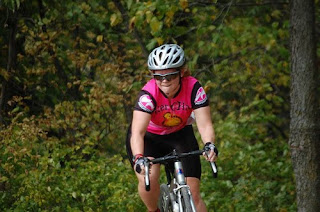
Now for what comes next. If Chris Cross doesn't or can't happen next week (that is if I decide that a cyclocross race isn't worth compromising the long-term health of my ankle), I'm ready to just scrap the cross season. There's always next year, after all.
This next week begins a long-term training plan for me, building up to a 26.2 mile journey in L.A. on March 21. I've always felt sort of ambivalent about marathons. Everyone does them. They don't seem like that big a deal, anymore. It's like a 4-minute mile: still impressive, but not superhuman. At any rate, I wasn't really interested in running one.
But after finishing at Lawrence, my mind started wandering here and here, and even here. And I knew that in order to make those dreams reality, I would (almost) have to run a marathon. (Quick note: I know people who have gone Iron without ever having done a marathon; it's possible, but not something I want to do.)
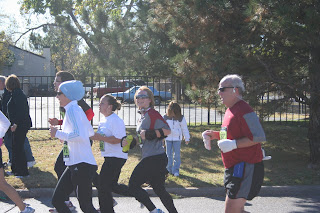
So here's the run-down on Jamie's future: P.F. Chang half-marathon in Phoenix in January. L.A. Marathon in March. Then depending on how that marathon feels . . . well, if it totally kicked my ass, then I'll see you in Lawrence in June. If I finish and I feel good and I feel strong and I feel excited . . .
Then I'll see you here in September.

This next week begins a long-term training plan for me, building up to a 26.2 mile journey in L.A. on March 21. I've always felt sort of ambivalent about marathons. Everyone does them. They don't seem like that big a deal, anymore. It's like a 4-minute mile: still impressive, but not superhuman. At any rate, I wasn't really interested in running one.
But after finishing at Lawrence, my mind started wandering here and here, and even here. And I knew that in order to make those dreams reality, I would (almost) have to run a marathon. (Quick note: I know people who have gone Iron without ever having done a marathon; it's possible, but not something I want to do.)

Then I'll see you here in September.
Friday, October 2, 2009
The Next Step: Chasing it Down

Triathlon is an inherently painful sport; all endurance sports, actually, entail more suffering than most humans (at least humans in our culture) are comfortable with. So when the intense discomfort of racing near your limits smacks you in the face, what do you turn to? How do you ensure that the hard work you've put in leading to your A race doesn't fizzle out when you need it most?
One way is to establish a rival. This is what I did for the Boathouse International Triathlon. I checked the list of registered athletes for women in my age group; I looked up their USAT rankings and previous race performances, trying to determine which ones would pose a threat. I found race pictures of them online and posted them above my desk (note: this creeps people out) with their times from races I'd also been at last year. Seriously. Ask my co-workers and clients. I had to look at those pictures every day, and before going out on training runs, I would see those photos and get a surge of adrenaline that told me, You want it more than they do.
Another method I've used with great success is focusing on a mantra--a phrase you repeat to yourself constantly to drown out the noise of pain and stink of lactate in your body. The best one I've found so far is "Trust the work"; that's what brought me through my first 70.3. But you can use any phrase that you find appealing. Works best when it's short, succinct, and burns an image in your brain. One of my athletes likes to use "Slow and steady"; another took herself through her first tri with the phrase "Home stretch." Keep it appropriate to your goals, though; if you're looking to podium for the first time, "Just finish" is probably not going to be immensely helpful to you.
My favorite method is to get a song stuck in my head. This can be tricky, if you're not a particularly musical person. It can also disrupt your rhythm if you try to match your cadence to an inappropriate song. And I've found that I can't always choose what song ends up swirling around in my brain (it's been this one in every workout I've done for the past two weeks, which is downright annoying). But when your brain hits on the right song--maybe something from your pre-race playlist--and it keeps coming back to (again) drown out the noise of your body, it's golden.
A key thing to note is that different methods are going to work differently for each individual. Personally, the rivalry thing doesn't prompt me to push myself into the realms of true pain. Speedy, on the other hand, thrives on that kind of competition. "Trust the work" brought me to a new half marathon PR, because I knew that I could run 2:15, and I just had to stay on the pace I knew I could run. But when you're racing against other people, it's less effective, because you have to trust that your work is also better than theirs. My most successful method is the song, because I can completely let go and take my brain out of my body. I still have to maintain enough focus and awareness to keep the legs turning over, but I no longer have to think about how bad it's hurting or how much I want it to be over already.
At this point, all I can do is offer you these three strategies, with examples of how they've worked for me. But I'm sure there are other strategies out there. Best bet is to ask more experienced athletes what they do to push themselves through the pain to the next level on race day. Experienced athletes, do you have anything to add? How do you mentally prepare for and execute your race in order to get the most out of training?
Thursday, October 1, 2009
Head Position in Freestyle

So yesterday I was swimming with a pull buoy (because what else can I do with this damn bum ankle?). And I was doing drills and generally enjoying the feel of slipping effortlessly through the water. At any rate, I had my moments. And at one point I lifted my head just a little bit to look slightly ahead in the water. As soon as I did that, I felt my speed increase. It was instantaneous. It was amazing!
It's been a long time since I felt that kind of improvement in my swimming. Crazy thing is that I already knew to do that. I distinctly remember a clinician telling me to look 45* in front of me at a workout in college. And then after I got into Total Immersion and a different clinician told me to get my head down, I started focusing more on streamlining. I just assumed that was the fastest way to swim.
And it might be the fastest way for some people to swim. But apparently not for me.
Sunday, September 27, 2009
Diamond Blackfan Cross Challenge: DNS
Another race missed due to the bum ankle.
Also I had a shitty date.
Also I had a shitty date.
Wednesday, September 23, 2009
As it Stands
I was pretty freaked out by Monday about my ankle. Not sure if this has come up before, but I don't have health insurance. That means that if I fall off my bike and break my collar bone, I am (going to censor my language for the protection of readers who are younger and/or related to me). So all day at work, people kept asking, "Have you seen a doctor yet?" No! You know I don't have health insurance, so you should know that the medical profession is a last-resort type of thing for me! But of course, everyone thinks that doctors are the end-all-be-all to telling you how your body works and what it needs (here's a quick clue: they're not).
But having everyone tell me how important it was that I get it checked out was really making stressed. I started creating scenarios: what if it is broken, or torn? What if I have to have some kind of surgery? What if my ankle is permanently screwed unless I do such-and-such A.S.A.P.?
Then I talked with one of my physical therapist friends (who began by saying, "Have you seen a doctor yet?"). I know there's no telling without an X-ray or possibly and MRI, but in her opinion, the ankle's not swollen enough to indicate break, tear, rupture, or anything else equally unpleasant. She recommended that I go through as full and natural a range of motion with it as possible and put as much weight on it as I could stand. In other words, treat it as close to normally as you can.
So I hobbled around on crutches for a couple days (just to take some of the weight off the leg), and each day has gotten progressively better. Today I'm off the crutches and walking almost normally; if you didn't know I'd been hurt, you wouldn't notice me limping. Ankle is still swollen, and there's going to be some pretty severe bruising, I'm sure. It's tender on the medial side of the Achilles (but it was always sore there, where I have tendinitis), and on the lateral front ankle, where I think I hyper-stretched something (peroneals, maybe?).
I've been swimming with a pull buoy, and lifting weights. I guess one good thing about this injury is that it forces me to do the two things I haven't been doing at all over the past month or two! I think I'll be back on the bike by the weekend, and if it's feeling all right, I'll go ahead and race women's cat 4 at the DeStad opener this weekend; I was really wanting to do all five of those races!
Saturday, September 19, 2009
Race Report: Wichita Cyclocross Weekend, Day 1
I shouldn't have tried to do this race.
I was taking one more lap to practice the course before we started staging. I didn't really want to (it hurt!), but I figured I should make the best of my last 15 minutes and not let my body get cold. Coming up on the second set of barriers, I was moving too fast. I didn't release my right foot in time. My front wheel ran into the barrier. My bike tried to go up and over. My foot tried to stay in the same place. My ankle sort of got caught in the middle.
It seems like I have a pretty hardcore sprain. I've got a puffy, flesh-colored tennis ball connecting my shin to my foot. It was extremely painful for a while. Like crying and quivering kind of painful. Now it's just faded to a dull ache. Hurts to dorsiflex.
As soon as I could (probably about the time the ibuprofen kicked in, actually), I got up and started walking around. USAT club championship is tomorrow at Redman; I was slated to race the sprint. I figured that if nothing else, I could walk the 5k, assuming I could walk. Driving home from the race, I was convincing myself that I could do it, that I should at least drive down to Oklahoma City and see how I felt tomorrow.
My best friend, who broke her ankle freshman year of college (it's still not back to normal), talked me back out of it again. She pointed out that if I tried to walk/run tomorrow, I might damage the ankle further; I might damage it permanently. And she also questioned whether I should really try driving on the interstate (this is my right foot, we're talking about). Sure, I can depress the brake and the accelerator. But if something ran out in front of me and I had to brake quickly, would I be able to?
Ultimately, it's not worth the risk. Redman was important to me, but it's probably not worth the potential long-term problems that running (ha! hobbling) on it at this stage might cause.
So I'm sitting at home with frozen vegetables wrapped around my ankle, which is propped up on a chair.
And the worst part is that I don't even get to try out my new, over-priced, team custom Oakleys.
(Um, actually the worst part is that this is the end of my tri season and I was in great shape for it. But the sunglasses thing is funnier.)
Tuesday, September 15, 2009
The Next Step: Single-Sport Focus

This is the standard view for me when riding with the full-time cyclists.
You are a triathlete. That means you train for three sports simultaneously. You are (as one of my friends once put it) striving to be solidly mediocre in three sports. That means that when you pit yourself up against dedicated swimmers, focused cyclists, and well-trained runners, you are probably going to come up short. Why? Because you're not trying to be the best swimmer, biker, or runner; you're trying to be the best triathlete.
But when the triathlon season is over, there's no reason to continue to pursue adequate mediocrity in three sports at once. Why not focus on just one sport, and get really, really good at it? What if you can make your "solidly mediocre" as good as a single-sport athletes' top performance?
It was this step, more than any other, that brought me more success as a multisport athlete. Running was always my weakness. I didn't like it; I didn't want to do it; it was my primary limiter in every race I did.
But I signed up for a half marathon anyway. And then I did another one. And somewhere in that training to go long, I encountered a runner within myself that I didn't know existed. I started to enjoy running, to look forward to it, to consider myself a runner. Of course, once the triathlon season came back around, I became (once again) a triathlete. But the hard work I'd put in and the improvement I'd seen stuck around, and by this season, I was running 8:30/mile instead of 9:20.
My guess is that for most triathletes who weren't previously athletic, running is the limiter. If you came from a running or cycling background, swimming is probably your biggest struggle. If cycling is your weakness, that's completely legitimate, too. Whatever your weakest sport is, you need to figure that out (I bet you already know it, if you think about it). My recommendation to you is that you do an end-of-season focus on that sport.
The alternative to choosing your weakness is to choose what you like. You probably won't see as much benefit going into next season, as far as catching up to your competition, but you will still come back stronger, more capable, and more confident in your abilities. Last year, I focused on a half marathon at the end of the season, and it saw my average speed drop by 50-60 seconds per mile; this season, I'm focusing on cyclocross and group riding, and I think by the end of next season, I can easily be averaging 22 MPH. That's not going to provide as great an edge as if I were to drop my run times by another 30 seconds per mile. But cyclocross is fun and I'm enjoying racing with my cycling team. (FYI, I'm planning to do a half marathon and marathon after the cyclocross season).
Once you figure out which sport you're going to focus on, here's what you do:
Swim: Find a swim meet in your area or close enough to drive to. Determine which events you'll compete in. Challenge yourself! Don't do three long-distance freestyle events; try the 100 breaststroke, or the 200 IM. Developing your skills in the other competitive swim strokes will give you more overall strength and confidence in the coming year, as well as balance out your muscular engagement (which will reduce your chance of shoulder injury).
From there, you have two options: join a masters swim team and work with them on preparing to race your target meet, or prepare on your own. If you're going to prepare on your own, you need to make a plan. It could be as simple as committing to swim 5 days a week; it could be as involved as building a periodized schedule with weekly yardage and daily training objectives. Read up on swimming--coaching techniques, tapering, stroke mechanics, and so on. The more you learn about your swim stroke from this phase, the more you'll have to bring into your next tri season. If you're going with a masters group, be sure your coach knows about your plans and goals; he or she might not write up a whole plan for you, but you'll get some more specific help in workouts, and maybe even some workouts written with you especially in mind.
Bike: Again, you pick an event. It might be a race. It might be a series of races. It might be a tour; check at a local bike shop, as they'll usually have flyers up, or will at least know the cycling scuttlebutt. Whatever your event, commit to it (psst: that means go ahead and register!). Once you've chosen what to do, start riding with a group. Start with a casual, local ride; again, check with a local bike shop. Be sure to ascertain what kind of pace the group keeps (you need to be able to hang in) and what kind of purposes the ride serves. If you're racing (as opposed to doing a long tour), I highly recommend you find a friend who's into the cycling scene and has some experience with racing. Cycling races aren't quite as beginner-friendly (and not nearly as welcoming) as triathlons. Be prepared for that.
Commit yourself to getting out of your comfort zone. If you're used to riding triathlon-style, you probably prefer to train by yourself. You're not necessarily used to hanging in a draft; you don't often need to feel responsible for holding your line. These are things that are valuable for a triathlete to learn and be comfortable with, just likes it's beneficial to be able to swim all four competitive strokes (yes, even butterfly).
Run: This is probably the easiest of the three to focus on in the off-season. You have a few options available to you as far as how you pursue this emphasis, but all of them start with the same basic premise: choose an event! Maybe you want to gun for a PR at the mile, 5k, or 10k distances. Maybe you want to run your first marathon or half marathon. Maybe you want to try something new, like trail running. Whichever it is, choose an event and commit to it (yep, that means register)!
If you're prepping for a PR, you should already have run the distance you'll be gunning for. You should have an appropriate base of distance built up. And you should already have been working in some intensity (i.e. sprints, intervals, track work). Set up a detailed plan with a couple of speed workouts a week, a long run that isn't more than 50% of your weekly volume, and some cross-training. If you're looking for speed, I recommend 5 days of running per week; if you're not running at least 4, are you really doing a single-sport focus?
If you're shooting for your first half marathon or marathon, it's all about building distance slowly and safely. Otherwise you get hurt. Plan on 3-5 days of running per week, with at least 2 days of cross-training. Look not so much at daily volume as weekly volume, especially at the beginning. The long run becomes all-important eventually, but at first you need to accustom your body to taking so many miles. When in doubt, take it slow. Never increase weekly mileage by more than 10%; never increase your longest run by more than 10%. And don't do all your mileage in one big, long run!
The main physiological benefit you derive from a single-sport focus (in my opinion) is putting in all the time. Because you're not dividing yourself (at least) three ways (we're not even getting into weight lifting, flexibility, yoga, and bricks), you have a lot more time and energy to devote to quality workouts in a single sport. And that leads to big improvement fast.
But equally important is the psychological benefit--you become more confident. I went last year from claiming that my strength was transitions to firmly believing "I am a runner!" And the same will happen to you, whether you choose to spend this season focusing on swimming, biking, or running (or something else entirely; why not focus on weight lifting or yoga?).
So. Which one will you be doing?
Subscribe to:
Posts (Atom)