Tomorrow I'm out to California to wonderful Wildflower! Oh, there will be hella antics.
Or at the very least an underwear run and topless aid station.
And of course beer.
Oh, and I'll also be racing. Or something like that.
Tuesday, April 29, 2008
Sunday, April 20, 2008
Race Report: Emporia Spring Migration Tri
I'm positive that I thought of some clever way to intro this post, but I can't recollect what it was, at the moment. So let's just jump right in.
Swim: 400 m, 7:50
This was slower than I expected (slower than my seed time). The swim worked like this: we all lined up by swim seed and they sent us off on 30 second intervals. And there were about 170 people. Which means that the last person started more than an hour after the person. Crazy, huh? I was seeded number 50, and I felt pretty good about that; it was cool to head towards the front of the line. Unfortunately, most of the athletes I coach were seeded way farther back, which meant that I didn't get to see them swim.
How did the swim feel? Easy. I'm sure it didn't feel easy while I was doing it, but in retrospect it certainly was. At the Central YMCA triathlon, I felt like I was pushing the absolute limits of my pace for 400 meters. But this felt like a steady, aerobic pace. In short, I wasn't really racing. Am I happy with my time? Yeah, I feel okay about it. But the lackadaisical attitude--one that viewed this race more as training than racing (and there's nothing wrong with that)--during the swim was a theme for my day.
Bike: 12.4 mi, 41:27, 17.5 MPH
I'll get right to it: I kicked ass on the bike. 17.5 MPH isn't that fast, really, but I can say most definitely that I laid everything on the line on the bike. I kept a high cadence and a challenging gear through the whole thing, even into the 20 MPH headwinds we experienced after the turn-around. I felt like a frickin' bad-ass. And I suppose that's probably all I need to say about that.
I also nailed my transitions. Managed to start and end with the pedals on the bike, and I'm pretty sure I'm the only one who did that at this race.
Run: 3.1 mi, 28:17, 9:07/mile
This was the real challenge. The course was exceptionally hilly, and I do not do hills well. I'm not built for hills, and I don't have an opportunity to really train on hills (except for the sledding hill in Sedgwick County Park and the dam at Lake Afton). I rounded the corner off of the Emporia State campus and asked the police officer at the corner, "There are no more hills, right?" Ha!
Again, I felt like I wasn't really racing; even in the back of my head, I kept saying "It's just a tempo run." But it wasn't just a tempo run; it was a race. And I kept trying to break through the "race to train" mentality, but I don't think I ever really did; I just managed to find a slightly faster training pace.
But it was a pleasant surprise to get to the end and realize that what i thought was a 12-minute pace turned out to be 9:00! Imagine what I could have done if I had been trying!
Final: 1:17:36, 1st F 20-24, 7th F overall
I could not have been happier with these results. I could have been happier with my performance, for sure, but these results made me kind of forget about the fact that I didn't perform to my full potential. Because it was a little training race, the first of the season. And for me to do so well in the competition when I wasn't even peaking . . .
Well, let's just say I'm very optimistic about this season.
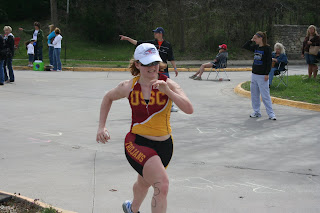
Swim: 400 m, 7:50
This was slower than I expected (slower than my seed time). The swim worked like this: we all lined up by swim seed and they sent us off on 30 second intervals. And there were about 170 people. Which means that the last person started more than an hour after the person. Crazy, huh? I was seeded number 50, and I felt pretty good about that; it was cool to head towards the front of the line. Unfortunately, most of the athletes I coach were seeded way farther back, which meant that I didn't get to see them swim.
How did the swim feel? Easy. I'm sure it didn't feel easy while I was doing it, but in retrospect it certainly was. At the Central YMCA triathlon, I felt like I was pushing the absolute limits of my pace for 400 meters. But this felt like a steady, aerobic pace. In short, I wasn't really racing. Am I happy with my time? Yeah, I feel okay about it. But the lackadaisical attitude--one that viewed this race more as training than racing (and there's nothing wrong with that)--during the swim was a theme for my day.
Bike: 12.4 mi, 41:27, 17.5 MPH
I'll get right to it: I kicked ass on the bike. 17.5 MPH isn't that fast, really, but I can say most definitely that I laid everything on the line on the bike. I kept a high cadence and a challenging gear through the whole thing, even into the 20 MPH headwinds we experienced after the turn-around. I felt like a frickin' bad-ass. And I suppose that's probably all I need to say about that.
I also nailed my transitions. Managed to start and end with the pedals on the bike, and I'm pretty sure I'm the only one who did that at this race.
Run: 3.1 mi, 28:17, 9:07/mile
This was the real challenge. The course was exceptionally hilly, and I do not do hills well. I'm not built for hills, and I don't have an opportunity to really train on hills (except for the sledding hill in Sedgwick County Park and the dam at Lake Afton). I rounded the corner off of the Emporia State campus and asked the police officer at the corner, "There are no more hills, right?" Ha!
Again, I felt like I wasn't really racing; even in the back of my head, I kept saying "It's just a tempo run." But it wasn't just a tempo run; it was a race. And I kept trying to break through the "race to train" mentality, but I don't think I ever really did; I just managed to find a slightly faster training pace.
But it was a pleasant surprise to get to the end and realize that what i thought was a 12-minute pace turned out to be 9:00! Imagine what I could have done if I had been trying!
Final: 1:17:36, 1st F 20-24, 7th F overall
I could not have been happier with these results. I could have been happier with my performance, for sure, but these results made me kind of forget about the fact that I didn't perform to my full potential. Because it was a little training race, the first of the season. And for me to do so well in the competition when I wasn't even peaking . . .
Well, let's just say I'm very optimistic about this season.

Saturday, April 19, 2008
Pre-Race
I am so excited.
I suppose this should be obvious, but the prospect of the first real race (even though it's in an indoor pool) of the season has focused my workouts in a way I've never before experienced. I was so focused, the second half of this week (I was still in recovery mode until Wednesday) I sort of killed my cycling classes. Seriously, Thursday night, all I could think was, "Hard as you can; c'mon this is the last chance to get a really solid workout before Emporia." And by the end, I think some of the people in the Group Ride class were crying. We all had little puddles under my bike, anyway. At any rate, I think I made half the class wish I had a race every weekend, while the other half is probably hoping I never race again.
It's always an interesting experience, dragging a dozen people along mostly on your own energy. Empowering.
Talk to you after the race!
Wednesday, April 16, 2008
Beginners' Guide: Finding Your Focus
It's a lot to deal with, isn't it? You sign up for a race, you start running around the block, attending bike classes at your local gym, struggling across the local pool in 25- and 50-yard bursts . . . And you're getting the hang of it. You're starting to feel really good about finishing that first race. You're pretty sure that you can do it.
But you're also trolling around the internet like a madman. Madwoman. Crazy person. Whichever politically correct moniker you prefer. You're looking for articles, blogs, race reports, collecting ever scrap of advice that could possibly help you. And you're starting to feel a little bit overwhelmed.
I had the same problem, and I'm realizing that I've passed on the same thing to the beginners I coach in my club. It's difficult to separate out what resources are beneficial for the beginner, what workouts will be helpful for them, what to tell them without completely freaking them out.
What I'm discovering (I think) is that it's vitally important to find a single thing on which to focus. This holds true for more experienced athletes, as well; for example, my single biggest goal for this year is to place in my age group at Shawnee Mission. That is the primary driving force behind my training. Notice I said "primary"; it's not like I'm working harder in every tough workout by chanting "Shawnee Mission Shawnee Mission Shawnee Mission." I'm also focused on building mental toughness, harnessing more discipline, building a stronger aerobic base; I have a handful of goals that are jostling in the back of my head during every workout.
I propose that the difference between the first-timer and the experienced triathlete--even a newly-minted, fresh-from-the-first-race green horn--is that the athlete with experience knows what they want and need. Athletes fresh from their first race will know exactly what I'm talking about. As you're running the last miles of your race, or right after you cross the finish line, you think, "This is what I want to do differently next time."
That next time is your focus. Until you've got that focus, all of your internet trolling, your message board questions, your desperate search through the library to find a triathlon book that was published more recently than 1998 is nothing more than guesswork. You might know roughly what you need to do (i.e. learn to swim), but as far as the kind of nuanced training suggestions you get from training guides (i.e. setting up complicated schedules based on percentages of time spent in each of five training zones) will be pretty useless to you.
With that in mind, I'd like to suggest the following focal point for the n00b: get through that first race. I absolutely guarantee that after that first race you'll have a much better sense of what you need to do. After that first race you can work on taking flying leaps onto your bike, setting up your transition area just so, shaving off seconds on the bike with advanced aerodynamic techniques (not to mention shaving your legs, men), and finding the perfect suit to wear.
Also keep in mind that even the first Ironman athletes were pretty dorky (see some of the early Kona experiences in Becoming an Ironman for a perfect example). None of us are going to laugh at you if you're wearing basketball shorts, your race shirt, and your son's bike helmet; I've been passed by people dressed exactly thus while riding a beat-up mountain bike--believe me, there was no laughing when they pushed past me up the hills at Pumpkinman a couple years ago.
My point is that you just need to get a race under your belt, then take it from there. Then after you've done that first race, post a race report somewhere online; not only will you probably get helpful responses from fellow athletes (and a big welcome to the community), you'll also have a better sense from writing out your experience what you want to do next time.
Triathlon is a sport that rewards attention to detail and dropping big bucks on equipment, but almost all of us did it the hard way first. If you read Becoming an Ironman (which I highly recommend), you realize that everyone--even the most elite competitors--started at square one, not knowing this sport or how to handle it. And there's something beautifully poignant about that initial confusion, the first few tentative steps into what is a very complex and intimidating world. Think of it as a coming-of-age.
And as rites of passage go, it sure beats a bris.
Tuesday, April 15, 2008
Moments in Tri
Note: I was going to title this entry "Moments in Tri-me," but I thought that might be just a little too much.
We have some pretty amazing moments in our sport, captured on video and preserved for posterity. Most famous? The 1982 Kailua Kona Ironman where Julie Moss collapsed 30 yards from a first-place finish.
The drama of this moment catapaulted the sport into the public eye, prompting millions (just kidding; at that point, there were probably only a couple thousand crazies) to internally ponder, "I wonder if I could do that."
Great moment in the sport. No question about it.
Then there's the Dave Scott/Mark Allen "Ironwar" of 1989 (and I know that the commentary on these is inane and annoying; sorry).
You guys might already know that I really enjoy watching the ITU World Cup races; it's a great way to take in the sport as a spectator (because Ironman isn't terribly spectator-friendly). My favorites to watch are the battles between Vanessa Fernandez and Emma Snowsill. Example:
No doubt about it; the visual stimulation to our triathlon sensibilities is pretty well fleshed out, electronically speaking.
Now you wanna see my favorite moment, the greatest moment ever in triathlon videography?
Now doesn't that make you want to hop out of your seat, a little? Doesn't it make you pull up your calendar and check again how many days/weeks/months you have until your next event?
Isn't that kind of excitement what it's all about?
I love this video because it captures so completely the reason I still do this crazy sport. It's exciting. "How many minutes to go? Two? EEEE!" It might be the challenge, the bombastic, "Heck, I can do that if she can!" attitude that drew me to the sport in the first place, but it's that intense excitement, the endless attention to detail to eke out every bit of speed and skill, the constant nitpicking and readjustments to training the schedules, the sleepless nights before a race . . .
That's what keeps me in this sport.
Do you have a favorite moment in triathlon history, be it video, audio, print, or personal? Share in the comments!
Thursday, April 10, 2008
The Triathlete's Non-Sand Cookbook
Props to SpeedRacer for her recent foray into a thriving lifestyle. Like (I would estimate) many triathletes, Speedy would be totally willing to eat sand (or at least food that tastes like sand) for the next ten years if it meant she could be competitive, like really competitive (actually, come to think of it, how competitive, Speedy? Like qualifying for Kona competitive or like qualifying for the Olympics competitive?).
But Speedy is a much better person than I am. I would much rather not eat sand and be slow. But I think it's because I believe that it's possible to have the best of both worlds--that is, you can eat well for your body while still enjoying your food. To be sure, this attitude takes some readjustment of your taste buds. Personally, I can have a great time with a bowl of brown rice and some steamed vegetables without even salt and pepper. But I know that not everyone has such a highly developed palette (read: boring taste buds), so I submit a few of my favorites for your non-sandy dining pleasure.
For breakfast, I mix plain yogurt (if you get vanilla or some other flavor, check the ingredients for nasty additives like high fructose corn syrup) with a handful of berries (I currently have fresh blue and black) and a handful of nuts (currently almonds). The berries lend sweetness, the almonds add crunch. The yogurt is an awesome source of complete protein (sorry, vegans) and vitamin B12 (very important for athletes!). Bonus is that it's very filling.
My new favorite thing to take for lunch is a tomato soup (actually, it's kind of like gazpacho, now that I think about it) I make by combining one can of tomatoes (the kind that are pre-seasoned, either with Mexican or Italian seasonings) with whatever frozen vegetables I have around. I cook it until it's hot and the vegetables are cooked, then eat it. It's a great way to get a ton of vegetables, and it tastes awesome. You don't have to add any additional spices, either.
I also really enjoy making wasabi peas by microwaving some frozen peas then mixing in some wasabi and soy sauce. Delicious. I obviously use quite a lot of frozen vegetables. Not raw, sorry; if I'm going to go raw for lunch, I just eat a salad. Always keep ingredients for a salad around. Quicker and easier and more healthful even than whole grains.
I can't think of anything quick and easy that I do for dinner (by the time I get home from work, it doesn't make sense for me to eat a full meal, anyway), but I'll give you a quick recipe for a snack: green smoothie. Mix whatever fruit you have around in a blender (this morning I used an orange and a handful of frozen strawberries), adding enough water to get your preferred consistency. Then throw in 1/2 cup to a cup of leafy greens--I prefer spinach or romaine lettuce; Kale tastes funny to me. The color will be unpleasant, to say the least. Also, be very sure to add enough water to thin it out; otherwise you will want to vomit with every sip. Bonus points for adding superfood powders like spirulina, chlorella, maca, etc. (this morning I used some hemp protein powder). The key for the smoothie is to start with a good base of fruit that you'll enjoy.
For more ideas for healthy, quick, and easy recipes, check out Ben Greenfield's article on Trifuel. Those are all great ideas as well. Sound off with your favorite quick, easy, and nutritious recipes in the comments.
Wednesday, April 9, 2008
Uphills
About 1/2 a mile from my place of work, there is a hill. Please understand the significance of this statement; I live in central Kansas. This might be the only hill within a 5 mile radius (not including highway on-ramps and the sledding hill in Sedgwick County Park). It's not a particularly big hill or a particularly long hill. But this morning it was enough to set me off. I was driving up this tiny hill after lunch when my mind shot out of my body and onto the race course at Shawnee Mission.
The Shawnee Mission Triathlon bike course is somewhat notorious in these parts, a gruesomely hilly 4.5 mile loop which competitors (on the long course) must repeat four times--a quartet of cardiac-arresting climbs, followed by a brief 1/2 mile of flat terrain before repeating the whole thing. Okay, really it's not that bad. The total elevation gain is like 400-450 feet per loop (1800 total feet climbed), and I've definitely raced more difficult courses than that (Pumpkinman, for one, and soon Wildflower). But it feels like a lot of climbing, especially when you already know what's waiting for you on the next three loops.
All of which is beside the point. Because when I was driving up that teeny tiny baby hill this afternoon, I wasn't thinking about how difficult all that climbing will be, or how much it's going to hurt, or how lame I am for thinking 400 feet of elevation gain is even that much. In that moment, I got that sinking, bubbly feeling in my stomach that's sort of like being slightly too buzzed.
It's the feeling of simultaneously thinking "I can't believe I get to do this again!" and "Why the hell am I doing this again?" It's the same feeling that you have the night/week/month before a race when you know you need to sleep but you can't seem to. It's the feeling that makes you pace and posture and get to transition two and a half hours before the race starts.
It's the feeling that fills port-a-johns.
And it's here, already, more than three months away from Shawnee Mission, still two weeks out from my first race of the season.
 I really want this one, guys; it's what it's all about, this year.
Tuesday, April 8, 2008
We Interrupt Your Regularly Scheduled Podcast . . .
You know how difficult it is to do Tabata intervals on the bike by yourself? It's a frickin' pain in the butt. I did a set the other day, trying to balance my stopwatch so I could see it the whole time, trying to push through every interval when I was ready to stop after two, trying to look at the time through the pain.
So I thought I'd give my fellow cyclists a little help in this respect. Set your bike up on the trainer and get ready to work!
(For more on Tabata intervals see the following:
http://www.active.com/triathlon/Articles/Go-for-Broke-with-Tabata-Intervals.htm
http://www.ncbi.nlm.nih.gov/pubmed/8897392)
Tri Harder Podcast: Tabata Intervals
Looking for more workouts? Go here!
Sunday, April 6, 2008
50 Degrees
First open water swim of the year! Woohoo! It was frickin' cold, so cold that when I put my face in I got an instant headache. Brainfreeze. But after I got warmed up, it felt pretty nice. And I finally got to use my new wetsuit (which works beautifully).
Tuesday, April 1, 2008
Quick Notes
Thanks for all the responses about the pain in my ass! I saw a physical therapist today, who suspects that the problem is my SI joint, with unrelated pains coming from trigger points in my piriformis and gluteus medius. Cool. No bulging discs, no ruptured or torn anything . . . and I can still run (although he instructed me to start at a mile and gradually build up, mile by mile, over the next several weeks) and can still bike (but he told me to stay out of the aerobars), so all's well, right? Oh, and I'm also not supposed to bend over at the waist. So no more straight-leg deadlifts. Anyway, that's that, and I'll go out for a mile run tomorrow (although it hardly seems worth it for a mile, eh?)
I booked my flight to sunny California for Wildflower tonight. Anyone else going to be there?
This month is National Poetry Writing Month (NaPoWriMo) Which isn't really related to this blog, but it's fun and I thought I'd throw it in. My poetry lives over here (in small, very strong cages; I don't want it to get out), just in case you need a little break from the tri lifestyle (or tri-ing, if you like).
Be back in a few days with a surprise podcast!
Saturday, March 29, 2008
The Tragic Tale of the Pain in my Ass
Sigh. In the past year, the only injury I've had has been rock-climbing related. I think that run is at an end.
Starting last Sunday, I had a little twinge in my back. I didn't think much of it. Figured I had slept wrong and it would go away in a couple of days. When I went out to run that day, I sort of ran out of steam after about a mile. I wasn't tired; I didn't hurt; I just sort of . . . stopped. When I got back to my house, my dad said, "Well, there was probably a reason why you didn't want to run today." Whatever, I thought. The reason is because I suck!
The next day, I went to Pawnee Prairie Park to try that long run again. I thought that it would be more interesting and therefore more bearable to run on trails than on the long, straight, boring dirt roads. And I was correct! After the first ten minutes, I felt right as rain and at peace with the whole world, running over a soft, grassy trail and enjoying the sounds of nature.
Then, after about 20 minutes, I felt a little niggling pain in my right buttock, just to the right of my sacrum. Ooh, I thought. I don't think that's good. So I slowed to a walk, trying to determine what that pain might possibly be. After a few minutes of walking, it went away, so I tried again. Nope, there it is again. And I continued in that manner for the next 20 minutes or so, experimenting with walking and running to see what caused pain and what didn't. It was never so bad that I couldn't have run through it; I could definitely have kept going through this pain. But it was the kind of pain that made me slow down because something is definitely wrong back there.
Tuesday I managed a twenty-mile bike workout without pain, but today's spinning class brought it out. I have an appointment with a physical therapist on Tuesday, so we'll see what's up. I think that it's sciatic pain brought on by knots and tension in my piriformis, but considering the alternative possible causes (i.e. a herniated disc), I think it's best to be sure. Until then, I will not be running or cycling (except for my Monday morning spin class).
And that is the tragic tale of the pain in my ass.
Ironmom: A Swim Workout to be Eager For
Thanks to Robin for this swim workout, which has kicked my butt for the last two weeks' interval swims, and has presented me with my fastest 100 splits EVER. Give it a try as you start to work speed and power into your swim sets:
6 x 100 Fast
2 x 50 Focus on technique
5 x 100 Fast
2 x 50 Technique
4 x 100 Fast
2 x 50 Technique
3 x 100 Fast
2 x 50 Technique
2 x 100 Fast
2 x 50 Technique
Robin didn't specify rest intervals, so here's what I did:
100 SKIPS (swim, kick, IM, pull, swim)
5x100 fast on 3:00 interval
2x50 for technique
4x100 fast w/ 1:00 RI (rest interval)
2x50 for technique
3x100 fast on 2:00 interval
2x50 for technique
2x100 fast w/ 1:00 RI
100 cool down
I think the 3:00 intervals were a little long; they enabled me to pretty much fully clear the lactate from my blood, starting each repeat fresh. The 1:00 rest interval was challenging; I saw my form and speed deteriorate over the course. The 2:00 intervals were frickin' hard, but I only lost :02 between the first and last repeat. I averaged about 1:38-1:39 on my splits, with the fastest being 1:35 and the slowest 1:44 (the very last 100). But the whole workout was fully awesome.
Thanks, Robin, for a wonderful workout!
Thursday, March 27, 2008
Spinning Workout 18 - Rollers
A new workout! Woohoo!
SPINNING WORKOUT 18 - ROLLERS (45 minutes)
Higher (3:55): Pre
What I'm Trying to Say (3:23): Pre
Porcelain (4:01): Pre
Rockin' the Suburbs (4:29): Warm up with one light climb; +(5), up @ 2nd chorus; -(4), down @ last chorus
Karma (4:18): Moderate to high climb; +(5) @ beginning; +(6), up @ verse, stay quick; +(7), stay quick @ “I remember when”; -(6) @ chorus; +(7) @ “I remember when”; +(8) @ 2nd time through chorus to end
Hey Baby (3:29): Descent; quick break to coast and bring resistance back down; beginning in (3), easy, quick spin; small increase every 64 counts (just enough to feel a little change); at (4)-(5) @ chorus; in (4), easy, quick spin; small increase every 64 counts; (4)-(5) @ chorus; quick in (5) at chant; add a little bit @ last chorus; pick up tempo @ 2nd time through chorus
Can't Stop (4:29): Moderate climb; intro to cruise, build to cadence; in (5) or just a little above, find climbing rhythm; add a little at 2nd half of verse; +(6), up @ 2nd verse; add a little at 2nd half of verse; down in (6) @ bridge, guitar solo; +(7), up @ last verse
Way Away (3:22): Descent; coast @ intro; begin in (3), easy, quick spin; add a little resistance @ 2nd half of verse; pick up tempo @ chorus; back off tempo at MT; +(4) @ 2nd verse; add a little at 2nd half of verse; pick up tempo @ chorus; back off @ bridge; add a little resistance every 16 counts; pick up tempo @ chorus
Satin in a Coffin (2:37): Moderate climb; ++(6), up, @ verse; +(7) @ 2nd time through verse; standing recovery @ slow bit; follow rhythm as it builds speed; back off resistance, cruise as music fades
The Machine Gun Song (2:51): Descent; in (4), match cadence; +(5), up @ chorus; -(4), down @ 2nd chorus; +(5) @ bridge; up @ next verse, stay up until end
Everlong (4:11): Descent; in (3), build to cadence; add a little at full entrance; add a little more every 32 beats during verse; don't add at MT; add every 32 beats during verse; +(5), up @ chorus; repeat sequence; rest during quiet interlude; build during song build; +(5), up @ last chorus
We're Not Gonna Take It (3:35): Moderate climb; stay in (5), down, quick; +(6), up @ chorus; down @ 2nd verse; +(7), up @ 2nd chorus; -(6) @ guitar solo; +(7) @ last chorus; -(6) @ fade
Carbon Monoxide (3:10): Moderate to hard climb; find rhythm in (6), standing; sit, maintain rhythm (adjust resistance if necessary) @ 2nd verse; +(6), up @ chorus; -(5), down, at quiet part; +(6), up @ chorus
I Ain't Saying my Goodbyes (3:43): Hard climb; cruise during intro; find rhythm in (6), up, @ full instrumental intro; add a touch @ 2nd time through verse; +(7) @ chorus; option to climb seated @ instrumental break; +(8), everyone up @ chorus; extra credit addition @ “you don't get upset,” stay consistent
Are You Gonna be my Girl (3:39): Cool down; cruise @ beginning; if you want to spin out quick on the descent, also acceptable
Somewhere Only We Know (3:57): Post
Looking for more workouts? Go here!
Quick Catch Video
I had a few questions about how exactly one does the Quick Catch drill which has been so helpful for me. And what better way to demonstrate than in film? Also see Dave Scott's video, which is actually filmed on a pool deck with real swimmers (not in a bedroom with a webcam)! Any more questions about this drill (or any others), just let me know in the comments.
Wednesday, March 26, 2008
Go read Wil's insightful (and well-written) post. Then come back here.
I've mentioned before that I'm not ready to tackle Ironman, yet. I believe there will be a time for me to take my training to that level, but it's not now.
And looking ahead to that time when I will inevitably face a long day of hard work . . . looking even beyond that to when I have that day--whether it be twelve hours or seventeen--behind me . . .
I wonder what comes next.
After rising to what is arguably the greatest challenge of our age--the most demanding, the most grueling, the most gut-wrenchingly humbling--after conquering that, what's left? Where do I go from there?
I think I go back to whatever it was I did before I started running.
I don't mean running in a literal sense. I mean that there were things in my life that I was confronting before I got into this whole triathlon thing. I faced pain. I suffered. I uncovered wounds I never knew I had. I wrote angst-filled poetry. For some reason, all of that got pushed to the background after my first triathlon. Well, not immediately. It sort of faded away. I've been thinking that it's a result of moving into the workforce, that it's because I have a full-time job and don't have time for the angst, the philosophy, the exploration of my own self and soul. But maybe it has more to do with sport than I realize.
Far be it from me to describe sport as escapism; that word is entirely too pejorative. No, it's more like sport provides a training ground for me, a temporary place from which I can safely step back, observe the world, and learn. It's teaching me discipline (self-control), endurance (perseverance), and the virtue of carrying on through suffering (or, as Wil said, carrying a cross).
Maybe that's why some athletes feel compelled to run double- or even triple-Ironmans (Ironmen?) . . . they just need a little more training.
Thanks to Wil for the insight and inspiration. Feel free to add your thoughts in the comments.
Sunday, March 23, 2008

Friday, March 21, 2008
Getting Over the Hump: Overcoming March Malaise
What a crappy time to feel lack of motivation in training. The weather's starting to warm up; the equinox has come; we have more daylight, more warmth, less wind . . . and here we are reading blogs, putting off the inevitable swim, bike, run, weights, core, technique, drills, tempo, flexibility . . . It's all so overwhelming, and we don't want to do it anymore.
It seems to be a common problem, this time of year: I know I'm feeling it; several of the athletes I coach have mentioned it; I have a friend in Germany who just e-mailed me about the same thing--March Malaise; March Melancholy; March Mediocrity; March Don't-Make-Me.
Why is that? Like I said, it's the perfect time of year for training. We should all be chomping at our respective bits, rather than dreading the next workout!
I think it's because we've been training for several months, all in base training. We've worked our asses off since January, but have seen precious little result. Plus, the long steady work is starting to take its toll; after all, there are only so many times you can listen to your Long Run Ultra-Hardcore Superstar Like-Macca Playlist before you go a little nutty (and know exactly which song comes next).
If you're starting to feel a little lackluster in your training week, here are my ideas for putting some spark back into your schedule:
- Throw in some intensity. Do some fartlek work in your long workouts. Fartlek means speed play. So play! Have fun with it! Include some short intervals in your tempo workouts. Add a big kick to the end of your workouts. If you've already worked through months of base work, some high-intensity training is not going to jeopardize your path to peak fitness.
- Cross train. I know, I know; that's kind of our whole sport. I mean try something new. Find a climbing wall (or, if you are so fortunate to live in an area that has those funny things called mountains, get out and climb); take yoga or pilates; play basketball or soccer with your kids. Shake things up a little.
- Get outside! Bonus points for going with friends.
- Buy gear. You know that as soon as you pick up new equipment, you can't wait to try it out. It can be something small and simple (and cheap!) like new goggles, a running cap, or . . . okay, I can't think of anything small, simple, and cheap that you would need on your bike. What can I say? It's an expensive sport.
- Reflect on your goals. This is the one that has by far been the most helpful for me. Take some time to think about what you want from this season and what it will take to get it. If you can remind yourself why you're working so hard and keep those things in front of you all the time, your motivation will strengthen. I recently finished a book that suggested writing down your goals and using a colored dot (or gold star, or anything similar) next to each goal. Let's say I place a red dot next to each goal on my goal sheet (I actually use a pocket-sized notebook for this). Then I put red dots on my toothpaste, my phone, my watch, my computer screen . . . Everywhere I look, I'm constantly reminded of my goals. Pretty soon, I think of my goals when I see a stop sign, or a red light. Even thinking about the technique gets me excited!
- Rest. This is a big one. Don't skimp on recovery. Lack of motivation and general ennui are some of the symptoms of overtraining. Remember that it's better to be 10% undertrained than 1% overtrained, come race day. If you've been pushing hard and your body starts to say, "Hey! I don't wanna do this!" then listen! One thing I've done in my recovery weeks is replace scheduled workouts with goal sessions; two birds with one stone (I know you triathletes love that multi-tasking stuff)!
Wednesday, March 19, 2008
Wildflower
I am officially registered for Wildflower.
And at $175 for race entry alone, I'm definitely committed.
Look for a video on quick-catch, a new cycling workout, and an article on getting over the hump in the next week.
And at $175 for race entry alone, I'm definitely committed.
Look for a video on quick-catch, a new cycling workout, and an article on getting over the hump in the next week.
Wednesday, March 12, 2008
Mental Training: A Break from your Regularly Scheduled Podcast
Well this is an experiment. I've read a few articles on mental training in the past few months. I'm guilty of not training the mental side of my racing hard enough, and I'm sure you are, too.
So I decided that guided meditation might work as a way to help us all prepare a little bit better for that next open water race.
Let me know whether or not this works for you: Is it helpful to have someone talk you through something we all should be doing anyway? What would make it more effective? More space between comments to absorb what I'm saying? Different conditions (i.e. a cold open-water swim, lake swim, river swim, swim through high surf, pool swim, etc.)? Corny Tai Chi music?
I would appreciate any feedback on this little project of mine. Let me know if you want more!
Mental Tri Training: Open Water Swim
"This audio file is a guided meditation for the use of open-water swimmers. In it, you will focus on relaxing and practicing good form. Try to visualize yourself completing each movement. The more real it is in your mind, the more beneficial the meditation will be in improving your neuromuscular performance in swimming."
Monday, March 10, 2008
Quick Catch
On my faster swim pace:
I've seen a 10-20 second decrease in the pace of my 100 yard repeats in the past month. I attribute the bulk of this new speed to one drill: the quick catch drill.
I spent all of last summer working on my balance on body position. I spent the off-season focusing on my recovery, entry, and breathing. By January, I was looking pretty good in the water. But I still wasn't going anywhere (at least nowhere fast). Focusing on my catch has allowed me to apply more power to the water using my arms, shoulders, back, and core. It took about a month of doing quick catch drills constantly--the first workout I tried it, I could only do about 30 meters before my arms were exhausted--for me to work the concept into my stroke, but it was definitely worth it.
I recommend doing the following sets (maybe not all at once, though) to help you incorporate the quick catch.
Drill Set 1
8x100 as
25 quick catch
25 fist swim
25 quick catch
25 regular swim
4x25 as fast as possible while maintaining the feel of quick catch
Drill Set 2
8x50 drill quick catch/50 swim (if you can't do quick catch for a full 50 to begin, do alternate 25 drill by 25 swim)
4x25 as fast as possible while maintaining perfect form
Drill Set 3
8x50 fingertip drag, incorporating the feel of quick catch (I love using fingertip drag as a base for focusing on other drill points, because it forces you to swim slowly with relaxed arms)
8x25 quick catch drill with high arm turnover
Quick catch drill isn't the secret to success for all mid-level swimmers, but it is the next step for many of the athletes I'm coaching currently, so I bet that it'll also apply to some of you.
For more on why quick catch is important, read this.
Subscribe to:
Posts (Atom)