Monday, March 29, 2010

Runner's High: Dad

This is us at the opera. This is not what we look like running.
I love my Dad. He is the epitome of the phrase, "Slow and steady wins the race." He's one of my biggest fans, and one of my most constant companions. He started cycling a year or two before I did; he's run for as long as I can remember (off and on . . . okay, more off than on). When I was young, he always tried to get me to go out running with him. On several occasions, he signed me up for local 2-mile races . . . which I may or may not have wanted to do (but mostly the latter).

As of yesterday, he's still trying to get me to run.

Because I overslept yesterday morning and missed the wonderful companionship of the Derby Sunday morning 10-miler group. And so I told myself I would go running on my own. But it didn't take much convincing for me to avoid the 15 MPH northern winds and stay in my bed reading a book instead. I took the dog out for a run (all of 15 minutes in the cold and breezy). Then I spent the afternoon watching basketball.

Let me make it very clear: I did not want to run yesterday.

But I made the mistake of asking my dad if he planned to run. His response? "Sure! I'm ready whenever you are!"

So we went out to do a little 2 miles. I made the additional mistake of telling him I planned to do a 2-mile warm-up, followed by 14 minutes at tempo. After we finished our little 2-mile out-and-back (with me grumping all the way about how my legs hurt and I didn't want to run and my body didn't feel like it wanted to do this), he said, "I'll take your coat in if you want to keep running." Whine . . . sigh. I walked back and forth, debating whether or not I wanted to go ahead with the tempo run, and finally told myself, "It's only 7 minutes out and 7 minutes back; it would be silly not to do it." So I sighed again and said, "Alright, I'll do it. If it hurts too bad, I can always turn around and come back after a few minutes."

What does my dad do? He runs with me. "You can just run on ahead, and I'll turn back whenever you turn back." Of course, once we got started, I had to finish it. So I ran my full warm up, and my full tempo run, and another 10 minutes of cool down, as well.

And I wouldn't have done any of it without my dad.

Monday, March 22, 2010

Beginners' Guide: Synthesis

Beginners' articles, for the most part, come in one of two flavors (no, not chocolate and vanilla): either they tell you the same information as every other beginners' article, or they try to share new tips, most of which don't really apply to beginners. Now neither one is necessarily bad, mind you. In fact, the former is highly useful, and the latter can be useful (eventually).


The problem, I think, is that the people with the information--those of us who have been there, those of us who have done that, those of us who have learned all the things beginners need to know--have forgotten what it's like to be the greenhorn. You remember how in middle school, you just knew that your teachers (and parents and lunch ladies and principles and every other person over the age of 20) had no idea what you were going through? Well, same thing. You get to a certain point in your training, and you forget the kinds of struggles that newbies have. You forget that sense of dread and fear on race day, the confusion of the transition area, the fear that everyone else knows what to do except you.


Point is, those of us who have been there and done that are only so helpful. Sure, we try to answer your questions on blogs and message boards, at pools and in cycling classes. But in the end, you have to be able to bring this information together for yourself. You have to be able to synthesize.


Example? This article offers great tips for beginners. Sign up for a race, get a bike, have someone watch your stroke. Check. Those are all good things. But the article doesn't really break down for you how you're supposed to go from (hypothetically) the Couch to 5k plan you just completed to getting through your first triathlon.


This article isn't going to solve that problem for you, either. Why? Because there's plenty of information out there that already does that. The tips I want to give you are how to start building a mental picture of what it'll take to get you to the finish line your first time around. And here they are:
  1. Read voraciously. Seriously. There are so many websites. There are so many books. There are so many blogs. If all else fails, pull up Google and do a search for what you want to know (i.e. "Do people ever die in the swim?"). Read articles. Check out books and magazines from the library. Borrow books from friends. Ask for recommendations. Follow triathletes on Twitter. Just start putting information into your brain.
  2. Talk to everyone. Okay, probably not everyone has a bunch of athlete friends around. I know some of you are preparing for your first race in isolation. But you have this big, wide, online, global community at your fingertips. Take advantage of it. Ask questions on message boards. Ask questions on Twitter. Ask questions on blogs. You may have noticed that triathletes are a pretty evangelistic bunch. We want you to be part of our sport. So we're happy to answer your questions.
  3. Read between the lines. Now for the tricky part. Some of the articles are wrong. Some of the books are out-of-date. Some of the people don't know what they're talking about. So use your common sense, and always get a second opinion. If you read in a book from 1995 that heart rate monitoring is the hottest, most important new advance in endurance sports training, you might just look around for some new info (i.e. something written in the past 5 years or so). Again, there's so much raw information available, you shouldn't ever trust a single resource (yeah, even me).
And just in case you don't know where to start looking, here are some links to useful resources:
Beginner Triathlete
Trifuel
Slowtwitch
Triathlete Magazine (InsideTri)
Trihardist's Beginners' Guide
Ontri

Sunday, March 7, 2010

Recipe File: Jamie's Pasta al Diablo


Pasta in the style of the devil. Yum!

Here's how I do cooking:
At store: "Hmm, whole-wheat pasta sounds good. Also mushrooms. Ooh, look! Mini Naked juices! Cheap mini Naked juices! Score!"
At home: "Okay, water on to boil . . . I'm craving some garlic. Five cloves should about do it. Lots of olive oil, low heat . . . Now what else will go with garlic? Might as well use those mushrooms. Rough chop . . . And that would be really good with some tomatoes, too . . . Let's see what's in the fridge. Leftover chipotle peppers? Perfect! It'll be a spicy one . . . Fine chop on those . . . Ooh, sweet yellow bell peppers! That'll be great! Now all those into the mix . . . Hmm, maybe sun-dried tomatoes instead of fresh . . . Whoa, too spicy! What about some tomato paste . . . Yes, that's better; a little sweeter. And oregano! Oregano will go great with these flavors!"

And that's how I come up with new recipes.

Be aware that this one takes a little while. Figure about 30 minutes on prep time.

2 oz whole-wheat pasta (I used thin spaghetti)
Boiling water (reserve some of the water the pasta cooked in for the sauce)
Extra virgin olive oil
Fresh garlic (I used 6 cloves)
Fresh mushrooms (must be fresh, and I used 3 large ones)
Fresh sweet bell pepper (yellow, orange, or red, as green won't be sweat enough. I'm sure roasted red peppers would be good, too. I used about a quarter of a pepper.)
2 small chipotle peppers (reserve some of the sauce from
Sun-dried tomatoes (I used a handful of grape tomatoes that I dehydrated myself)
Tomato paste
Oregano
Kleenex (trust me)

Start by boiling water with a generous amount of olive oil and salt over high heat. After it comes to a rolling boil, add the pasta and cook for 6-8 minutes. While the water is boiling and the pasta is cooking, prep your veggies and other stuff. Roughly chop the garlic, mushrooms, and sweet pepper. Finely chop the sun-dried tomatoes and chipotle peppers. Start a saute pan over low heat with a generous amount of extra virgin olive oil (if you say E.V.O.O. I'm gonna punch you in the face) and the roughly chopped garlic. Keep the heat low, and let it simmer for about 10 minutes (until the garlic starts to soften; this makes the garlic soft and mild and delicious and also flavors the oil). By this time, the pasta should be done. Reserve 1-2 cups of the water from the pasta, then strain the pasta and run cool water over it to make sure the cooking process stops. Set the pasta aside.

When the garlic is soft and starting to turn translucent, add all the chopped elements (mushrooms, peppers, tomatoes, anything else you like). Let the mushrooms and peppers soften, and the flavors come together a little bit. Next, add the liquid from the chipotle peppers, about a tablespoon of it (you can do more, depending on how spicy you like it). Let that cook together for a minute or two. Then add the tomato paste. Start with a tablespoon or so, and add more to taste. You want the sweetness of the tomato to balance out the intense heat of the peppers, so be as generous with the tomato paste as you need to. As you add the tomato paste, add enough of the pasta water to start making a thick sauce. Thinner than gravy, but thicker than water. This is a matter of personal preference, but I go for the consistency of beef stew. I used about 2 tablespoons of tomato paste and maybe 3/4 cup of pasta water to achieve what I wanted. Finally, add oregano to taste. It should sort of take the edge off of the peppers a little more. You can also throw in some salt and pepper at this point, although I didn't add any.

Once you're satisfied with the flavor and texture of your sauce, take your cooked pasta and toss it in with the sauce, re-heating it a little bit. You can serve with chicken or shrimp, maybe some tofu. I'm not sure how well it would compliment beef or fish. Chorizo would be excellent with this, provided it's fairly mild. I didn't put any protein with mine, though. Some creme fresh or sour cream would probably be good, and help take the edge off.

And I'm serious about the tissue. I went through two of them.

This was more than enough food for me after a 10-mile run, so if you're cooking for more than one, adjust the amounts accordingly.

Friday, March 5, 2010

Race Report: Central Y Indoor Tri


Ah, back into the racing of swim, bike, run in sequence. How I've missed it. Now if we could just move it outside . . .

This triathlon, like so many of the indoor races, broke competitors into small groups (8 people per heat). 500 m in a 5-lane pool, 6 miles on a stationary (not spinning) bike, 2 miles on an indoor track. I was in the 3rd heat, seeded at an 8:30 500m, with a bunch of guys. Out of 8 competitors in the heat, I was the only female. I shared a lane with Lonnie, who was right behind me at the Derby Rock 'n' Route Tri. 

Neither one of us was much fun as a lane-mate, I think. I was definitely encroaching in his space. He stayed right in front of me for the first 200 m or so. Then I pulled up even with him, but never quite passed him. I swam my own pace as much as possible, and breathed bi-laterally to avoid the splashing from him and the guy in the next lane over (the lane ropes at the Central Y are yellow string with bits of blue foam noodle). I stuck with flip turns for the first couple hundred, then switched to open turns, because I was having trouble coming off the wall straight. In the last 100 m or so, Lonnie surged, and I let him. I picked up my pace just enough to stay on his hip, and tucked in a little closer to him. He pulled me home, and I beat him to the wall. Didn't bother with shoes or a towel; just took my cap and goggles off and ran (delicately) up the stairs.

Can I just say now that stairs are the worst part of indoor triathlons? You almost never encounter stairs at real races (UCSB and CSULB are two exceptions that I've seen)! I guess we'll just say it's practice for hills, which is something you don't have to deal with at all indoors.

The bikes were Cybex stationary bikes, standard-issue cardio equipment. These bikes are not at all attuned to the fine needs of triathletes' bodies. We are used to being crouched over and uncomfortable and aerodynamic. You could put Grandma on one of these bikes for physical therapy. It's way different than a spinning bike, even. The strategy with this kind of equipment in an indoor race is to push as hard as you can. A fast cadence will not be as effective as high resistance. So (if you're planning to do an indoor race on bikes like these) just turn up the resistance and push the pedals.

Of course, the disadvantage to that kind of biking is that your legs fill with lactate and feel like lead as soon as you get off the bike. Add to that the fact that you probably have to run upstairs to get to the indoor track, and you have a recipe for pain.

I could barely walk, let alone run, by the time I finished my six miles of Cybex hell bike leg. So I sort of clomped up the stairs and onto the track. My strategy for the run was to go easy for the first 14 laps (1 mile), then gradually build speed through the second half. I started relatively conservatively, but at a strong pace. The guys in my heat were mostly so much faster than me on the run that chasing them down wasn't even an option; the most I could do was try to minimize the number of times that I got lapped. I think Lonnie lapped me at least 5 times (of course, the lap is only 100m long, so lapping doesn't carry quite the same weight). He finished a good 5-6 laps ahead of me, but he and Alan stayed upstairs and cheered me in to the finish.

There used to be a trash can at the end of the first straightaway on the track. It was gone this year. I missed the comfort of knowing it was there after sprinting the last two laps.

I was happy with this race. It was short and fun, but it's not at all an indication of what I'll be capable of this year. It was a nice diversion, and a good time.

There were hardly any women there, it seemed. Only one in the first heat, two or three in the second heat, one in my heat, one or two in the next . . . maybe twenty out of the eighty competitors were women. I placed second out of all the women overall, and about 24-25 down in the overall rankings. First in my age group. Also, this is probably the last race I'll ever do in the 20-24 age group. Starting this year, I'm 25-29. That's only one age group shy of 30-34. Sigh. I feel old.

Total: 42:30
Swim: 8:30
Bike: 19:00
Run: 15:00
Not sure where the T1/T2 times fit into this, and I'm pretty sure that the run was a couple laps shy of two miles.

Sunday, February 21, 2010

Hibernation

Does the weather suck where you are? Yeah, me too. Today it's cloudy and rainy, wet and cold with no sun and a biting wind. It's not too cold for running, really. But it's too gloomy to do anything enjoyable, or to enjoy anything. Unless you're really determined. Which I'm not.

I'm grumpy.

I bet you're feeling the same way. The weather sucks, and it's going to continue to suck for the next several weeks, if not a few more months.

It's hard to train when you're grumpy and the weather sucks. It's hard to remember that everyone else--all your competitors and colleagues--are going through the exact same thing. We've all been spending way too much time on the trainer/treadmill. We've all had to bundle up and slow down to the point that it's almost not worth going outside at all. And we're all starting to get so grumpy that we don't even want to do it.

We need some sun.

Unfortunately, I don't have the power to bring you the sun. What I can give you, though, is a little bit of exposure to the stars.

Watch these videos and remember the awesomeness that is triathlon. Remember what it feels like to cross the finish line. Remember that you are a part of all of it.

And remember that the long, boring, grump-inducing hours inside will be worth it come summer.

Geelong 70.3 (2010)


GPI Triathlon (2009)


Des Moines Hy-Vee Triathlon (2009)

Wednesday, February 17, 2010

Race Report: Not 4 Wimps

Note: This picture does not accurately convey the misery that is a 42 MPH headwind.

Well, the best I can say is that I'm not a wimp.

But looking back, I kind of wish I were.

Sunday morning, I woke up to the sound of the tree outside my bedroom scratching against the house. Mind you, this tree is not next to my window. No, this tree is next to a solid exterior wall that sits right next to my bed. When I can hear the wind whipping it around, it means it's indecently windy out there. Indecently, I say.

But since the Not 4 Wimps 10 miler is a trail run, I figured we'd be running in woods, protected from the wind for most of the race.

Yeah, not so much.

The course begins with a mile of pavement, mostly downhill, that leads down into some ATV trails that run along the Arkansas River. You run under a bridge (through sand), then back up onto the trails, which wind along for some miles through the woods (woods being a relative term here; it's still Kansas, after all). Turn around point for the 10k gives you a tough choice. If you decide to continue with the 10 mile, the course heads out (and up) onto a levee on the west side of the river. The levee is completely exposed on both sides, probably 15-20 ft above ground level. There are no trees. No windbreaks. No shelter. The course takes you directly north and west.

Did I mention that the wind was gusting from the NNW at about 40 MPH?

The course continues for about 1.5 miles like that, then you turn around and head back the way you came.

So . . . my race.

First off, the course starts downhill, and I probably went out too hard. I was running with a group from my gym, not really paying attention to speed. I was running comfortably, so I figured I'd be fine. I got dropped by the main group (this is not the kind of race that casual runners do, so it's not like there's a big group of 12-minute-milers for me to pass), but I was passing people, especially as we got into the technical sections--the sand, the winding trails, the up- and downhills.

It might have been the sand that really took me out of my comfort zone. I just tried to maintain a steady pace. Probably what I should have done was walk. About 5 minutes later, my stomach started to get really cranky. Really, really cranky. I've never cramped like that in a race, especially not at 2.5 miles into it. I was doubled over, holding my gut and wondering if I should just turn around and go back. I didn't, of course, but I got to see all the people I'd passed before as they blew by me.

I seriously re-adjusted my expectations, at this point. No longer was the goal to see how well I could do; now the goal was to see whether or not I could even make it through.

I got to the 10k turnaround/water stop, and seriously considered packing it in. It was not going to be a fun race, for me. Might as well throw in the towel, preserve what I could of my day, and head back early. But the name of the race is Not 4 Wimps, and damned if I was going to be a wimp about it.

Had I known where exactly the course was going, I may have chosen differently.

I have never run in winds like that. I've cycled in winds like that, but usually when the conditions are that bad, I just postpone a workout. It's not worth it to go out and have a crappy run just to say I got in my 10 miles for the day. So I would never willingly subject myself to the kind of suffering that I endured on that 1.5 mile stretch. There were times when I was moving my legs and not moving forward at all. Like running on a treadmill.

The real low point, though, was when I got a rock in my shoe and stopped to shake it out. The wind blew me over, and I realized suddenly (and painfully) that the levee is a prime spot for sand burrs. So I sat down to brush those off of my gloves and sock (so that I could put my shoe back on). But you know what? Sand burrs will also stick to your butt. I spent a good 5 minutes there trying to pull all of those damned stickers out of my hands, foot, and ass. Meanwhile, everyone passed me (including the cute girl I met before the race, who smiled and asked, "Did you fall?" as she breezed by me going the other direction).

The race got marginally better after the turnaround. Having a 40 MPH tailwind to push you along sure helps. But my gut still hurt like none other, and I still had to keep stopping to let the stomach cramps work their way out. Apologies to the few runners who were still behind me at that point. I know I was upwind from you. Sorry.

Stomach cramps got to be too much for me to bear somewhere between miles 7 and 8 (I think; my memory's kind of hazy). I started looking for a . . . secluded place. You know. Off the trail. Where no one could see me. Yes, I did. I had to. I felt a lot better afterwards. Dirty, though.

After my Alone Time, I felt able to run again, and finished the race relatively strong. Final time was 1:50:22 for an average pace of 11:02/mile. Pbthhhhh. That's what I think of my time. I mean, any time was probably great for this race, considering the course and the conditions. But I'm still not pleased with the way I performed, even factoring out the time spent picking sand burrs out of my body (still have splinters in my right middle finger, by the way) and (erm) squatting. It was a shitty run (and if you are a good person, you will ignore that pun).

In short, this was the worst race I've ever done (only thing worse was when Shawnee Mission got rained out last year, but I don't think that counts). And if wimpiness = whinyness, then I am the biggest wimp ever.

Monday, February 15, 2010

That Psoas is a Bitch -or- Why Your Back Hurts

Over the winter, I remember reading a couple of cyclocross race reports, several of which included complaints of back pain. And since a lot of the problems in cyclocross riders will cross over into spinning class participants (if not necessarily to triathletes), it's time to address the issue of (dramatic pause) . . .

The psoas.

Wait. The Pso-what?
You may have heard of this muscle. Or you may have heard the term iliopsoas, which is a combination of the iliacus and the psoas major (not the same muscles, but close enough that there's a combined term for them). The psoas is a deep hip flexor, and acts to raise and externally rotate the leg at the hip. Know what activities involve frequent frequent flexion at the hip (and external rotation, if you have something wonky going on with your form). Yep. If you're a cyclist, a runner, a stair-stepper, an elliptical-user, or (I assume) a cross-country skier--in short, if you do cardio on the land--I can almost guarantee that your psoas are tight.

And the psoas originates at the spine; it's attached directly to your vertebrae (from T12 to L4). So when it's tight (or shortened, for example when you're sitting), know what it does? That's right. Cranks that lumbar spine forward! So if you've got one of those crappy jobs that requires you to sit at a desk all day, the psoas is constantly shortened. And if that job happens to entail a long commute (look down at your legs next time you're driving; are they flexed and externally rotated at the hips?) AND you're a cardio person? Yeah, you're pretty much screwed.

We've talked about the psoas before; it figures prominently into the anterior pelvic tilt associated with swayback (lower-crossed posture). It's not the only muscle acting on that posture, but it definitely contributes. And if you drive a lot, sit all the time, and are an avid biker (or runner, or both), it stands to reason that psoas tightness might be acting on your whole lumbo-pelvic area pretty powerfully.


But what does that have to do with this searing pain in my back?
Back pain related to tightness in the psoas usually presents as pain or pressure in the low back somewhere (or possibly everywhere) from the low middle back to the tailbone, off to the side (the pain is almost never right in the midline--that is, directly on the spine, 2). It might be relieved by sitting or laying with the knees bent (later I'll show you a position in which you can lay that--in my opinion--offers instant relief).

There are nerves all up in the psoas; the origins of the femoral nerve (which is the main lower-body nerve of the front, the sciatic nerve being the main nerve on the posterior side) are "invested within [the] psoas" (3). And the femoral nerve itself emerges between the iliacus and the psoas, so overactivity of the latter can cause compression (read: PAIN) of that nerve.

Keep in mind, though, that overactivity of the psoas isn't the only cause of back pain. So if you're getting constant pain, stabbing pain, or shooting pain down your back, you should go get your back checked out by a legitimate medical professional (FYI, I'm not one). But most of the exercises I'll recommend for you here are the kinds of things that won't hurt, might help, so you may as well give 'em a shot.

Yeah, yeah. Shut up with the stupid anatomy and tell me why I hurt!
Your back hurts when you bike because you're not stabilizing properly with your core. You're yanking up on the backside of the pedal stroke using the hip flexors (PSOAS!) and you're cranking down on the front half with help from your quadratus lumborem (remember that guy?). Those muscles are working to push power down to the pedals and stabilize against each other. Without sufficient stabilization from your core musculature, and without the help of other important muscle groups (particularly the glutes), you're going to be left with one cranky body. Or that's my operating theory, anyway.

This effect is going to be particularly pronounced in cyclocross. You're doing all you can to push maximum power at several points in a cyclocross race, and that power is coming from some touchy areas--namely the hips and back. And when you're riding over rough terrain, as on a cyclocross course, the ground is too choppy to allow for the kind of smooth, even pedal stroke for which we all strive on our road/tri bikes. So you're more likely to yank up/pound down on the pedals, overworking the hip flexors and back while the quads/glutes get a free(ish) ride.

Other times you're likely to pedal like that (and so make your psoas and back hate your stinking guts)? Spinning classes, when you crank the resistance really hard. Going up big climbs. And pushing too big a gear.

So what can I do about it?
Ah, we come to the heart of the matter. Key thing is to stretch your psoas. Strengthening the glutes and core (the psoas is connected to the pelvic floor, inner thighs, and quads by fascia, 3) also helps. Yoga has done wonders for me in both regards (but keep in mind that the benefit you get from yoga depends greatly on your instructor). Here are some ideas that I think will help you:

Instant relief
Ahhhhh . . . No seriously. Try it. Lay on your back with your knees bent and your feet greater than hip width apart. Then let your knees collapse in towards each other. Hip flexion and internal rotation. Say it with me now: Ahhhhh . . .

Low lunge series (I)
One of the best, but it takes a good amount of concentration to get it right. Start on all fours. Bring your right foot up between your hands, and sit straight up. You should be in a knee-down lunge. If you're having trouble not falling over, do this lunge next to a wall, so you have something to hold onto. Make sure that your knee is right over your ankle; if it's pushing past your ankle (i.e. your knee is forming a less-than-90* angle), wiggle your foot forward a little further. Hips should be level and square to the front.

Now assuming you have your balance here, put both hands on the front leg and use them to push your upper body up, making your back as straight and as long as you can. Chest lifted. Shoulders back. Now sink down into your hips, bringing your right bum forward and closer to the floor. Keep your hips level. Keep your hips square. Just let gravity pull your hips lower and lower. Bonus points if you squeeze your right butt cheek. If you can stand it, stay here for a minute on each side. You can repeat this one a couple times.

Low lunge series (II)
You've done both sides with the first lunge. You're back to having your right leg forward, left knee down. Wiggle your right foot off to the side, so it's out wider than your right hip, and turn your foot out to the side (externally rotate your hip). So your knee is right over your ankle and pointing out to the side. Now lower your upper body down towards the floor and see if you can bring your hands to the floor. How about your forearms? See if you can wiggle your left leg a little bit farther back, so that you're more on your thigh than your knee. Sink your hips down. Breathe.

Low lunge series (III)
If you want to take that stretch a little further, stretch your left heel back and raise your knee without letting your hips come up. Sink your hips towards the floor. Breathe.

References and Further Reading
Source 1: The Psoas: Is it Killing Your Back?
Source 2: The Psoas Syndrome
Source 3: The functional anatomy of the iliopsoas muscle and its implications to hip and back injury in dancers
Source 4: Yoga Anatomy - Release Your Psoas

Saturday, February 13, 2010

Spinning Workout: Triathlete's 45


I wrote this workout specifically for a triathlete, so it's perfect as a quick, high-intensity spin for tri training!

Triathlete's 45 (45 minutes)
Love's Gonna Live Here (Buck Owens & George Jones) - 91 BPM
Hard Rain's A-Gonna Fall (Leon Russell) - 88 BPM
Rolling (Soul Coughing) - 91 BPM
Where is my Mind (The Pixies) - 83 BPM
How Long (Toshi Reagon) - 120 BPM
Send a Little Love Token (The Duke Spirit) - 154 BPM
If You Have to Ask (Red Hot Chili Peppers) - 96 BPM
Cocaine (Eric Clapton) - 105 BPM
Super Bon Bon (Soul Coughing) - 99 BPM
My Name is Mud (Primus) - 98 BPM
One for the Road (BANG Sugar BANG) - 148 BPM
Our Love (Rhett Miller) - 165 BPM
Long Legs (The Magic Numbers) - 108 BPM

Purchase this workout

Note: After purchasing the workout, I will send you an e-mail with instructions on how to download.

This is one of my paid workouts. Looking for the free workouts? Go here!

Friday, February 12, 2010

Runner's High: Hit by a Train

After this week's training, I feel as though I've been run down by a locomotive.

:-D

Wednesday, February 3, 2010

The Most Necessary Thing

I don't have a coach. I don't have a power meter. I don't have a GPS device. I don't run in Newtons, don't ride on Zipps, and don't own a swim skin.

I've considered purchasing all of those things. I've thought about spending money I didn't really have on things I don't really need, because they might (in most cases, will) make me faster. And in terms of improving speed, all of these tools are reasonable investments. I'm on the fence about Newtons (seems to me that they could go either way), but all the others, I firmly believe that they will make you faster.

But I'm not going to spend money on them.

Why? Because at this point in my training, they're not necessary. Sure, I could probably ride faster with a pair of Zipps. And I could probably get more speed out of myself with a GPS device, a power meter, a coach. But the truth is that I can still get so much out of myself just by swimming, biking, and running, that the improvements I would see with a monetary investment aren't necessary right now.

Hard work in the workouts is (right now) the most necessary thing for me.

Same goes for the workouts themselves. This year, I think I can drop 20-30 seconds off my mile pace in the 5k just by continuing the pattern of training I've been doing: long run, tempo run, intervals. There's still plenty of room for improvement for me with getting all my runs done, too. So I probably won't consider adding in additional workouts (hills, for example) on any regular basis until I see the current performance gains I'm making level off.

Chances are good that in a couple years I'll start to see my improvements plateau; my times won't get faster, my results won't improve. That's when I'll consider hiring a coach, purchasing new training tools, upgrading my equipment. And that's when I might start looking for new training methods, concentrating more on strength and plyometrics, re-evaluating my plan.

But for right now, consistency in working hard is my most necessary thing.

What's yours?

Friday, January 29, 2010

Podcast Update and Custom Workouts


So I'm hard at work on the next installments of our podcasting adventures. Upcoming cycling podcast will be a power interval workout. It should be particularly useful for those using a Joe Friel plan or one of the plans from the Essential Week-by-Week Training Guide. These will be 20 second power blasts followed up by 5 minutes of recovery. Prepare to hurt.

Upcoming in the running podcast sector is a hill workout that you can do on the treadmill. 'Cause I know I'm not the only one stuck in a state where the only hills are interstate overpasses.

But I'd also like to announce that I'm making my custom cycling workouts available to the public. In the past, I've done custom workouts for a few of you with individualized soundtracks and Yours Truly bossing you through a kick-ass bike ride. I'm now opening that up to anyone who wants one. If you're interested in having your own custom workout, leave me a comment (with a valid e-mail address so I can get back to you) or send an e-mail to jamielynnmorton[at]gmail[dot]com. My prices start at $12.50 for a 45-minute workout. Just so you all know, that's way less money than it costs to train personally with me for an hour :-)

Expect to hear my voice soon, guys! Happy training!

Thursday, January 21, 2010

Strength

Not sure if you guys have picked up on this, but I'm kind of a stubborn, hard-headed person. I like to go my own way. I like to figure things out for myself. So when every endurance sports magazine and most of the blogs tell me about the importance of strength training for endurance athletes, do you think I listen? I do not!

Truth is, I used to love lifting weights. It was all I did, athletically speaking, in high school and most of college. I hated running. Knew zilch about cycling. And could barely swim. Also, I had almost no coordination and sucked at being a team player. Weight training was sort of right up my alley.

Even two seasons ago, I spent the bulk of my early-season training time doing hang cleans, squats, straight-leg deadlifts, and lat pull-downs with heavy, heavy weights. I made big gains in strength (and bulk). I could feel the power in my legs with every step.

Somewhere along the way, I got to really hate weight lifting. Might have to do with the fact that I work in a gym and frequently spend 10-12 hours a day around free weights, Cybex, Nautilus, Free Motion, and the like. Add to that my general unwillingness to listen to what everyone else says, and you have my current situation: I will do anything to avoid strength training.

However, about a month ago, I started noticing something on my long runs and bike workouts: my legs were getting tired. The quads and hamstrings and glutes would be crapping out, and my heart rate would barely be in the 140s. I was having trouble getting into the appropriate training zone because my legs weren't strong enough to get my heart working.

Now that's probably not all that abnormal; probably most athletes find that their hearts and lungs are stronger than their arms and legs (or vice versa) in the early part of the season, if not for most of the year. But it was a kick in the pants for me. Because I knew that I wasn't putting in enough time in the weight room, at least in terms of the results I want to see this year. So I sat down and (grudgingly) wrote out a weight training plan for myself.

I'm not going to try to convince you that you should lift weights (at least not in this post). If you want to lift weights, you already do, and if you don't want to lift weights, I'm not going to convince you that you should by anything I write (just like I wasn't convinced by anything I read). I will tell you (from experience) that Yoga--even a high-intensity kind like Bikram or Ashtanga--is not going to be enough strength training if you really want to train for your top performance. Anyway, the point is not to convince you of how great strength training is; the point is to give you the workout I do--which is as short and as concise as I could make it--so you can use it, if you want to. If you've never lifted before, find a personal trainer (or a knowledgeable friend) to show you how to do these things properly. Don't go in there without knowing what you're doing; you're too likely to hurt yourself, and then you'll really regret the strength training.

Jamie's IDon'tWannaBeHere Strength Plan


Squats
- Hold cables or dumbbells in hands. Don't use a barbell over the back of the neck; loading the spine like that is not (in my opinion) worth the strength gains. Besides, using cables/dumbbells is more work because it's an open kinetic chain exercise (can't lift as much raw weight, though).
- 1 set of 12 at 12 repetition maximum (as much weight as you can lift 12 times)
- 3 x 6-8 at repetition maximum


Straight-leg deadlifts
- These are fine to do with a dumbbell.
- Engage your pelvic floor and inner thighs to help stabilize the sacrum (if you have SI joint problems or piriformis syndrome, this may aggravate it).
- 1 x 12 @ rep. max.
- 3 x 6-8 @ rep. max.

Single-leg squats
- Focus on keeping the knee tracking over the ankle
- Stand on a BOSU trainer or Dyna Disc for more stabilization work
- 2 x 15, each leg

Single-leg straight-leg deadlifts
- Try to keep the hips square to the floor (reaching forward with the opposite hand helps with this)
- Try to keep the hips neutrally rotated
- 2 x 15, each leg

Side-lying leg raises
- Keep your body perpendicular to the floor
- Keep your hip neutrally rotated
- Don't let your leg come forward at all; this lets you cheat by using your hip flexors (particularly the tensor fascia lata) instead of your gluteus medius/minimus
- 2 x 15, each side

Yoga Ass
- Um, this one is sort of hard to describe. Start from your hands and knees. Stick your right leg straight out behind you without letting your back drop. Dorsiflex your foot. Externally rotate your leg at the hip (so it's like you're stacking your hips on top of each other). Then pull your foot forward. Your goal is to get your foot even with your right hip. Keep your arms straight.
- 2 x 30 sec. on each side

Push ups
- Keep the elbows tucked in close to the sides so you nail your triceps, too.
- 3 x 10
(No pic, because I didn't feel like hopping on the assisted pull up machine that day)
Pull ups
- I do these on an assisted pull up machine, but if you're cooler than me and can do non-cheater pull ups I commend you.
- Use an underhand grip to get into your biceps a little more.
- Focus on sliding your shoulder blades down your back, so that you really get the lats.
- 3 x 8

Hand stand
- Use the wall if you need to
- 3 x 4 breaths

Tuesday, January 19, 2010

Race Report: Rock 'n' Roll Arizona 1/2 Marathon

2:02:21.

I was totally blown away by this result. I was hoping that I could do 2:06, which seemed realistic based on a 12-miler I did a couple weeks ago at a 9:40/mile pace. When I crossed the finish line and checked my watch (after downing a bottle of water and sitting back on my heels half-asleep for about 20 minutes), I couldn't believe it. I held a 9:20 pace for 2 hours straight?! I had no idea I could do that.

And you know, I keep trying to write more about it than this, but the truth is there isn't much to say. My training for this race was spot-on. I've been consistent and strong in all my runs. I mean, I've missed a run here or there, but it's been more hit than miss (and that might be the first time I can say that about run training for any race). I got in a solid 15-mile run at the beginning of last week, and I managed to hit some really good tempo runs. When the race began, all I really had to do was show up and do what I knew I could do.

I didn't set out to run a 2:02 pace, though. Based on what I had been doing in my training runs, I decided to set out with the 2:07 group and try to hang on. I figured I would feel a little too fresh in the early miles, then end up hanging on for dear life in the last 3-4 miles. The pace group was wonderful: perfectly paced, with an encouraging leader and a good vibe. I felt good at that pace, and had no trouble surging ahead to pass, or to sneak ahead for some water. My legs felt zippy and springy every time I needed to accelerate. I knew I had plenty of gas in my tank.

I think it was around mile 8 when I started pulling away. I felt good, and I kept edging ahead of my pace group. There was another girl (in a pink "iRunLikeAGirl" shirt) who was sneaking ahead, as well; she had told the pacer early on to pull her back if she started to get ahead, because she was afraid that she would fade in the last few miles. So when she started to really pull away, I decided to pace off of her instead. At any rate, I figured if we slowed down later I could pick the pace group back up and still finish around 2:06, 2:07.

There were a few times when I lost the iRunner at water stops, then caught her up later. At around mile 10, I thought she'd dropped me for good, as she was picking up speed. I started to go with her ("She's not faster than me! I can keep up!"), but decided it wasn't worth it to pursue. So instead I just held my own pace. I passed her around a mile and a half from the finish line, when she started walking.

I have to say, the last 2-3 miles were difficult; they were tough. There were a few very slight inclines (like in Kansas, they were slight but noticeable) that were enough to hurt, but not enough to really offer an excuse to slow the pace. During those last 20 minutes or so, I kept glancing down at the clock, wondering when the pain would be over. I repeated to myself, "Strong and steady and strong and steady" as a mantra. I focused all my attention on that point just between and behind my eyes (the Third Eye). And all of it paid off. I didn't slow down, or at least not much; my last mile split was 9:30.

I ran without an iPod, because I wasn't going to be like all those one-timers in their basketball shorts with their music-players strapped onto their biceps; I am a runner, and I don't need music to have a good result, thank you very much. It was nice to have bands right on the course, although I was running by them at such exceptional speeds, I'm afraid I didn't get to enjoy the music for very long (I'm just kidding, of course).

One of my favorite parts about the race is that the Super Official and Very Expensive Thank You Very Much race photos of me all came out very well. I'm not going to pay $80 for them, but I can tell you that I actually look like a runner, I am not making any funny faces, and my legs aren't doing that wonky displacement thing that you often see in race pictures.

I am so happy with this time. Like my 70.3 time, I'm right on the cusp of breaking through a Big Number Barrier--in this case, 2 hours. I can surely knock off a measly little 2:21; all I have to do is run 20 seconds faster per mile next time (and all I have to do to break 6 hours in a half ironman is not stop at the toilet in T2). I can do that. I'm still nowhere near my potential.

You know, the great thing about endurance sports is that the horizon is forever receding. Today I ran 2:02:21; tomorrow I'll start trying to run 1:59. And once I do that, I'll lower the bar a little more. In fact, the whole endurance sports process is very much like a very long, very painful game of Limbo.

Tuesday, January 12, 2010

Running Podcast 1 - Overspeed

 It's been ridiculously cold all over the country (windchills of -15 here). I hope warmer weather is on its way. Really really. But until it is, we're all going to need some incentive to get our butts on the treadmill. Hope this workout helps!


I've been reading Joe Friel's blog. And one of the things that's really struck me, as I've been writing my training program for the next season, is his emphasis on speed drills.

Since we're dealing with running today, here's a break down of the concept as it applies specifically to running: the only ways you can become a faster runner are to take more steps and to take longer steps. So with this workout, we're trying to develop faster leg speed. How are we going to do that? Overspeed training!

For this workout, we start at a cadence of 88, which should be manageable. If it's not manageable, I've included a list of songs that are at an appropriate BPM for running in order to gradually up your cadence. As the workout progresses, you have intervals of faster and faster cadence, followed by recovery periods at 88-90 BPM. Intervals get longer and longer, too. If at some point, the cadence becomes too fast for you, just go back to a speed at which your comfortable. After a few weeks with the workout, you should be able to hit those faster cadences. Keep in mind that the taller and longer-legged among you will have more trouble holding a faster cadence, and will probably be more efficient at a slower cadence anyway. Hopefully, you'll eventually find a cadence that feels optimal.

The danger in this workout is in losing form due to fatigue. Remember to keep your body loose, especially your legs and knees. Maintain an athletic posture. Imagine that you're being hauled forward by a cable that's attached to your sternum. Relax your facial muscles. Align your breathing with your footfalls.

As far as when you do this, treat it like an early-season speed session. You're not doing intervals right now (probably), so do this instead!

Running Podcast 1 - Overspeed

Wonderwall (4:19) - Oasis (87 BPM)
Whole Lotta Trouble (2:27) - Cracker (87 BPM)
Extra Ordinary (3:42) - Better Than Ezra (90 BPM)
Inside Out (3:39) - Eve 6 (90 BPM)
The Swimming Song (2:33) - Loudon Wainwright III (93 BPM)
Cool Blue Reason (3:28) - Cake (88 BPM)
Soldier (3:46) - Eminem (95 BPM)
Healer (3:51) - Ten Shekel Shirt (90 BPM)
All My Life (3:37) - Shihan (97 BPM)
I am the Way (3:57) - Mark Schultz (90 BPM)
Don't Call me White (2:37) - NOFX (100 BPM)
Superstones Strike Back (2:42) - The O.C. Supertones (91 BPM)
Deeper Than Crying (2:38) - Alison Krauss (88 BPM)
Everloving (3:26) - Moby (90 BPM)

Monday, January 11, 2010

Runner's High - T-Shirt


I don't know if you guys have noticed, but it's been cold.

Florida? Cold. Dallas? Cold. Kansas? Really fucking cold.

It has been so cold that the weather actually constrained me to indoor running for a week and a half. Now I'm a pretty tough cookie, but when the wind chill is -15*, I take it as a sign and run on the damn treadmill. Or sometimes skip the run in favor of hot chocolate and donuts.

But today, when I walked out to my car in the morning, I smelled spring. It's not spring here in the Midwest, and won't be for some time. In fact, the air was so cold that I could barely breathe it in deeply enough to really taste the air. But there was no mistaking the smell of fresh earth, the smell of grass and dirt thawing in the balmy above-freezing air.

I was lucky (depending on whether or not you think I need money) enough to have the whole afternoon free, so I took the time for a long run. How was I dressed? In a T-shirt, tights, and light thermal jersey. No arm warmers. No gloves. I did wear a stocking cap. And for most of the run, I could have left the stocking cap and jersey in my locker (running into the north wind, I was glad I had them, and wished I would have brought gloves as well).

But the sun! The glorious, warm, sunny sun! It's hard to endure those weeks of cold, snow, ice, and wind, but they really made me grateful for the good weather, this time around. And now I'm that much more willing to get out there and work hard when the weather's nice.

Thursday, January 7, 2010

Making Tough Choices

How badly do you want to get better?

I don't ask what you're willing to sacrifice. If you're serious about this sport, it's clear already that you're willing to put your social life on the line; you have no problem spending copious amounts of time on a sport; and dropping hundreds (maybe thousands) of dollars on gear, racing, and travel is nothing new to you.

But let's say, for example, that running is your limiter. You can put in a decent swim, create a big lead on the bike, but then get re-passed by 50% of your competitors on the run. You're a strong athlete. You may not be "a runner," but you know you're strong. So you figure you should at least have a 45-minute 10k hidden deep inside you.

Here's the problem: In order to access that speed, you might have to focus just on running.

In my foray into cycling this year, I fully grasped something I should have known already: I cannot realize my potential in the individual sports of swimming, cycling, and running simultaneously. Neither can you. That's why pro triathletes don't win big-name marathons; it's why pro cyclists never win Kona.

Now in amateur triathlon, I have an awesome bike leg. That's where I do the most damage; that's where I gain my edge. But my 20-21 MPH speeds will not cut it for me in road races, criteriums, or even time trials. Part of this is a mental block (at least for me). When you've trained yourself always to save a little bit on the bike, it's tough to lay it all out in a bike race. Subconsciously, your body doesn't want to go 110% in a bike race, because it figures it's going to have to run after. I got to where I started asking myself, "Would I be able to run after this?" And if the answer was yes, it was time to get the lead out.


But most of the issue was with training. Even at the top of my game, I'm not going to be as strong cycling as a triathlete against dedicated cyclists as I would if I were only biking. In other words, I have untapped potential.

That doesn't mean that you never win a 5k or a time trial when you're training for triathlon, of course. I've gotten a few medals at local runs this year, and I've won some prize money in the bike scene. The problem isn't that I'm not competitive with runners/cyclists; the problem is that I'm not achieving my potential.

That's important, too, because there are triathletes out there who come from a background of competitive, dedicated running and cycling, and they're much closer to their potential in those sports--even when training for tris!--than I am. And if I want to beat them, I'm going to have to access some more of my own potential.

Which brings us back to the original question: how badly do you want to get better?

It's apparent to me, at this moment, that I will eventually want (or need) to put in a long-term, dedicated running focus. That means more than just a month or two in the offseason (like I did this year, after my ankle healed enough); that means like a season. And during that time, my swimming and cycling will go by the wayside. It's not that I'll never swim, or never ride. And it's not that I'll lose all the fitness and speed I've developed in those disciplines. But they won't be my focus, and I probably won't see the kind of improvement in those sports that I've become accustomed to. I'll still be able to race tris, too, although I may not have the cycling and swimming legs to be placing top 10 like I have been.

Can you tell I'm trying to talk myself into this?

Monday, January 4, 2010

Spinning Workout 28 - Endurance


Ha! Finally!

This workout is all about endurance. I tried to write it as a base-building workout with a little intensity. There are easy spinning sections, hard time trials, seated climbs, and standing climbs. There are also some overspeed sections to force you to turn a fast cadence (almost 140 RPM); if you want, you could also try those sections as one-legged drills, switching legs every minute. The main thing is to get some cadence/drill work into the base building period.

Try to keep everything in high zone 2/low zone 3. Probably won't make it the first time, but I hope that as you get more and more fit this workout will keep you right in the sweet spot of base building intensity. Or you can just go balls to the wall the whole time, just like you might in an actual spinning class.

Spinning Workout 28 - Endurance

I Woke up in a Car (4:13) - Something Corporate (107 BPM)
I Want You Back (2:58) - The Jackson 5 (100 BPM)
Walk This Way (3:32) - Aerosmith (104 BPM)
Heart of Glass (4:34) - Blondie (110 BPM)
Relax (3:56) - Frankie Goes to Hollywood (115 BPM)
Canned Heat (5:32) - Jamiroquai (128 BPM)
Beep Beep (6:29) - Beep Beep (132 BPM)
Kiss Kiss (3:24) - Holly Valance (98 BPM)
How Bad do You Want it? (3:45) - Tim Mcgraw (88 BPM)
If Looks Could Kill (3:41) - Heart (79 BPM)
Burning Up (3:47) - Madonna (137 BPM)
I Get Around (2:13) - Beach Boys (148 BPM)
The General (4:07) - Dispatch (90 BPM)


Looking for more workouts? Go here!

Sunday, January 3, 2010

Race Report: Resolution Run 5k

Oh yeah. I forgot. I actually like this.


What a fun race. Last one of the year. Snow on the roads. Temps are biting. Wind chill is sub-zero. Sun is setting, leaving us all in the freezing shade.

But there's beer.

This isn't a PR kind of race. For one thing, if you're doing it properly, you're stopping to drink at three points on the course. There is no other reason to drive to El Dorado and do this race except to show up and have fun by drinking lots of beer while running. If you live in El Dorado already, you are excused. Besides the beer drinking aspect, there's also the fact that a good third of the course has slick patches of ice and/or snow. So imagine running like *stride* *stride* *stride* *stride* *tippy tippy tippy toe* *stride* *stride* and so on. Unless you prefer to go *stride* *stride* *st--*slip!* *fall on ass* *swear profusely.* Whether you take the tippy toe option or the full-stride fall-on-ass, you're not going to be setting any records.

And I certainly did not set records. But I did have fun.

First beer stop was at the start line. There was some issue with open containers in public places, so the "aid stations" had to be strategically placed. I had maybe 4 ounces of beer before the start (Budweiser Select 55, just in case you wanted to know). I lined up about halfway back, thinking that I didn't want to get caught up in the high-speed scrum at the line. The sidewalk was only about 4 feet wide, with hard-packed snow piled up on either side. So it was going to be tight quarters at the start.

I left all my best warm-weather gear at the Firehouse (where I take a spinning class, and which is actually, if possible, colder than it would be to ride outside), so I had no arm-warmers and (most importantly) no gloves. Well, I had a pair of $1 gloves. But I threw them away because they smelled like wet dog and sardines. Stupid, stupid, stupid. My hands were freezing during the first mile. I eventually caved and tucked them into the sleeves of my sweatshirt (trying to hold my beer mug at the same time, by the way). They were so cold it felt like my thumbnails had been stepped on by a full back. Then, at about the 1 mile mark, they just magically stopped being cold. Not sure what that was all about. I guess it takes me exactly two miles to warm up (I did one before the start).
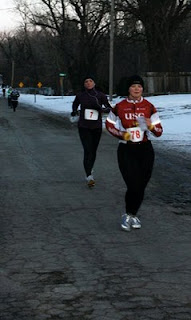


There was another woman who was running about the same pace as me from the beginning, and we'd kept each other close the whole time. Well, around the 1-mile point, I put in just enough of a surge to (in my mind) break her. Didn't look back, but I didn't hear her breathing or her footfalls anymore. Then we got to Aid Station #2. And I, being the fun-loving spirit that I am, said, "Ah! Now this is what I've been running for!" Upon which, the volunteer with the pitcher said, "Oh, well let's just fill you up here!" and filled my little plastic mug up almost to the top. That's gotta be 12 ounces. Crap.

So, wanting to keep the spirit alive, I walked quickly and tried to guzzle as quickly as I can. As with any endurance activity, you have to walk a fine balance between going fast and puking, and I definitely wanted to stay out of the puking camp. It took me probably 2-3 minutes to drain the beer and get moving again. And by that time my companion/nemesis from earlier had re-passed me and put a little bit of time into me. Because she didn't even stop, the pansy.
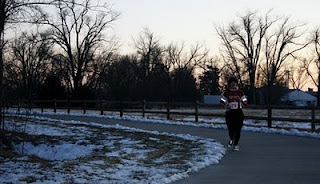


As I neared the turn-around, I started counting warm, female bodies coming back the other way. There were at least 10 in front of me. I hit the turn-around (I estimate it was about the 2 mile point) and turned on the speed. I was really surprised by how much faster I was running. It was like I'd just finished the warm-up, and was finally ready to race. I started reeling those girls back in. Shortly after the turn-around, the beer hit me; I went from zero to tipsy in about a second. Felt like I was running on clouds. I ran myself back into the top 10 while slightly drunk, then saw that my original running buddy was within reach. She had maybe 50 yards on me. I knew I could catch her; I had about half a mile left to go, at that point. I passed her not 200 yards from the last aid station. At this one, I told them, "Just a swallow!" I knew that she wasn't going to stop, but I was gonna do the beer thing right, dammit! So I stopped long enough for a swallow of beer, then tore after her again. I passed her with about 20 yards to go, and finished in a time of 27:15.

27:15 is 8:47 pace. Not fast, but definitely faster than I could have run last year. Did run last year, actually, at the Jingle Bell 4-mile. Just makes me wonder what I could do at a race with a decent temperature (or at least the right clothes) and no ice/snow on the roads and no stopping for beer. Although jury's still out on whether the beer helped more than it hurt or vice versa.


And a few more special things about the race: My client Kim came out too late to run in the race herself (the original plan), but did take pictures and cheer and run with me for a bit. And I got to meet a reader, Lindsey, who won the women's overall! Always nice to meet you lurkers, especially the local ones :-)

I had a ton of fun at this race. Felt like I got a good start to 2010. And I rediscovered my competitiveness in an unexpected (and unobnoxious) way.
Friday, January 1, 2010

Hiatus


Well, might as well call it what it is.

It's been--what?--a good two months since I've posted. Know what else I haven't done in about two months? Haven't swam or biked over about that same span of time. Well, except for spinning classes. But that's my job. And the SpinStrong Firehouse workouts. But we go out for margaritas and Mexican food after that.

I'm beginning to understand my lack of ambition, though; the reasons for my missing mojo are becoming clear. I'm starting to feel restless, here in south central Kansas. Nothing I can put my finger on, exactly. But I think I'm ready to move on. It feels right. I feel ready.

But when you're getting ready to make a big transition, it's difficult to plan for things like training and racing, even though (for me, anyway) training and racing is more central than periphery. How shall I train? Should I peak for Shawnee Mission? Incorporate Mudwater and Rock 'n' Route? Plan to run the newly-designed Wichita Marathon course? See, I'm not sure I'm going to be around when all those things are going down, so I'm not sure what (if anything) I should target in the coming season.

Still, I miss having something to shoot for, a reason to go out and work up a sweat. And I've gained weight, over this holiday/off-season period. So I'm working on getting back on a plan. It's tentative, of course, but I figure that wherever I am in six months, they will have triathlons, and I will be able to find something within driving distance that I can do that will roughly approximate the events for which I've been training. So I'm trying to proceed as normal with this season, planning-wise. And if none of it works out, that'll be fine too.

None of which addresses my extended absence from the online community. I still read most of your blogs, by the way. I've become a little bit of a lurker, but I'm still out there, following your progress. Congrats to those of you who finished IMs in the past two months. You are all awesome and rock. As to writing, what I should have done was prepare a series of drafts that would take minimal work to complete, so that I could have kept publishing during my down-time. But I did not do that, and the result was a short . . . let's call it a sabbatical. Had my time off. Recharged a little bit. Now I'm back fresh, with some new ideas, ready to bring more info to you (and not just about my little life).

And really, that's what an off-season is supposed to be.
