What is natural is not popular. What is popular is not natural. What is popular is not healthy, and does not lead us toward healthy behaviors or healthy attitudes.
And we, as athletes (or, if you don't consider yourself an athlete, health-conscious people), have very special relationships with our bodies. We move more than other people; we're more active. We exercise! Which means we build a degree of kinesthetic awareness and proprioception that is greatly above the norm. In other words, we know our bodies better.
Oddly enough, this doesn't necessarily mean that we love our bodies. In fact, it can mean just the opposite. Instead of seeing the body as a tool, an ally, a friend that allows us to do some remarkable and crazy things, we see it as an enemy. There's too much of it (or not enough). It's too flabby. It's too short. It doesn't look the way it should. So instead of having an exceptionally close relationship with our bodies because we spend so much time one-on-one with them, we end up (in some cases) developing ever-greater animosity towards them.
And this is not okay. This is not living as part of the world.
So what are we to do?
Oh, nothing too big--just completely revamp our perception of what "healthy" and "fit" look like.
It wasn't that long ago that bustles were considered attractive. Or--even better--hoop skirts! The Modern Victorian Woman says, "I don't care that this fashion makes my butt and hips look enormous--I am wearing it!" Similarly, fashionable Victorian men and women cultivated pale skin; tan was the look of peasants, because they were always outside working. Granted, the peasants were probably much healthier than the fashionable aristocrats, but I am trying to make a point here.
And the point is that we (21st century "civilized" people) have made a habit of tricking ourselves into believing that pursuing what is (currently) fashionable is actually healthy.
Look around the health clubs. People are not necessarily helping their bodies, there. They are doing asinine exercises in pursuit of larger pectorals, bigger biceps, flatter abdominals. Why? Because our cultural perception of how a healthy person looks is so screwed up that we equate those things with fitness, capability, wellness.
And it's just bullshit.
On the other end of the spectrum, we do have to take into account that a large segment of the population is carrying too much body fat on its collective frame. Which has led me recently to ask, "Man, what would these people look like if they were lean and toned, the way evolution predisposed them to be?" Really. What might America look like behind the fat?
Man, this point is so hard to make. What I'm saying is that there must be something between this and this, between nausea-inducing obesity and hyper-focused fitness (you know, the kind of fitness that would prefer a six-pack to a stable spine).
I've said it before: the problem of being part of the world is too big for us to tackle all at once (Tyler Durden, are you listening?)--we have to start with ourselves. So although it would be great to try to change America's perception of a "healthy" appearance, why don't you change your own? Stop trying to fit the frickin' mold! If you're anything like me, your genetics will make that impossible anyway. And don't go too far in the other direction; if you're carrying too much weight, you know it, and it needs to come off.
Now assuming you're still with me and you're willing to change your perceptions, here's your practical application (step 1: change perception, step 2: change yourself): let a healthy appearance be a result of your healthy lifestyle. Stop trying to look "healthy." It is not a goal; it is not an end, in and of itself. It is part of the entire package. The clean, healthful eating. The regular, sensible exercise. The meditation. The spiritual pursuit. The enriching relationships. Rather than trying to look healthy and fit, you are healthy and fit! It's a pursuit of being a better, stronger, more capable person. Of being who and what you were meant (either by evolution or by a higher power) to be. Of being part of the world.
I have been remiss, my friends. I'm behind on blog posts, e-mail, phone calls . . . looking forward to catching up, this week, so if you've been waiting to hear from me, your wait will soon be over.
In the meantime, let me tell you about my first race as a bandit! I had a friend in town this week (from L.A.), and I didn't really want to take the time to register for the race in person. And $25 seemed a little steep for a 2-mile race anyway. So I elected simply to show up and run as hard as I could for 20 minutes, take advantage of the post-race food if I could, then take off. My dad was also running the race, so that provided extra incentive.
The beginnings of races like these are always interesting, and consist mostly of dodging ankle-biters, who sprint-walk-sprint-walk, and ask their moms, "Are we half-way there?" after 200 yards. But once I got past the knee-height nuisances . . . well, by that time, it was almost over. Really, how much is there to say about a local 2-mile race? So let me just say that I finished in 17:08 (according to my watch; bandit, remember). My first mile split was 8:14, and my second was 8:54. I probably could have run the second mile harder than I did, but I don't have the sense of pacing at such a short distance, right now. I was pretty happy with how I ran, although my left calf and right rhomboid weren't. The calf especially locked up extra tight (deep, deep in the calf--I think in the soleus, which is underneath the gastrocnemius), so I've been giving it lots of love (read: punishment) on the foam roller and stretching it out constantly. Although the foam rolling treatment basically consists of me sitting with a foam roller under my leg, as the pressure is too intense to put any weight on it.
That's much more than just a race report. Bonus! Keep an eye open for the second part of the Appearance dialogue which Amanda opened on Saturday. Also, I wrote a guest post for Mizfit that she published on Saturday; go read it!
For previous entries in this series, read here and here.
I started to write this post myself.
But then I realized that I don't have a great deal of insight to bring to the subject. Like all western women, I'm conscious of my appearance. There are times when I'd like to change it. I work on "problem areas" (ahem, half-heartedly, because I don't really care). And my feelings about my body probably affect my behaviors and attitudes more than I realize (or would like to admit).
However, for this post, I wanted to invite an author and fellow blogger who has (and does) deal with issues of self-image in a more concrete and immediate way. As a result, we have a wonderful guest post from Amanda, who was kind enough to provide her insight on the matter. Amanda is a dedicated runner, a college student, and an aspiring nutritionist. She also has a great, timely post about Thanksgiving that she posted recently (for you Americans who are staring Turkey Day dead in the face). So visit her and get to know her; she's smart.
By now, you're probably familiar with Mark's Primal Blueprint, and what it means to those of us concerned about how to live in this world. I think of my body as the part of the Earth that I most directly affect. I can change it, move it, use it to do things that are good for the Earth. In that way, it is dynamic.
But it is also static, in the sense that when other people see it at any given time it is like a picture, something at which they have to look, and something that can only look one way at any given time. And I have never seen any sense in not making it the best picture possible. In this respect, my body is property -- it is my "yard," if you will.
Have you ever passed a (literal) yard that was ugly, unkempt, or simply not aesthetically pleasing? Overgrown and an eyesore? Did you judge the yard negatively? This is what I do not want people to do to me. Judge me negatively based on my body. Judge me by my property and how I maintain it.
So when I look down and see that my body does not meet others' expectations or standards (real or perceived), I feel like a failure. Shouldn't my tummy look the way "a tummy" should? We all deal in images, in patterns, and if my tummy does not fit the specifications of "a tummy" laid out by society, then it is not "a tummy" any longer. It is not a "big tummy" or a "tiny tummy," but an eyesore, a failure as a human being, just as something that looks like a field in front of a house is not a field but a gross, unkempt yard. To me, such a failure is akin to being given a small plot of land (by the Powers that Be, by the Earth, by whatever it is you believe in) and have let it go to waste, to ruin. Because I do not meet the specifications for "human" laid out by society, I am no longer human. And that, for me spiritually, is a death sentence. It is a lack of definition, and without definition or identity, I feel (as many would) that I am nothing compared to what I could be as my best human self, what I believe I was intended to be.
And I realize that my physical appearance, and even my entire physical manifestation inside and out, is just a snapshot of who I am, of my humanity. So in that respect, I could "cut myself slack" if my property was not the most beautiful -- after all, there are other dimensions of me and of my humanity, right?
But my body is not just my property, or my yard: it is also a tool. It is both currency and a signal to everyone who sees me.
When my mother used to help me with projects for school, she'd always tell me, "Presentation is everything." I feel that
he same holds for our physical appearances. People rarely think "Is she a doctor," or "Is he Catholic?" when seeing a person for the first time. Observations -- and judgments -- are made based on physical appearance. If you're pretty and slender, you get things other people don't. Free drinks. More opportunities. Presentation affects the way your teachers, coworkers, boss, love interests, friends, and enemies view you. If your best friend became goth, what would you think? Would you view him/her differently? If your best friend gained 100 pounds, what would you think? Would you view him/her differently? These are all physical aspects of your friend, and surely you care about and appreciate the other aspects, but even to you -- who is not judging your friend based on his/her initial appearance, I would be surprised to hear you say that your friend's physical appearance doesn't matter at all or doesn't at least provide you with some new opinions about your friend. Now, take that same friend -- how would those seeing your friend for the first time judge him or her?
Your physical condition and your presentation says a lot about you, and discrimination against people based on physical traits (including weight) is not news.
Finally, and along the same lines, your physical appearance is also a signal, telling others about -- among other things -- your socioeconomic status, the cleanliness of your lifestyle, your upbringing, profession, religion, age group, sexual preferences, and outside interests and hobbies. It is an indicator of nearly everything about you, simply because meeting you begins with seeing you, and is the first indicator of you as an entire person (in all your varied dimensions) that other people have. They have to make initial judgments based on your appearance and do judge based on your appearance. Racism, sexism, and weightism are just a few of the ways people discriminate and stereotype, simply because humans are pattern-oriented creatures. And while this says something about humans and humanity and the way we operate, it has definitely been a cause of stress in my life, as my obsession with perfecting my appearance has taken me to the point of anorexia in previous years. But this is, of course, my human struggle. Even the classic novel Candide ends with a call to "cultivate our gardens." So sometimes I wonder...how much is too much?
Many thanks to Amanda for sharing her ideas and experience. Check back later this week to read my personal opinions (read: Ishmaelian analysis) of the appearance question.
I forgot to put up a pre-race post for this race! Well here's what it would have said:
"13.1 miles on Sunday. Longest run since August? 8 miles. But am I nervous? Hell no! Actually, I think I'm in denial."
Or something like that.
This race was a brand new experience for me. I mean, I'd done a half marathon before. Last year, my dad and I did the Wichita Marathon as a two-person relay. So I ran 13.1 miles that time. I was a lot better prepared then, too, and hadn't been fighting injury all season. But this half marathon felt way different from that. I'll explain how in a minute.
Tulsa hosts the Route 66 Marathon, which includes a half, a quarter, and a 5k as well. The mayor of Oklahoma challenged her city to log a million miles of walking and running leading up to the marathon, which doesn't have anything to do with my story, but is pretty encouraging. My parents were kind enough to accompany me; we drove up on Saturday night and settled into our relatively cushy hotel room.
Sunday morning involved a relatively late wake-up call; I didn't have to be up until 6:45! That's way better than your standard 4:00-5:00 triathlon wake up call. Navigating to the race and parking once we got there were ridiculously easy. The race was very well-directed in that respect.
We got to Veterans Park just in time to see the full marathon start at 8:00. I knew that this would be a relatively large race, but I didn't understand just how many people were involved until I watched them all run by. Relative to a race like the LA marathon, or even San Antonio, which was also this weekend, Route 66 was tiny. But I think that this may have been the largest race I've ever been in.
It was certainly the biggest mass start I've ever experienced. We packed into the start corrals, self-seeded (and I think most people did a good job of seeding themselves appropriately). I lined up right behind the 2:15 pacer. I thought to myself, "2:15. I can do 2:15. No matter how I feel, I can do 2:15."
Of course, as soon as the crowd started thinning out, I jetted ahead, running about a 9:30 pace. I figured the 2:15 group would probably catch up to me eventually, at which point I could always hop back in with them. My hope was to pick up the pace again in the last two miles, and finish well ahead of the pace group.
There isn't much to say about those middle miles. The 2:15 group did catch up with me about 1.5 miles in, although I don't know how; I was still running a 9:30 pace, so they must have gone out a little fast, too. At mile 2, there were port-a-potties, and I availed myself of their presence. Of course, while I was in there, I completely lost the 2:15 pace group. I wasn't sure how much farther ahead they were--too far away to see the balloons, at least. I fartleked my way through the next mile (I can't help fartleking when listening to music), and caught the pace group again just a little bit past the 5 k mark.
And there's not much to say about the next 7 miles. The course followed the Arkansas River away from downtown Tulsa on a long out-and-back. The sun was warm and bright; the light had that autumnal quality that makes fall such a wonderful time. The road was completely closed to traffic and littered with a handful of spectators. There were trees lining the lane. It was really a beautiful course. And all this time I was getting to know the few people who remained in my pace group.
The out and back took us through mile 9, and we had about another mile of running through peaceful, pretty neighborhoods. Then, just a little past mile 10, the hills started. And didn't stop.
I got dropped on the first big hill. I got dropped on the second hill. I got dropped on the third hill. Every time, I tried to stick to my own pace, then booked it on the downhills (which is a skill I possess, at least) to catch the group again. We rolled through miles 10 and 11, and I was starting to suffer a little bit. It was getting harder and harder to hang on to my pacers's heels. I just kept telling myself, "2:15 isn't bad. I can run 2:15. I can run 2:15." Knowing that I could hold that pace enabled me to hold that pace, and I kept picking it up to stay with the group, ignoring my heart rate monitor, which was starting to tell me that I was working a little harder than I normally should.
There was a long hill that led us back into downtown Tulsa, and that's where I got dropped for the last time. For the rest of the race (about 1.5 miles to the finish), I kept trying to reel in the pace group again, but I never did. It hurt to let it go; I'd worked hard to stay with it for 12 miles, but in the end it was taking all I had just to keep my feet shuffling along.
I was helped along greatly, that last mile, by one of my favorite songs. To spectators and fellow competitors, it sounded something like this:
"I can't explain all the feelings that you're makin' me feeeel! *pant pant pant* My heart's in overdrive and *pant pant* steering wheeeel *pant pant.*"
No joke. At the top of my lungs. The weird thing is that no one gave me strange looks. No one looked at me at all, really. At that point, we were all focused on our own suffering, on getting ourselves to the finish.
The downside of allowing myself to have such a great time singing was that I paid less and less attention to my running form. At that point, I was so tired that it might not have mattered, but my quads sure took a lot of pounding from the downhills! I noticed at one point how sloppy my running was, and briefly tried to fix it. But then gave up. It was too much work, at that point, and I was almost there.
Coming around the final turn, there was a guy holding a huge sign that said, "SUCK IT UP!" And I really wanted to; I really tried. But by that point, I had so little left that my "kick" was just enough to bring my back to what my pace had been the first mile. Maybe.
Long story short, my time was 2:13:46. Last year, I ran a half marathon in 2:29. That's like a 15-minute PR. And I did it on way less training, with way less pain. And something else extremely significant?
I enjoyed it.
That's right. Before the race, I remember thinking, "Why am I doing this? I don't even like running!" But somewhere around the turn-around for the quarter marathon (when I found, to my surprise, that I wasn't wishing I were running 6.5 miles instead of 13.1), I realized that running actually is enjoyable. Which isn't to say it's easy or even fun all the time. But something about it makes me feel strong and empowered and capable and good. It feels right.
And that's why this marathon was a new experience. It didn't feel like the hardest thing I've ever done. It didn't suck. I didn't spend the last 20-30 minutes thinking, "I am never doing this again." In fact, the race seemed like part of a process; I was excited about this race, because after this one there will be another one. And in that next race, I'll be faster and stronger and better. In short, I couldn't wait to do it again.
So a half marathon no longer seems like a big deal. Which probably means it's time to schedule my first 70.3.
Note: Pictures to come as soon as I find the time to upload them.
Remember when I mentioned Mark's Primal Blueprint in the discussion about eating as "part of the world"? Well, what I failed to mention is that though I think his ideas are well-founded and certainly one of the best ways to eat, I don't follow them myself. Haven't fully wanted to commit to it.
That's because Mark has broken down getting started in the Primal way to the very basics; consider it a Primal primer, a step-by-step for caveman eating. So if you've been looking for ways to become more a part of the world, go visit Mark for a quick-and-easy guide.
Note to the raw foodists: I longed for such a straightforward, simple guide to stocking my raw pantry during that phase of my life. Get on it, guys!
It's been a puzzle to everyone (including me): why won't iTunes do what it's supposed to do with my podcasts?
I hope I've cleared the issue up by creating a blog specifically for the purpose of podcasting. You can view that blog here. If you'd like to subscribe to that blog in iTunes, click on the orange button on the upper right part of the page (the Subscribe Now! icon). That will take you to the Feedburner feed, which gives you several options for subscribing.
Or I suppose I could make it really easy and just provide a link here
And it's a long process, but I'll also work on getting the link to the podcast in the iTunes store straightened out. Let me know if things still aren't working!
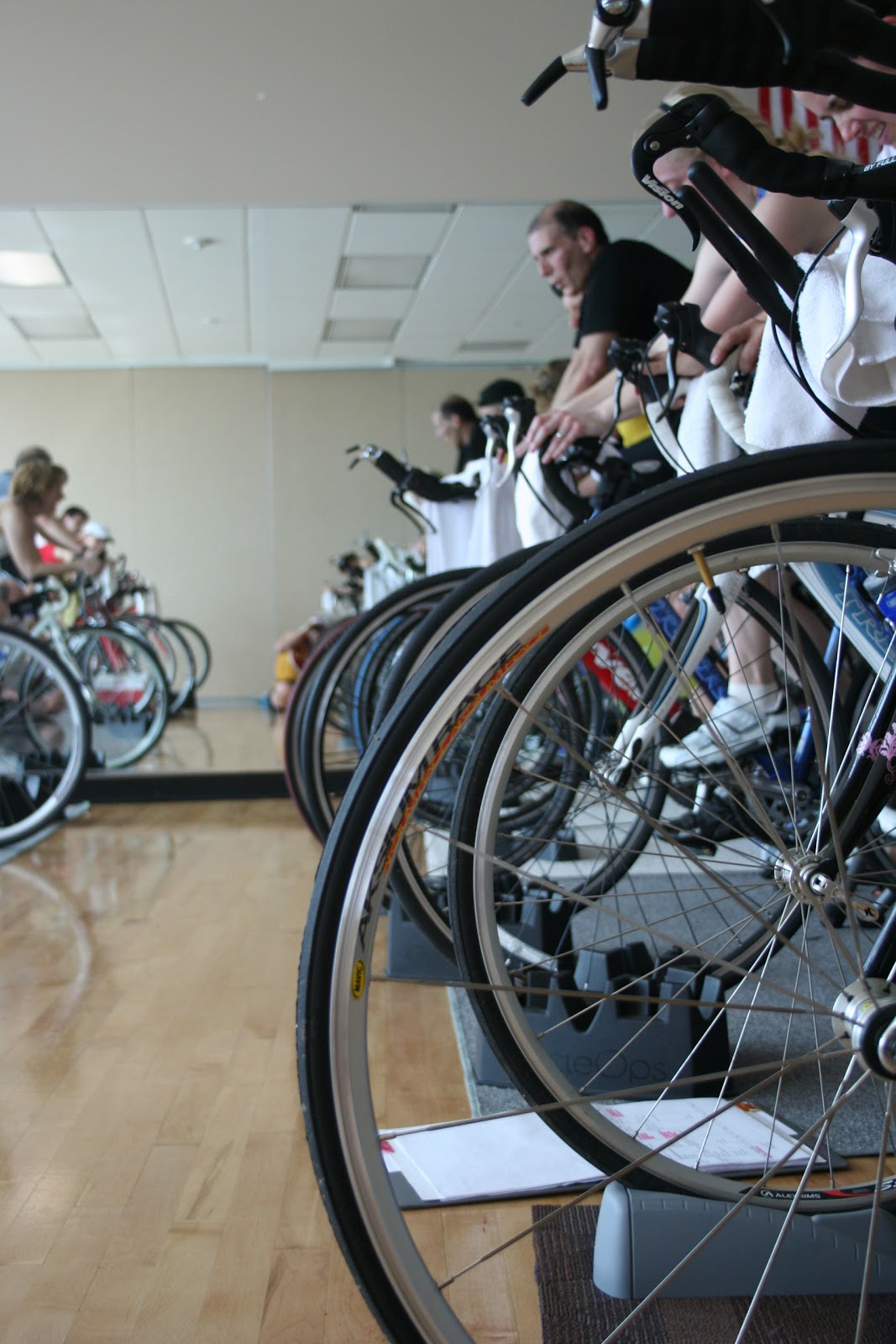
Have I ever mentioned that the middle-aged women of my cycling classes are often uninspired by my musical selections? Um, to the point that they have walked out in the middle of class. "I'm sorry, but I just couldn't take that music!" they say. I don't understand. Muse, Less Than Jake, Yellowcard . . . it's good music!
Anyway, the music of this podcast was all selected from a pool of what I thought my class would accept. So lots of 70's rock, with a few more modern songs that have the same sound and feel.
Now without further ado:
Spinning Workout 27 - Sweatfest One Way or Another (3:29): Warm up
Gimme Gimme Gimme (4:50): Warm up
White Room (4:57): Terrain track
Born to Run (4:31): Climb
I Believe in a Thing Called Love (3:36): Terrain
Hit me With Your Best Shot (2:51): Spin
More Than A Feeling (4:45): Terrain
Life in the Fast Lane (4:47): Chase
All Right Now (5:34): Terrain w/ big climbs
Dani California (4:40): Spin
25 or 6 to 4 (4:53): Climb
Kyrie (4:26): Cool down
Dream on (4:28): Stretch
Living as a part of the world isn't easy. For one thing, it's not a one-off decision, a one-step process. It took millenia for our human cultures to stray this far from nature; it'll take more than a few months (and a few articles by yours truly) to get back.
A second significant barrier that stands in the way of living as part of the world presents itself when we start looking for how (exactly) we're supposed to do that. My topic for this initial article is eating as part of the world, and for an example of what I mean, read here, here, and here.
See? Everyone has their own idea of what the most natural diet is like. Raw foodists believe that we should eat everything raw, because our most primitive ancestors wouldn't have had the capability of cooking food. Mark's Primal Blueprint advocates eating plenty of meat, because "Grok" would have had to eat meat to fill out his diet through the bare winter months. And fruitarians . . . well, I have to confess that I think fruitarians are a little bit weird. The point is that every one of them claims that their collective lifestyle (because it becomes more than just eating, you know) is the most natural, which is why you should be following it with them!
So what's a neophyte Ishmaelite (Ishmaelist? Ishmaelian?) to do? How do you determine which style of eating is actually the most natural, the closest to the world, and therefore (we suppose) the most beneficial?
Um, I don't think you can.
What you have to do, I think, is determine first what manner of eating is going to make the most sense for you. I, for example, tried to eat raw. It was a mess. I am not going to be able to eat raw all day every day (at least at this point in my life). Nothing wrong with that. You can eat healthy and be healthy without being a raw foodist. Furthermore, there's no reason to assume that you have to agree with one of these pre-fabricated eating plans; you can figure out your own way as you go along.
That said, you need to follow your common sense and your conscience. Common sense should tell you that high fructose corn syrup is not good and natural, no matter what they say. Use your brain (and a little low-key research) to figure out which foods (and food additives, if you must) are naturally-occurring. From there, your conscience takes over. In your heart, do you believe that people really shouldn't be eating animals? Do you prefer only to eat foods that would have been available to your ancestors? Do you draw the line at corn on the cob? Corn meal? Corn syrup? These are questions that need to be addressed individually, according to what you know and what you believe.
In short, I can't tell you how you should eat. What I can do is give you a few broad guidelines as a starting point for eating as part of the world.
Make your own food. You don't want nasty additives (unnecessary sweeteners, flavorings and colorings, preservatives) in your food. You don't want HFCS. You don't want MSG. The best way to ensure that those things are not in your food is to make your food yourself. Come on. This is your first step. Stop buying convenience foods. No more TV dinners. No more 100 calorie bags of snacks. No more spray cheese. No more canned pasta sauce. Do you really need those things? No. Make good, clean food for yourself!
Grow your own food. If you can buy produce, good; if you can buy organic, even better. If you can grow your own, though, that's the best. And you can make it as easy or as extreme as you like. Maybe you keep a few potted herbs on your counter so you don't have to buy dried. Maybe you buy a bison every year, slaughter it, and freeze the meat (I really did know a family that did that). You have options here, you know.
Store your own food. Connect the dots from the last two. You want all-natural applesauce. You happen to have some apples from a tree in your backyard. See where I'm going with this? Canning isn't that difficult!
Sacrifices will have to be made, but you can make them gradually. And you can pick and choose which ones to make. One of the advantages to the advances that we've made, culturally, is that we have consistent availability of a large variety of food. I can eat kiwi. My ancestors wouldn't have eaten kiwi. Grok probably wouldn't have eaten kiwi. But I get to eat kiwi. And you know what? I really like kiwi. So I'm gonna have kiwi, every now and then.
The point of all this "part of the world" stuff isn't to see how tough we can make it on ourselves; it's not an exercise in some survivalist mentality. The overarching purpose is to begin re-submitting ourselves to the laws of nature--those same laws which we've spent years conquering.
Because as long as we willingly choose not to follow the same rules as the rest of the world--exempting ourselves from drought, famine, natural disasters--we won't have a good reason for actively caring for the world. So keep the big picture in mind. What and how you eat is important, but it's about more than simply being healthy.
DMcQ wrote up a pretty cool review of my podcasts this week. Big thanks to him for the recognition, and for ways in which I can improve my offerings in that regard.
A reminder: if there's something in particular you'd like to work on, let me know! I'm totally willing to put together workouts by request (it's what I do for my classes here at the gym). And if you have ideas for how those podcasts can be better, feel free to leave constructive criticism. I'm tough; I can take it.
(Also, if you know how to do the podcast thing so it will work in iTunes, please help me!)
I'm currently recording the next podcast, so be on the lookout for that within the next week. This one is all about working up a sweat (because that's what my real-life cycling class wanted)!
In retrospect, it might not have been the best plan to drive 4 hours each way to and from a race that only lasted 30 minutes. And I had to go alone. My Cross Yoda had a busy weekend, and my parents wanted to go to church. It would have been a great time to have a supportive girlfriend.
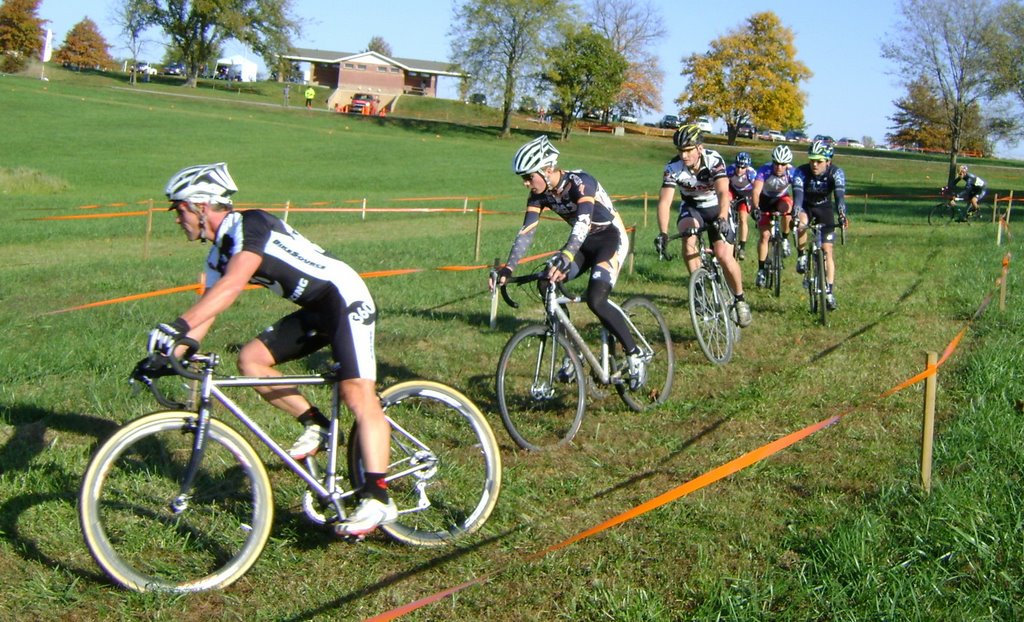
Anyway, the day was ridiculously windy. Like can't walk in a straight line kind of windy. Like trouble staying upright kind of windy. And the course was also much more exposed to the wind than the course at Chris Cross. I'll only talk briefly about the course, because I just don't have the energy tonight. It wound back and forth quite a bit. Like a very long snake. It made for some pretty sharp turns. There was some off-camber riding, as well. And, in one part, a realllly steep run-up. You'll see that in the video, when I post it (it'll be a short one).
So my race, once again, was the last one of the day. Our race left five seconds after the masters' men and five seconds before the juniors. Eight juniors in the field, by the way, and that was really cool. I probably went out too hard on the first lap. I was in third place for a while. But after that first lap, I knew I had pushed too hard. The second lap was really hard. I wanted it to be over. But coming to the end of the second lap and seeing that were only two laps left gave me . . . well, let's call it hope. So I was able to push through the final two laps. There was one other woman whom I passed in the first lap and then worked really hard to hold her off through the next three laps. And I did!
I managed to finish in 6th place out of 12, which is a far cry from second-to-last. And I was happy with my performance. I still think that I can do better. I think I could win. But it's only my second race, still, and there's still plenty of time for that later. I'm extremely happy with the way my cycling skills are coming along--my handling, my cornering, my accerating, my body position. It's all coming together, and it feels awesome, especially after so little time doing it. Also? Totally nailed the mounts and dismounts. Didn't so much nail the run up. My borrowed mountain biking shoes are about half a size too big, and my feet kept sliding out of them while I was trying to run up this super steep hill. Had to pause and jam my feet back into them a couple times. But once I got past that run up, I was golden. Unfortunately, I think the racing and driving, combined with two cycling classes and a 4 mile run today, may have taken some kind of toll on my body. All day, I've felt sluggish, hungry, thirsty, and cold. It may just be low blood sugar and dehydration, but I'm a little concerned that I'm getting sick. At any rate, I'm exhausted right now, and that's why this race report is so boring.
Note: In my haste to get this post up last night, I failed to link to the rightful owner of this picture (whose cross photos are way better than mine). Sorry, Cross Guru!
Big thanks to Jamie, whose race report inspired me to go out and practice mounting and dismounting this afternoon.
I am totally going to own those flying mounts tomorrow!
Also, if you haven't checked out Manda Pants's blog yet, go read it! She was kind enough to accept some of my mediocre writing for a guest post to her blog (thanks, Pants!)
It was a good day. It began with a few miles of cross-specific bike training (which was quite the cold, muddy, rainy adventure). In the middle there was some core training (not like that) and a kick-ass cycling class. Seriously. Kick. Ass. I kicked my students asses. And they were kind enough to return the favor. I could have had a swim workout in the lake underneath my bike when I was done.
But the best part of the day was the end. The part after my 7:00 client. You know. When Grey's Anatomy came on and I decided to do a long run on the treadmill because if I drove home to watch it I would miss the first half.
Now I was really hating the treadmill tonight. But I had no problem running fast after that, I can tell you.
I love this chili. It's adapted from a recipe I found in Men's Health. The taste is fresh and lean, and benefits greatly from sour cream, parmesan cheese, or corn chips. And I'm sure that crackers would also be delicious (if predictable).
Ingredients
3 Tbsp olive oil 1 lb ground buffalo chuck (or any ground/chopped game you have around. My family usually has some elk in the freezer. Rabbit would be nice. Beef is acceptable, but be sure it's grass-fed and organic, or else the flavor won't be sufficiently strong.) 1 jalapeño, seeded and diced 1 Poblano pepper, seeded and diced 1 serrano chili, seeded and diced (leave the seeds in if you want an extra kick!) 1 yellow onion, diced 3 garlic cloves, minced 1 green bell pepper, diced 1 big can (28 oz) of diced tomatoes (watch out for unnatural gunk in the ingredients list, and buy organic if you can. Or, even better, use fresh ones!) 1 can (8 oz) tomato sauce (again, be sure to check the ingredients) 2 cups beef stock (good luck finding all natural. Make your own if it concerns you.) 3 Tbsp chopped cilantro (I used dried, and it turned out okay. But I'm sure fresh would have been much better) 1 Tbsp paprika 2 tsp crushed cumin seeds 1 cup cooked black beans Salt and pepper to taste
Coat a heavy skillet with the oil and heat it on medium-high. Cook the buffalo until it's brown. Add the jalapeños, onion, garlic, and bell pepper. Cook over medium until the onions turn translucent. Add the tomato sauce, beef stock, tomatillos, cilantro, paprika, and cumin. Boil. Then simmer for 1½ hours. Add beans. Season with salt and pepper. Serves 6
These directions are the basic version, for those of you who aren't fortunate enough to (have parents who) own a crockpot. If you are so blessed as to have one of these ingenious devices, brown the meat in oil. When it's mostly cooked, add the peppers, garlic, and onion. After the onions turn translucent, dump all remaining ingredients with the meat mixture into the crockpot. Cover, turn on, go to work, and come home to the delicious smells of chili in your home. Particularly satisfying if it's cold outside.
Note: Videos and pictures of exercises to come. Just really wanted to get this up today; I've been working on this one for weeks.
We talked a while back about kyphosis, or the "dowager hump" (which sounds like a new-fangled dance move) and some of the steps you can take to reduce that (stop slouching! I know you're slouching as you read this). Today I want to address a problem that I see occurring more frequently than kyphosis in the athletic population: lordosis.
Lordosis isn't exactly the opposite of kyphosis; it's the same thing in a different part of the spine. Where kyphosis describes an exaggeration in the primary curve of the spine, lordosis is an exaggeration of one of the secondary curves--the lumbar curve. Lordosis, like kyphosis, can be highly pronounced (don't click that unless you're ready to be grossed out), but you'll see much milder manifestations on a day-to-day basis. I get to see it everyday when I look in the mirror. You'll know that you have it if your butt sticks out (ghetto booty, natch), you thrust your stomach and hips forward when you stand, you've been told you're swaybacked, or if you've ever been mistaken for a pregnant person (if you're actually pregnant, chances are good that you're lordotic also, in which case you'll probably need to come back here in a few months and work on regaining correct posture after delivery).
What causes lordosis? There's a matrix of factors that can come together to produce this postural misalignment, but I'll focus on how it can happen for endurance athletes. At the most technical level, lordosis occurs when someone has tight hip flexors, weak abdominals, glutes, and/or hamstrings, and overactive spinal extensors (could be a combination of any of these factors). If you're reading this blog, it's totally safe to guess that your hip flexors are tight from cycling and running so much, your back extensors are overactive from swimming when you're tired, your hamstrings and glutes are weak because your run and bike form reinforce already existent biomechanical imbalances, and your abs are weak because you're too busy/tired/lazy to work in core strengthening and spinal stability with a full schedule of swimming, cycling, and running. Either that, or you're doing the wrong ab exercises.
For the majority of the population, the cure will involve strengthening the abs and glutes. And endurance athletes (particularly triathletes) will also need to do significant stretching and possibly myofascial release of the hip flexors.
But how do I do that, Jamie? Ah, fear not, gentle readers. I shall tell you how to work towards proper posture in ways that (primarily) will not require access to a gym. Here's a start:
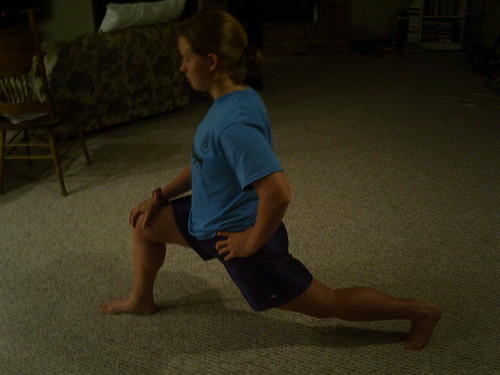
Hip Flexor Stretch I showed you this one a couple months back, when we discussed lumbo-pelvic stretches. Here's a refresher!
Stretch one leg back behind you, drop the knee, and tilt the top of the hips back (this is called a posterior pelvic tilt). Keep the chest lifted. Stand next to a wall if you need to hold on to something for balance. Variations: you can drop the back knee, continuing to maintain upright posture and a posterior pelvic tilt. In either position, you can lift your ipsilater (i.e. on the same side as the stretching hip) overhead and back behind you. That's a more advanced stretch, so be sure you can hold your balance before you try it. Hold that stretch 20-30 seconds 2-4 times on each side.
Pelvic Tilts This is one of the safest and most basic abdominal exercises you can do. And I don't care if it looks too easy; it's going to be helpful for you, so do it even if you think it's too basic!
Begin by laying on your back, knees bent and feet 3-6 inches from your derriere. You'll need to keep your knees aligned with hips and feet, so if that's going to be hard for you, grab a yoga block (a thick paperback or two will also do the trick) and stick it between your legs. Squeeze together for a little bit of inner thigh work as well! Take a deep breath in, and direct the air into your stomach; make your stomach swell up with the air. As you exhale, force the air out of your stomach and keep tightening down (the rhythmic breathing is to make sure that you engage your deep abdominals). While holding your abs down (still exhaling), pull your hips towards you (posterior pelvic tilt, again) without lifting your bum from the ground. You should feel your low back press against the floor, but don't let your hips come up. On your next breath in, relax, then repeat. Do this 15-20 times, or for 30-60 seconds. Make sure you're engaging your abdominals with each repetition.
Bridge This is the next step up from the pelvic tilts, and should activate your glutes and hamstrings along with the abs. Bonus? Do it right and you get a mild stretch through the hip flexors as well!
Start like you did with the pelvic tilts. You still need to keep your knees aligned, so keep using the block/books, if you need to. Also? Turn your toes in, a bit, so that you're pigeon-toed. Breathe in, fill the stomach with air. Breathe out, tilt the pelvis towards your chest, push through both heels at once, and lift your hips up into the air. Concentrate on squeezing your butt cheeks and pushing your knees forward (still holding them in alignment). Take a deep breath in at the top of the movement, and as you exhale press each vertebra deliberately into the ground. Repeat 6-12 times.
12 times feel too easy? Try these variations. At the top of your movement, take several deep breaths, focusing on filling your stomach with air on the inhale and tightening your abdominals down while pulling the pelvic floor up (tighten your sphincter muscles--the urethra and anus) on the exhale. You can put your feet on a bosu ("and the butt-ocks") or stability ball (and is it just me, or is that stability ball far too squishy?). You can lift one leg up (think of it as a continuation of the line of your body, i.e. don't lift it too high) and do a one-legged bridge (note that in the video the guy is lifting his leg too high) . . . Lots of options here, guys, if a plain old bridge seems too easy!
Back Extensor Stretch First off, stop doing spinal extensions. Seriously. Stop it.
There are many stretches that will work to loosen up those erector spinae; most of them involve rounding the back like a cat. Here's my favorite one. Start in a standing position. Stretch both arms up overhead and cross one arm over the other. Flexing at the hips, knees, and back simultaneously, reach over and grab hold of your legs just above the knees (arms are still crossed). Anchor yourself there with your hands, then slowly extend the hips and knees. Allow the back to round. Do this stretch right, and you should feel it all the way up your spine, into your neck, even around the crown of your head and forehead. You might also feel the muscles across your thoracic spine and shoulder blades stretching. Hold for 20-30 seconds, then do the same thing with the arms switched. Repeat 2-3 times on each side.
Self Myofascial Release Of the thoracolumbar fascia (hell yes, I just worked that into a blog post!). Too long to put it all in a heading. This is an above-and-beyond kind of exercise. If you have access to a foam roller, it'll probably help with the posture, and if nothing else it'll feel good.
But first, do you have lower back pain? If so, don't do this one. Too risky. Go back to stretching. If not, you may proceed.
Lay with the foam roller under your low back. Gently contract your abs to support your back. Roll slightly to one side, so that the foam roller isn't contacting your spine. Slowly roll yourself on the foam roller from the top of your hips to the base of your ribs. If you find a tight spot, pause there for 30-60 seconds. Look for those little spots, and hold yourself right on it; avoid rolling back and forth over those trigger points. Switch sides. Give yourself at least 5 minutes on each side; if it's too intense, switch back and forth, side to side. Try to relax into it a little more each time, but remember to keep the core lightly engaged to support your back.
But Why? But Jamie, you say, this just occurred to me: you are a random person on the internet. It is entirely possible that you are full of shit. Why should I listen to what you say, let alone bother fixing my supposed excessive lumbar lordosis?
A fair point, my friend. And if you're concerned about following the advice of some random person on the internet, you can feel free to come in and see me at my gym. I will be happy to train you.
As to why you should bother with correcting your posture, the first is a structural concern. The excessive curvature of your spine indicates that the space between your lumbar vertebrae is decreased on the posterior side. Couple problems with this. First off, you're at increased risk of lower back injury, particularly when performing standing or lying hip flexion exercises, spinal flexion or stabilization movements, and weighted overhead activities. Additionally, if you have some pretty serious lordosis (the kind you see when female gymnasts finish their routines), the backs of your vertebrae--the facet joints--might actually be acting to support your spine. And they weren't designed for that; they were designed to sort of steer your spine. In short, you don't want those facet joints knocking together. And apparently (I didn't know this until I researched this article) if the facet joints get too close together, they can cause pain that is very similar to the pain or herniated discs, as well as sciatica; in fact, sciatic pain is more commonly caused by facet joints rubbing together than by bulging discs. So avoiding back pain is a pretty good reason to correct your posture.
For athletes, there's an additional incentive to improve posture, and therefore stability. Ever heard of the concept of energy leaks? The idea is that there are certain points where athletes lose energy. If you've got specific shoes for cycling, you've experienced what I'm talking about: the stiff soles of your cycling shoes allow you better power transfer to the pedals than the flexible soles of regular sneakers. Same idea with your body, whether you're running, swimming, throwing shot, or swinging a golf club. If you cannot use your muscles to maintain the structural integrity of your joints, you're going to lose some of the power that you could be delivering into propulsion at your extremities. I mean, you're going to lose some of the power anyway. But the more effectively--and, for endurance athletes, the longer--you can maintain appropriate biomechanics (in this case, posture), the better you'll perform as an athlete.
And I'd never really thought about it until I started researching this article, but this is a central concept for us triathletes. Possibly one of the most central concepts. Think about it: because we do three different sports, the one commonality between everything we do is posture. Everything comes back to that basic ability to keep your body functioning properly, and it happens from the core out.
It's for that reason that I intend to make my next installment in the "Stop Slouching!" series about spinal stability. It's a big project. It'll take a while. It'll take a lot of research. It may take multiple posts. But if we, as athletes, can nail the spinal and core strength and stability, we will all get much, much faster and be safer while we're doing it.
Ideally, I wouldn't need to keep notecards around with my favorite swim workouts on them; ideally, I would have a photographic memory and all of my swim workouts (not to mention my splits) would be memorized.
But I do not have a photographic memory. What I do have is a plastic baggy, a stack of notecards, and a rubber band.
Each of the notecards has a swim workout written on it. The rubber band keeps the notecards together, and the plastic baggy keeps the whole thing from getting soaked.
As I was thinking about my 1-page guide to swim technique, I realized that it would be very helpful to have a list of focal points for technique that would fit in with my workout. That way, I could keep track of my workout and my form simultaneously.
With that in mind, I present to you the Single Notecard of Swimming Excellence. Actually, it's just a PDF of swimming focal points, but if you print it out, glue it to a notecard, and stick it in a plastic baggy (or laminate it!), it may become the Single Notecard of Swimming Excellence.
Because your swimming is never too good.
To get this on a notecard, right-click (or control-click, if you're a sexy mac user) and save the picture as a file. When you go to print it, set the print size to 3 x 5 inches. If you'd prefer a PDF of the notecard, you may contact me (jamielynnmorton [at] gmail.com) and I'll send you a link to the PDF on Google Docs.
And did you see that post-season belly? Oh goodness. I am going on a diet. And by "diet" I mean that I will eat less and healthier food and work out more. You know; what "diet" is supposed to mean.
5. Smaller field. Especially for women. Still very competitive, and a little intimidating to be starting on the same line as experienced women. But nowhere near as scary as a mass swim start with 100+ other women.
4. Improves bike handling skills. In the same way that throwing a toddler into the deep end of the pool improves swimming skills. By the end of the race, I was fish-tailing--nearly wiping out--and thinking, "How the hell did I do that, and how can I learn to do it again?!"
3. Cross-training. Think about it: high-intensity, anaerobic cycling (one big, long interval). Running through sand (resisted running). Jumping barriers (plyometrics). Pedaling through grass, mud, and gravel (power intervals). Yeah, go ahead and tell me this sport won't do wonders for your race performance.
2. Builds power. Try sustaining your maximum wattage for 30 minutes and tell me what it does to your fitness. Oh yeah.
Pre-race Cyclocross is structured a little differently than most races. First off, the division of racers follows the same classification structure as road cycling. So where runners and triathletes have age groups, cyclists have "cats." Cat 1 is the highest; Cat 5 is the lowest. But in cyclocross, Cat 4 is the lowest. I assume that "cat" is short for category, but I didn't think to ask, and I don't really care that much. I am a Cat 4 woman. A beginner. A n00b.
The race course for cyclocross is a circuit, and at Chris Cross, parts of the 1.5 mile course were really, really narrow--some of it resembled single track mountain bike trails. So you can see where unleashing the n00bs and the serious competitors on a narrow, winding 1.5 mile circuit might be a bad idea. Oh my God. I would have been run over for sure! I would have tire tracks all over my face and body!
All of that to say that there were eight different races, ranging in length from 30 to 60 minutes. The first one was at 10:30. The last one began at 2:45. Guess whose race was at the very, very end.
My cyclocross yoda, Brett, was racing in the men's Cat 4 field, which began at 11:30. And since the race was up in Lawrence, we made the 2.5 hour trek up together. So I got to get up at 6 a.m., even though my race didn't begin until 2:45. But not complaining. Oh no.
Actually, I'm glad my race was the last of the day. It gave me a chance to watch what other people did, and get some idea of what the hell I was supposed to do.
That's the big difference at this race--I didn't know what the hell I was doing. Triathlons are old hat to me, now. I still get nervous at some races, but it's never that first-timer feeling of "Where do I go?! What do I do?! Someone please tell me that everything is going to be all right!" And although I'm not an experienced runner when it comes to the racing thing, it's so basic: arrive in gear, line up, run, leave. Not much of a learning curve there.
Cycling is like a whole different world, though, and I felt it from the moment we left the driveway. I do not know much about bikes, or biking, and I definitely do not know much about the nooks and crannies of what is already a pretty elitist sport. So I was freaked out. But in a way it was sort of exciting. I'd forgotten what that felt like, to be coming into something so new. I mean, I encourage people to do that all the time, getting them started as a coach and trainer in triathlon. But I long ago forgot what that feels like. To be reminded of how nervous-making that can be was actually a pretty cool aspect of doing something completely new.
I got the chance to ride the course a little bit before I had to race on it, which was a very good thing. Before any of the races started, Brett and I rode part of it before they shut it down for the first race. Then again, after the women's Cat 1/2/3 (not enough women to field a race for each) I got to ride the whole thing.
The Course Like I said, the course was a 1.5 mile loop through one of the campgrounds at Clinton Lake. For each race, the officials timed the first two laps, then from that time estimated how many loops the competitors could complete in the alotted time, and counted each racer down for that many loops. The race started on pavement, on the tarmac that ran around the camping area. From there it made a sharp right turn through some very loose, very sketchy gravel. It wound back through some trees, over some pretty awesome little rollers, and back onto the tarmac. It cut back into the gravel, down some single track goodness, over a dry creek bed (OH MY GOD THE ROCKS), and back onto the pavement. From there, it looped around into the grass, then to the first hazard--a sand pit. At the sand you're supposed to dismount, shoulder your bike, run through the sand pit, then mount and ride on again. The next major section was a long, downhill straightaway through more grass, back through some more trees (and frickin' gravel), up the same straightaway (UPHILL this time) to the second hazard: the barriers. Once again, dismount, shoulder the bike, jump the barriers, hop back on, and you're through the first lap.
Yeah.
I think I felt better about it before I rode the course.
The Race
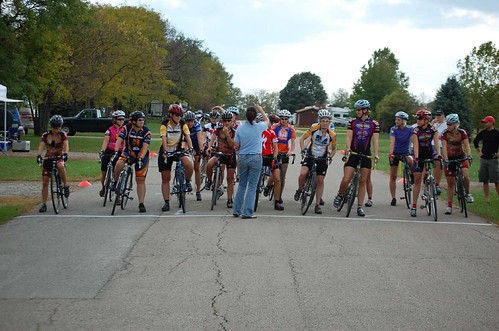
When 2:45 finally rolled around, the Cat 4 women assembled behind the line (actually, behind the Cat 4 masters, who left a minute before us). All 15 of us. But last year there were 4, so this is some serious progress, apparently. The officials blew the whistle, and we were off. Brett told me not to hold back on the first lap, to find my rhythm on the second and third laps but hammer through the first. So when it seemed like the women were getting a slow start, I jumped right into the lead pack. I was in good position going into the first turn, when the leader totally wiped out. I kept right on going and stayed on my bike. I hammered hardcore, staying right on the tail of the first 3. It felt amazing. "I'm doing great!" I thought. "Maybe I really will be good at this!"
When we got to the sand pit, I dismounted like I knew what I was doing (Brett wiped out in the sand, so at least I knew what not to do). I ran my bike through, trying hard to hold back the other women. But when I got back on the bike, something was wrong. The back wheel was sticking, and I was getting this terrible, grinding, whirring sound. I hopped off and took a look at it. Adjusted the brakes. Hopped back on. Nope, still there. Hopped off again. "Run it to the pit!" one of the women who was passing me hollered. I wheeled my bike over to the pit (what kind of endurance sport requires it's own pit?!) as fast as I could, slammed my bike down on the ground (so everyone would know how frustrated I was), and tried to figure out what the hell was going on.
It wasn't the brakes. It wasn't the hub. It wasn't the wheel out of true. Brett came over to help, but he couldn't touch or even step into the pit. Finally, after I'd taken the wheel off and put it back on, he told me to just ride on it, just get through it. So I did. And somehow, taking the wheel off and putting it back on must have done some good, because the whirring was gone.
Meanwhile, every single woman in the race had passed me. Even the fat one.
I hammered out of the pit, frustrated and pumping with adrenaline. Even though I'd just spent the last few minutes standing still, I felt like I had just sprinted a mile. My lungs burned. My quads screamed. I tasted blood. I hammered through the straightaway, pushing my wheels through the grass, grunting and swearing and screaming primal screams the likes of which I'd only uttered during some very grueling Tabata intervals.
When I came to the barriers, Brett was there (with the video camera) shouting at me to move, because "the big girl's not that far ahead of ya!"
Which meant that I could at least pass one girl, and not come in last place. But by this time my body was absolutely revolting. "No!" it screamed at me. "I don't wanna!"
"Shut the fuck up!" I screamed back. "This is my race, and you've still got at least three laps to go!"
I got through it. The second and third laps felt like murder. They felt like hell. I swore up a storm. I slowed to a virtual crawl, even dropping into my small chainring, when I knew no one could see me. I started getting lapped by the men (I held off the other women until lap 4). I even walked my bike through the sand pits. The race was interminable. It wasn't that it seemed like a long time; it was more like time was standing perfectly still.
At the end of the third lap, just as we were going over the barriers, I passed the big girl. I feel kind of guilty, in retrospect, for making my one main goal not to get beat by the fat girl (that and not to run into any trees), but whatever. That was my goal, and I accomplished it. Call me mean, if you like. It sort of fits with the whole cyclist attitude I copped.
And then going into that fourth lap . . . I don't know if it was the adrenaline rush from passing someone, or if I was finally starting to warm up into it, but I felt a second wind coming. I pounded through the first half of the loop. I leapt off my bike and absolutely sprinted through the sand, bike on my shoulder. I cornered like a pro through the gravel, almost losing it a couple times, but adjusting my body weight so that I didn't wipe out. I leapt over the barriers. I would have actually passed another chick at the end of that last loop, except that she remounted quicker than I did after the barriers, and at that point I didn't have time to catch her, even sprinting.
But sprint I did, guys. All the way to the finish. You know me. That's how I like to end.
The Aftermath I was in some serious pain, after that final kick. And the SPD-equipped shoes I had borrowed were too big and too narrow for my feet, so I had some blisters and soreness in the footsies. And somehow, in the course of a 30-minute ride, I managed to get ridiculously chafed. How that happened in 30 minutes, I have no idea. But I was miserable.
The race had been 30 minutes of pure hell, no doubt about it. Through most of the race, all I could think was "If Brett ever tries to get me to do something new again, I am going to kill him." And I would have thought of something much worse than death, if I had been able to spare the oxygen for it.
But after dismounting and taking my shoes off and walking barefoot for a bit, and after getting back to the car and changing into normal clothes beneath a towel like a surfer at Venice Beach, and after putting a few calories into my pie hole, I started thinking about the next race I would be able to do.
Because I got second-to-last place in this race. And it felt awful. But I started in fourth place, and there were two women, by the end, whom I would have passed, given another loop.
If I hadn't had mechanical trouble so early in the race, if I hadn't lost so much time, what might I have done?
And if I can learn to handle my bike a little better, to corner a little more confidently, and if I can practice my mounting and dismounting, and if I can get a little more familiar with SPD cleats, and if I can practice those graceful bounds over the barriers (not like this) that the men seem to effect so effortlessly, what might I do?
And that's what's got me thinking about the next several weekends, and when and where I can try this crazy sport again.
Video to come tomorrow, along with the top 5 reasons you should try cyclocross.
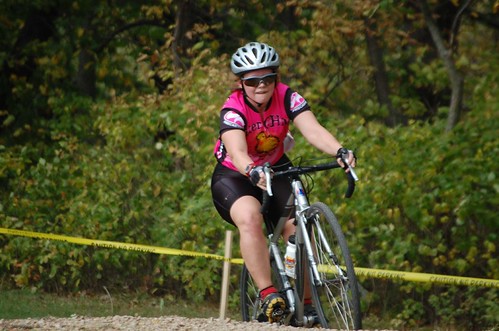
Photo credits go to Lantern Rouge Racing, not to me. I did not take pictures of myself while I was biking.



 Add to iTunes!